

Interpretation of GB/T 28264-2017 "Safety Monitoring and Management System for Lifting Machinery": 9 Mandatory Monitoring Requirements and System Architecture
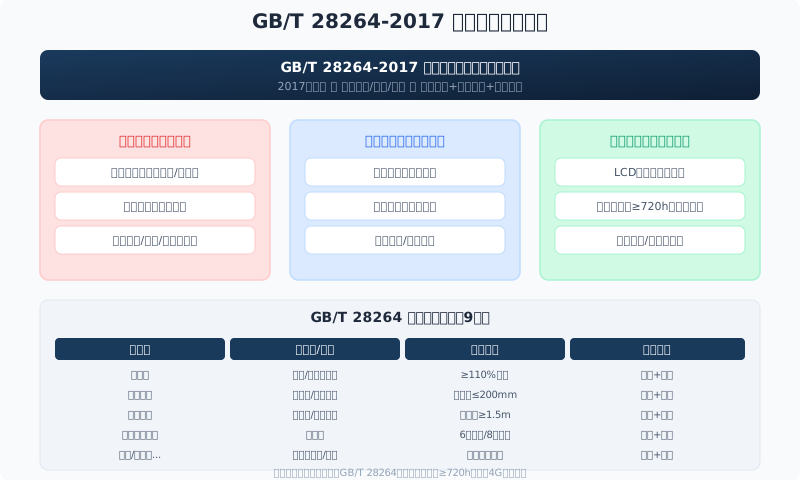
📌 Key Points GB/T 28264-2017 “Safety Monitoring and Management System for Lifting Machinery” specifies the composition, technical requirements, test methods, and inspection rules for safety monitoring and management systems for lifting machinery. ① Three-tier system: Sensor layer (sensing) → Monitoring host layer (control) → Display and recording layer (output); ② Nine mandatory monitored parameters: load capacity, lifting height, travel distance, wind speed, deviation, rail clamp status, wind resistance and anti-slip protection, interlock protection, and self-diagnostic testing; ③ Historical data storage capacity of ≥720 hours, with a remote transmission interface; ④ The standard applies to cranes requiring safety monitoring, such as bridge cranes with a lifting capacity of ≥10 t and gantry cranes with a lifting capacity of ≥20 t. The Krude Heavy Industry Safety Monitoring System has obtained GB/T 28264 type certification and supports 4G remote transmission and cloud platform integration.
Overview and Scope of the Standard
GB/T 28264-2017, “Safety Monitoring and Management System for Lifting Machinery,” was issued in 2017, replacing the 2012 edition. This standard applies to the following cranes: ① overhead cranes with a rated lifting capacity of ≥10 t; ② Gantry cranes (including loading and unloading bridges) with a rated lifting capacity of ≥20 t; ③ Tower cranes with a rated lifting capacity of ≥40 t; ④ Other types of cranes may be implemented in accordance with this standard. The system shall be equipped with nine functions: load capacity monitoring, height limit monitoring, travel limit monitoring, wind speed monitoring (outdoors), sway monitoring (for long-span cranes), rail clamp/anchor status monitoring, wind resistance and anti-slip device monitoring, interlock protection monitoring, and self-diagnostic testing.
Requirements for Monitoring Data Recording and Storage
GB/T 28264-2017 stipulates that safety monitoring systems must record at least the following data: operating time, cumulative number of operating cycles, number of actuator operations, lifting capacity, lifting moment, travel distance, wind speed (for outdoor units), fault codes, and operator information. The black box (monitoring data storage unit) must have a storage capacity of ≥72 hours of continuous operation data, and the data must be retained for ≥72 hours after a power failure. The Krude Heavy Industry SMCS-3000 monitoring system comes standard with a 256GB industrial-grade memory card, capable of recording ≥1 year of operational data, and supports USB export and remote data retrieval.
Data Sampling Frequency Standards:The sampling frequency for load and torque sensors is ≥10 Hz; for travel and speed detection, it is ≥5 Hz; and the response time to fault signals is ≤0.5 seconds. Alarm records must include a timestamp (accurate to the second) and the alarm type. The Krude Heavy Industry monitoring system also features cloud-based data backup, meeting the extended management requirements of GB/T 28264.
Three-Tier System Architecture
1. Sensor Layer (Perception Layer)
The sensor layer is responsible for collecting various operating parameters of the crane. Load sensors—which can be pressure or tension sensors—are installed on the hook assembly or the drum bearing housing. Hoisting height is monitored using a dual-sensor system consisting of limit switches and encoders. Travel sensors are installed at the ends of the main and trolley hoists. The anemometer is installed at the highest point of the crane to avoid obstruction. The tilt sensor is used to detect leg tilt in long-span gantry cranes. The Krude Heavy Industry Safety Monitoring System comes standard with high-precision sensors (comprehensive load capacity error ≤ ±2%, which exceeds the national standard of ±5%).
2. Host Monitoring Layer (Control Layer)
The monitoring host is the system’s core control unit, responsible for sensor signal acquisition, logical evaluation, alarm output, and control shutdown. When monitored parameters exceed preset thresholds: ① Audible and visual alarms (buzzer + red indicator light); ② Automatic shutdown of the power supply to the corresponding mechanism (e.g., overload shutdown of the hoisting circuit, travel limit shutdown of the operating circuit). The monitoring host features a self-diagnostic function and automatically issues an alarm notification in the event of sensor or communication anomalies.
3. Display the record layer (output layer)
The LCD color touchscreen displays the current values and status of various monitoring parameters in real time. Historical data is stored for ≥720 hours (30 days), allowing users to retrieve operational cycle data for any time period. The system is equipped with USB and Ethernet ports, supporting local data export and remote data transmission. The Krude Heavy Industry Safety Monitoring System can be optionally equipped with a 4G module to upload data to a cloud platform, enabling remote monitoring and equipment management.
A Detailed Explanation of the 9 Mandatory Monitoring Features
| Number | Monitoring Projects | Alarm Threshold | Control Actions | Sensor Configuration |
|---|---|---|---|---|
| 1 | Lifting Capacity | ≥110% Alarm / ≥130% Shutdown | Disconnect the hoisting circuit | Pressure/Tension Sensor |
| 2 | Lifting Height | ≤200 mm from the upper limit | Disconnect the hoisting circuit | Limit Switches/Encoders |
| 3 | Operating Schedule | ≥1.5 m from the stop block (gantry crane) | Disconnect the operating circuit | Travel Limit Switch |
| 4 | Wind Speed (Outdoors) | Alarm at ≥ Level 6 / Shutdown at ≥ Level 8 | Turn off the power to the entire machine | Anemometer |
| 5 | Skew | The deviation exceeds the design value | Disconnect the operating circuit | Tilt Sensor |
| 6~9 | Track Clamp / Anchoring / Interlock / Self-Test | Abnormal Status Alert | Restricted Operation | Limit Switches/Sensors |
System Selection and Configuration Recommendations
Frequently Asked Questions
Q: Which cranes are required to be equipped with safety monitoring systems?
Answer: GB/T 28264 requires that bridge cranes with a capacity of ≥10 metric tons, gantry cranes with a capacity of ≥20 metric tons, and tower cranes with a capacity of ≥40 metric tons must be equipped with this system. However, Krued Heavy Industry recommends that all outdoor cranes (regardless of capacity) be equipped with this system to facilitate equipment management and safety oversight.
Q: Is there a difference between a safety monitoring system and an overload limiter?
Answer: The overload limiter is one of the sub-functions of the safety monitoring system. The safety monitoring system offers more comprehensive functionality: in addition to overload protection, it monitors height, travel distance, wind speed, deviation, and the status of the track clamps, among other parameters, and is equipped with data logging and remote transmission capabilities.
Q: Can a safety monitoring system be retrofitted onto an older crane?
Answer: Yes. Krude Heavy Industries offers retrofitting services for safety monitoring systems on existing cranes, including sensor installation, main unit installation, display installation, and wiring. After retrofitting, recalibration and type testing are required.
Q: How long is the data stored? Can it be exported?
Answer: The standard requires ≥720 hours; the Krude Heavy Industry system comes standard with ≥8,760 hours (1 year). Data can be exported via a USB port in Excel or CSV format, and historical data can also be viewed remotely through the cloud platform.
The above is an interpretation of the GB/T 28264-2017 standard, “Safety Monitoring and Management System for Lifting Machinery.” The Krude Heavy Industry Safety Monitoring System has passed testing and certification, with accuracy exceeding the national standard (comprehensive error ≤ ±2%), and optional 4G remote transmission is available. For system configuration solutions, please contact the Krude Heavy Industry technical team.
