
Crane Selection for Food & Pharma Plants

Key Takeaways Crane solutions for food & pharmaceutical plants: cleanroom-type hoists/overhead cranes (1t–5t) for cleanrooms, GMP-compliant stainless steel; LD Type (3t–10t) for raw material warehouses; LD Type (5t–16t) for finished goods warehouses; frost-proof hoists (1t–3t) for cold storage zones. Kelude Heavy Industry delivers cleanroom crane configurations that meet GMP/FDA requirements.

Industry Solutions · Food & Pharma
Crane Selection for the Food & Pharmaceutical Industry
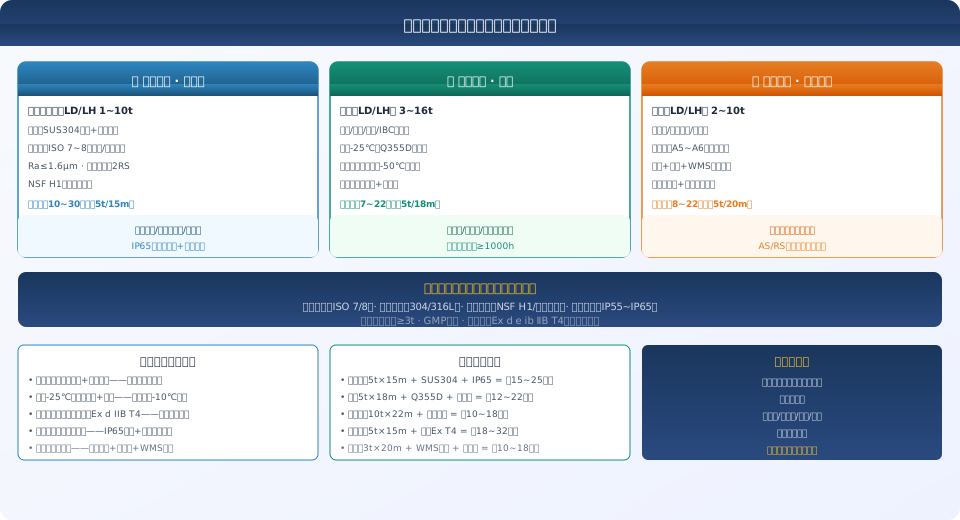
Three-Scenario Configuration Comparison · Full Cleanroom & Warehouse Coverage
Coverage: Cleanroom · Raw Material Warehouse · Finished Goods Logistics Industries: Aseptic Pharma · Food Processing · Biologics Configuration: Food-Grade · Cleanroom Type · Corrosion Resistant · Washdown Capable

Lifting equipment in the food and pharmaceutical sector faces requirements that set it apart from virtually every other industry—cleanliness, corrosion resistance, cleanability, and contamination control often outweigh tonnage and span as the deciding factors. From handling bagged materials in active pharmaceutical ingredient (API) warehouses, to equipment installation and maintenance in aseptic filling lines, to automated palletizing and storage/retrieval in finished goods distribution centers, each scenario imposes distinctly different demands on crane materials, sealing, lubrication, and electrical protection. This guide breaks down crane selection and configuration across the three primary scenarios—cleanroom, raw material warehouse, and finished goods logistics—aligned with food-grade and pharmaceutical-grade technical standards.

Food & Pharmaceutical IndustrycraneThree Major Application ScenariosconfigurationComparison

Food & Pharma Crane Applications: A Full-Scenario Overview

The food and pharmaceutical industry spans a broad spectrum—from primary agricultural processing to high-end biologics manufacturing—and hoisting needs vary significantly across segments. Drawing on years of dedicated service to the food and pharma sector, Kelude Heavy Industry groups crane requirements into three typical scenarios:

Cleanroom
Aseptic preparation, filling lines, bioreactor areas, QC laboratories. Core requirements: ISO Class 7–8 cleanliness, 304 stainless steel, food-grade lubrication, dust-tight sealing.
Raw Material Warehouse
Herbal material storage, API warehouses, cold rooms (−25°C), bagged/drummed/powdered materials. Core requirements: dustproof and moisture-proof design, low-temperature/arctic service, IP55 or higher protection, compatibility with easy-to-clean flooring.
Finished Goods Logistics
Finished goods warehouse, shipping docks, palletizing areas, cold-chain distribution centers. Core requirements: high-frequency duty cycles, automated interface integration, WMS/MES connectivity, rapid response.
Comparison Parameter cleanroom Raw Material Warehouse Finished Goods Logistics
Typicaltonnage 1~10t 3~16t 2~10t
Work Duty / Classification A3~A4 A4~A5 A5~A6
Main Structure Material SUS304Stainless Steel Carbon Steel+Corrosion Resistant Coating Carbon Steel/Stainless Steel Optional
cleanliness class ISO Class 7~8Class(10K/Class 100,000) General Cleanroom(Dustproof) General Cleanroom
lubrication requirements NSF H1Food Grade Standard Grease Standard Grease
Electrical Protection IP65+stainless steel cabinet Body IP55 IP54
drive mode Variable Frequency Speed Control Variable Frequency Drive (VFD)/Two-Speed Variable Frequency Drive (VFD)+Automation
Control Mode Floorremote control+Wiredspare / standby remote control/Operator Cabin remote control/Automatic/System Interlocking

Cleanroom Bridge Cranes for Sterile Environments

Cleanrooms represent the most demanding environment for overhead cranes in the food and pharmaceutical industries. Whether servicing aseptic filling lines, maintaining bioreactor areas, or handling equipment in QC laboratories, the crane must not only perform its material handling duties but also preserve cleanroom airflow integrity, prevent particle shedding, and avoid becoming a breeding ground for microbial contamination.

Structural Design Requirements for Cleanroom Cranes

Kelude's cleanroom cranes are engineered in accordance with GMP guidelines and ISO 14644-1 cleanroom standards, incorporating the following structural measures:

  • All-Stainless Steel Construction: Main girder, end carriages, trolley frame, walkway, and guardrails are fabricated from SUS304 stainless steel with acid pickling and passivation treatment, achieving a surface roughness of Ra≤1.6μm to prevent dust accumulation and microbial adhesion.
  • Aerodynamic Profile Design: The main girder features a curved cross-section with no right angles or horizontal recesses, minimizing disruption to unidirectional airflow. All horizontal surfaces are inclined at 15° or greater to prevent dust settling.
  • Sealed Bearings Throughout: All moving parts utilize double-sealed bearings (2RS class) with a maintenance-free lubrication design, eliminating any risk of grease leakage contaminating the cleanroom environment.
  • Stainless Steel Wire Rope: The hoisting rope is manufactured from SUS304 stainless steel or nickel-plated wire rope, offering superior corrosion resistance and zero flaking, with a service life 2–3 times longer than standard galvanized wire rope.
  • Rail Dust Covers: A 304 stainless steel dust cover is installed beneath the crane rail to prevent metallic particles generated during wheel travel from falling through rail gaps.

Electrical System Configuration for Cleanroom Cranes

The electrical system is the most vulnerable component of a cleanroom crane—cooling fans draw in airborne particles, and electrical components accumulate static-attracted dust. Kelude's cleanroom series employs the following electrical solutions:

  • The electric control cabinet features a SUS304 stainless steel housing with IP65 protection. Heat dissipation is achieved through a plate-type heat exchanger (air-to-air), eliminating the need for direct fan exhaust openings.
  • Control buttons utilize a 304 stainless steel panel with touch-sensitive membrane switches—seamless, easy to clean, and safe to disinfect with alcohol or hydrogen peroxide.
  • All sensors are housed in fully sealed stainless steel enclosures (IP67), and cables feature low-smoke, halogen-free (LSZH) jacketing.
  • Motors are totally enclosed, fan-cooled (TEFC) with smooth surfaces and no cooling fin recesses, rated at IP55 protection or higher.
  • Optional HEPA filters (H13 efficiency) can be installed on reducer breather vents, ensuring no contaminants are expelled during operation.

Warehouse Cranes for Raw Material Handling

Raw material warehouses in the food and pharmaceutical industries vary widely, including herbal medicine storage, active pharmaceutical ingredient (API) areas, food additive warehouses, cold storage facilities (-25°C), and liquid raw material tank farms. Different material forms impose distinct requirements on crane work duty, safety protection, and control methods.

Bagged and Drummed Material Warehouses

This is the most common warehouse configuration—materials are stored in woven bags (25–50 kg/bag), fiber drums (20–100 kg/drum), bulk bags (500–1,500 kg/bag), or IBC totes (200–1,000 L/tote). Recommended configuration:

  • Recommended Model: LD-type single-girder electric overhead crane (3–10 t) or BZD-type column-mounted jib crane (0.5–3 t for workstation applications)
  • Lifting Height: 6–8 m standard (8–10 m required for high-bay racking to access upper tiers)
  • Control Method: Radio remote control, allowing the operator to manage lifting operations from floor level without riding the crane
  • Safety Configuration: Overload limiter, upper and lower limit switches, anti-skew protection, audible and visual alarm
  • Anti-Corrosion Treatment: Steel structure finished with epoxy zinc-rich primer and polyurethane topcoat (three-coat, two-bake system), certified to withstand salt spray testing for 1,000+ hours

Cranes for Cold Storage and Low-Temperature Warehouses

Many food and pharmaceutical raw materials require refrigerated or frozen storage (e.g., biological materials, vaccine intermediates, frozen food ingredients), with cold room temperatures typically maintained at -20°C to -25°C. Low-temperature environments present unique challenges for crane operation, including increased material brittleness, grease solidification, condensation-induced electrical faults, and ice buildup on rails causing wheel slippage. Kelude's cold-storage cranes incorporate the following low-temperature adaptations:

  • Material Selection: Load-bearing structures utilize low-alloy high-strength steel Q355D (impact toughness ≥34J at -20°C) or SUS304 stainless steel for superior low-temperature performance
  • Low-Temperature Lubrication: Synthetic low-temperature grease (rated -50°C to +120°C) is used throughout, with PAO synthetic oil in reducers for excellent cold-flow characteristics
  • Electrical Heating: Thermostatically controlled heaters inside the control cabinet (auto-activate below 5°C) and anti-condensation heating tapes on motors
  • Anti-Icing Measures: Anti-icing coating applied to rail surfaces and ice scrapers fitted to wheel flanges
  • Stainless Steel Wire Rope: Stainless steel or nickel-plated wire rope prevents zinc layer flaking at low temperatures
Cold Storage Parameter Standardconfiguration Kruud Low-Temperature Solution
Ambient Temperature -5℃~-10℃ -25℃~-30℃(Customizable Down To-45℃)
Main Structure Material Q235Carbon Steel Q355DAlloy Steel/SUS304
Lubrication Kruud Low-Temperature Solution Standard Lithium grease(Low-Temp Hardening) Synthetic Low-Temp Grease(-50℃Available)
Electrical Protection No Heating Device Thermostatic Heating+Anti-Condensation
reference price(5t/10mSpan) 6~1010K RMB 12~2210K RMB

4. Finished Goods Warehouse Cranes — High-Frequency Automated Hoisting

In food and pharmaceutical companies, the finished goods warehouse serves as the critical link between production and shipping. With high daily inbound and outbound volumes, these facilities demand exceptional operational efficiency. Traditional manual forklift handling is increasingly unable to meet GMP requirements for product traceability and batch control. As a result, more food and pharmaceutical manufacturers are adopting a combined approach that integrates overhead cranes with Automated Storage & Retrieval Systems (AS/RS).

4.1 Crane Solutions for Flat-Floor Finished Goods Warehouses

For small to mid-sized food and pharmaceutical companies (daily output under 50 tons), flat-floor warehousing remains the predominant storage format. Installing a single-girder electric overhead crane in this setting enables rapid lifting and transport from the production line end to the shipping area:

  • Recommended model: LH-type electric hoist bridge crane (5–10t) or LD-type (3–5t), with spans from 15 to 25m
  • Work duty: A5 (moderate duty), operating 8–12 hours per day
  • Speed configuration: Hoisting at 4/0.7m/min with two-speed or VFD control, cross travel at 20m/min, long travel at 30m/min
  • Optional features: Electronic hook scale for real-time weighing before shipment, wireless data terminal interfacing with ERP systems to log product name, batch number, and weight for every lift
  • Reference price: LD-type 3t/18m: approximately $10,400–$14,800; LH-type 10t/22m: approximately $22,200–$32,600

4.2 Crane Solutions for High-Bay and Automated Finished Goods Warehouses

Large food and pharmaceutical groups — such as pharmaceutical companies with revenues exceeding RMB 10 billion or publicly listed food corporations — typically deploy Automated Storage & Retrieval Systems (AS/RS) with stacker cranes and shuttle cart systems. In these environments, overhead cranes no longer handle high-frequency lifting; instead, they serve three distinct functions:

  • Inbound loading cranes: One or two jib cranes or light-duty overhead cranes positioned at the AS/RS entry point transfer pallets from trucks or buffer lines to the stacker crane pickup station.
  • Outbound truck-loading cranes: BZD-type jib cranes (0.5–2t) or mobile gantries installed at the shipping dock to assist with truck loading and container transfer operations.
  • Equipment maintenance cranes: A small overhead crane (2–5t) located in the stacker maintenance bay, used for hoisting and servicing stacker cranes, shuttle carts, and other mobile equipment.

5. Food-Grade vs. Standard Industrial Cranes: Technical Comparison

Food-grade cranes used in the food and pharmaceutical industries differ fundamentally from standard industrial cranes across five key dimensions: materials, sealing, lubrication, electrical systems, and cleanability. The comparison table below helps procurement professionals quickly distinguish the technical differences between the two product types:

Technical Aspect Standard Industrialcrane Kruud Food Gradecrane Application Scenarios
Main Structure Material Q235Carbon Steel+Standard Paint SUS304Stainless Steel+Pickling and Passivation cleanroom/Sterile Zone
surface roughness Ra≤12.5μm(Welding Rear Spray painting) Ra≤1.6μm(Machinery Polishing) All Cleanroom Areas
Bearing Sealing Standard ZZ/2ZBearing Double-Sided Sealing2RS+Food-grade grease General Cleanroom/Food Processing Area
Lubricating Oil Synthetic Low-Temp Grease Standard Lithium grease/Calcium grease NSF H1Certification Food-grade grease Food Contact Area
Wire Rope galvanized wire rope SUS304Stainless Steel/Nickel-Plated Wire Rope General Cleanroom/Protectioncorrosive environment
electric control cabinetguards Carbon Steel Enclosure+IP54+Direct Fan Exhaust SUS304Stainless Steel+IP65+Plate Heat Exchange All Cleanroom Areas
Fastener Standard Galvanized Bolt A2-70Stainless Steel Countersunk Bolt All Cleanroom Areas
Washdown-Capabledesign None(Rusting from Water Washdown) Stainless Steel+Drainage Slope+Sealing Bearing Food Processing Area/Washdown Area
anti-static/Explosion-proof Standard None Customizableanti-static+dust explosion-proof DIP Raw Material Dust Area/Alcohol Extraction Workshop
Price Surcharge Rate Base Price +30%~+80%(Subject Tocleanliness class)

6. Special-Process Cranes for Extraction, Fermentation, and Batching Areas

Beyond the three primary production scenarios, food and pharmaceutical facilities require specialized cranes for several additional process areas:

6.1 Extraction Workshop / Alcohol Recovery Zone

Herbal extraction and food additive processing typically involve alcohol or other organic solvents, creating a potentially explosive gas atmosphere (Zone 1/Zone 2). Cranes installed in these areas must be equipped with explosion-proof systems:

  • Explosion Protection Class: Ex d e ib ⅡB T4 Gb (combined flameproof, increased safety, and intrinsic safety design, suitable for Group IIB gases such as alcohol and acetone)
  • Recommended Model: Explosion-proof LD or LB type electric single-girder crane (1–10 t)
  • Motor and Electrical System: Explosion-proof motor (Ex d ⅡB T4) + explosion-proof electrical control box (Ex e ⅡB T4) + explosion-proof remote control
  • Special Configurations: Grounding copper busbar + anti-static hook + gas detection sensor interlock (automatic power shutdown when combustible gas concentration exceeds safe levels)

6.2 Fermentation Workshop / Bioreactor Area

Fermentation tanks and bioreactors typically range from 5 to 15 m in height, requiring regular maintenance operations such as lid removal, agitator hoisting, and internal cleaning. Recommended configurations for this area include:

  • Recommended Models: Single-girder bridge crane (5–16 t) or double-girder bridge crane (16–32 t for large-volume reactors), with lifting heights of 10–18 m
  • Cleanliness Requirements: This area is classified as a controlled zone (non-sterile). SUS304 stainless steel is the primary material; food-grade lubrication is not required, but corrosion resistance is essential
  • Variable Frequency Micro-Motion: VFD-equipped hoisting with micro-motion capability of 0.2–0.5 m/min enables precise installation of reactor agitator shafts and mechanical seals
  • Safety Interlock: Optional access control interlock along the hoisting path — when the crane is positioned over a reactor for lifting operations, personnel are prevented from entering the danger zone below

7. Kelude Benchmark Projects in Food and Pharmaceutical Industries

Kelude Heavy Industry has delivered numerous successful projects across the food and pharmaceutical sectors, serving clients in biopharmaceuticals, traditional Chinese medicine, dairy, beverages, condiments, and other specialized segments.

Case Study 1: Cleanroom Retrofit for a Major Biopharmaceutical Company

Project Overview: 2024 retrofit project involving 4 cleanroom overhead cranes (5 t / 10 t) installed in a Class C (ISO Class 7) cleanroom facility.

Key Features: Full 304 stainless steel construction, streamlined design, HEPA-filtered gearbox, touch-sensitive membrane switch panel, NSF H1 food-grade lubrication.

Project Results: Cleanliness in the crane operating zone maintained at Class C level after retrofit; human contamination risk during lifting and transport eliminated (approximately 2,000 fewer personnel movements per year); operator staffing reduced from 4 to 1 per shift (monitoring only), saving approximately $160,000 annually; payback period of approximately 22 months.

Case Study 2: Cold Storage Cranes for a Dairy Manufacturer

Project Overview: Two LH-type overhead cranes (5 t / 10 t) with a 22 m span installed in a new cold storage facility (-25°C) for a major dairy group.

Key Features: Q355D low-alloy steel main structure, low-temperature synthetic grease (operable down to -50°C), control cabinet heater with anti-condensation protection, stainless steel rail dust covers, IP65 stainless steel control cabinet.

Project Results: No equipment failures attributable to low-temperature conditions after 2 years of operation; 100% pass rate on airborne particulate detection in the cold storage area; daily lifting cycles increased by 40% compared to pre-retrofit levels.

Case Study 3: Complete Crane Package for a Traditional Chinese Medicine Manufacturer

Project Overview: A newly built extraction workshop and raw material warehouse for a major traditional Chinese medicine group, supplied with 8 cranes (5 standard LD-type units, 3–10 t, plus 3 explosion-proof LB-type units, 5 t), with a total contract value of approximately $415,000.

Key Features: 5 standard LD-type cranes in the raw material warehouse + 3 explosion-proof Ex d e ib ⅡB T4 Gb units in the extraction workshop, with integrated planning across explosion-proof and standard zones; unified electrical control system brand (Schneider) across the complete plant for simplified future smart upgrades.

Project Results: Zero safety incidents over 3 years of operation; explosion-proof equipment passed acceptance inspection on first attempt; batch processing capacity increased by 60%; unified maintenance system across all plant lifting equipment reduced annual maintenance costs by approximately 35%.

8. Kelude Service Advantages for Food and Pharmaceutical Cranes

Kelude Heavy Industry provides end-to-end services for food and pharmaceutical clients, from solution design through delivery and acceptance. Our key advantages include:

17+
Years of food and pharmaceutical industry experience
200+
Food and pharmaceutical projects successfully delivered
GMP
Full process compliant with GMP standards
316L
Customizable up to 316L stainless steel construction
  • Scenario-Based Customization: Kelude Heavy Industry offers a complete product line—from standard models to deeply customized solutions—for food and pharmaceutical environments including cleanrooms, raw material warehouses, cold storage, extraction workshops, and finished goods logistics. Special configurations include 304/316L stainless steel, food-grade lubrication, explosion-proof protection, and low-temperature operation.
  • Compliance Assurance: All cranes for the food and pharmaceutical industry come with full compliance documentation, including material certificates, cleanliness test reports, NSF H1 grease certification, and Explosion Proof Certificates—meeting GMP, FDA, and EU CE audit requirements.
  • Lifecycle Service: From site survey and solution design through manufacturing, installation, commissioning and acceptance, operator training, and annual maintenance, Kelude provides a 2-year full-machine warranty (5-year anti-corrosion warranty on stainless steel structures) plus 7×24 nationwide after-sales support.
  • Smart Integration: Food and pharmaceutical cranes can connect to workshop MES systems (auto-linking lifting data with batch records), WMS warehouse management systems (seamless inbound/outbound automation), and enterprise-level equipment management platforms (real-time monitoring of all cranes plant-wide).
Selection Recommendations: Crane selection for food and pharmaceutical facilities should not be based on tonnage and span alone. Cleanliness class, material grade, lubrication rating, and electrical protection are the four criteria that determine whether a crane is truly suited to the application. We recommend having the Kelude technical team conduct an on-site survey during the planning phase to confirm the workshop cleanliness class, temperature and humidity range, material handling characteristics, and cleaning frequency before issuing a tailored selection and configuration solution with quotation.

FAQ

Q: Do food workshops and pharmaceutical workshops have the same cleanliness requirements for cranes?

A: Not exactly. Food workshops (e.g., meat processing, bakeries) typically require ISO Class 8 (100,000-class) cleanliness, with the focus on washdown resistance, corrosion prevention, and food-grade lubrication (NSF H1). A sloped drainage design on the structure is sufficient for rinse-down cleaning. Pharmaceutical workshops—especially aseptic filling areas—typically require ISO Class 7 (10,000-class) or even ISO Class 5 (100-class) cleanliness. Beyond material and lubrication requirements, cranes must not disrupt unidirectional airflow, must limit surface particle shedding to ≤0.1 μg/cm², and must withstand wiping with disinfectants such as alcohol and hydrogen peroxide. Kelude has developed two dedicated product lines for these applications: the F Series (food-grade) and the P Series (pharmaceutical-grade).

Q: Is stainless steel mandatory for cranes in the food and pharmaceutical industry?

A: Not necessarily—it depends on the application. Cleanrooms and aseptic areas require SUS304/316L stainless steel. Painted carbon steel surfaces degrade rapidly under frequent washdown and disinfection, generating rust particles that can contaminate products. Raw material warehouses and finished goods warehouses, however, can use carbon steel with a high-performance anti-corrosion coating system. An epoxy zinc-rich primer plus Polyurethane Topcoat costs only 50%–60% of stainless steel and is fully adequate for areas that do not come into contact with food or pharmaceuticals. For cold storage, Q355D low-alloy steel or stainless steel is recommended—carbon steel's low-temperature brittleness (significant drop in impact toughness below -20°C) requires special attention. Kelude offers a full range of material options to match your budget and application.

Q: How should cranes in the food and pharmaceutical industry be cleaned on a daily basis?

A: Crane cleaning in food and pharmaceutical facilities follows a three-tier approach: ① Daily wipe-down—after each production shift, wipe the main girder and hook surfaces with a clean cloth dampened with 75% alcohol or 0.1% benzalkonium chloride solution (in cleanrooms); ② Periodic washdown—in food processing areas, rinse the entire crane weekly using 40–60°C hot water with a neutral detergent (requires IP65 electrical protection and sloped drainage design); ③ Deep cleaning—quarterly disassembly cleaning of the entire crane, including replacing the reducer breather filter media, polishing and passivating stainless steel surfaces, and replenishing or replacing grease. Kelude food-grade cranes are designed for cleanability: all exposed threads are countersunk, component mating surfaces feature angled drainage channels, and bearing housings have drain holes at the bottom for direct washdown.

Q: What certifications and qualifications are required for cranes in the food and pharmaceutical industry?

A: The certifications and qualifications for food and pharmaceutical cranes include: ① Special Equipment Manufacturing License—cranes are classified as special equipment, and manufacturers must hold a manufacturing license (Grade A or Grade B) issued by the State Administration for Market Regulation; ② Material certificates—mill test certificates for SUS304/316L stainless steel plate (including chemical composition and mechanical properties); ③ Food-grade grease certification—NSF H1 certificate (for environments with incidental food contact); ④ Explosion Proof Certificate—cranes for explosion-proof zones such as extraction workshops must obtain national explosion-proof certification (Ex d e ib ⅡB T4 Gb); ⑤ Cleanliness test report—cleanroom cranes must undergo particle shedding testing and cleanliness recovery testing after delivery. Kelude supplies all required documentation with every crane to facilitate GMP or FDA system audits.

Related News

contact

contact us

phone:
+86 13903802779

mail:3915269@qq.com

Working hours: Monday to Friday

Wechat
Wechat
SHARE
TOP