
Crane Configuration Solutions for Data Centers & Telecom

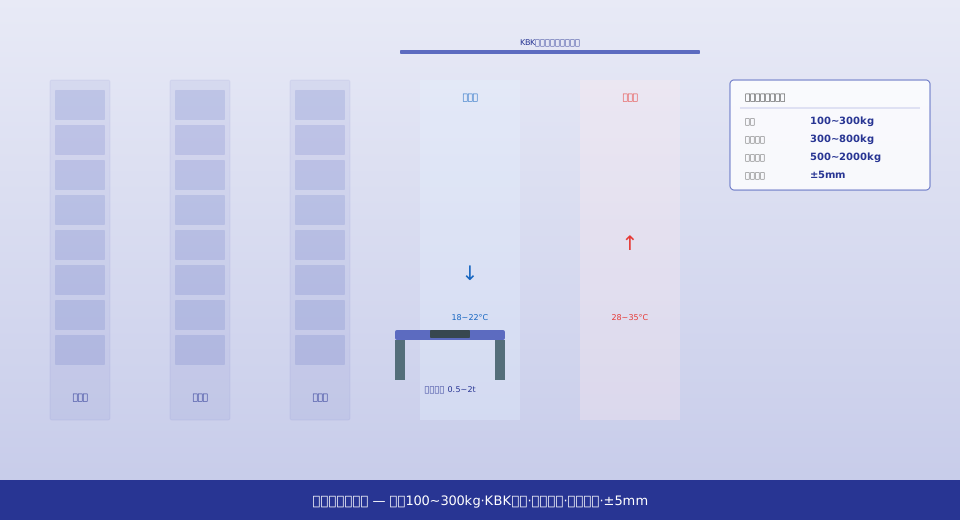
For data centers and telecom rooms (server racks, precision cooling units, power distribution cabinets, battery banks, satellite antennas), the lifting and installation requirements center on three scenarios: ① Equipment offloading and transport upon delivery (server racks 100–300 kg / precision cooling units 300–800 kg / power distribution cabinets 200–500 kg / battery banks 500–2,000 kg); ② Precision installation inside the facility (positioning accuracy of ±5 mm with zero vibration or impact); ③ Retrofitting existing facilities (dismantling old equipment, moving in new units, and positioning them). Recommended configuration: LD Type overhead crane, 3–5 t (for new data center construction) + KBK flexible suspension crane, 0.25–0.5 t (for workstation-level lifting inside the room) + manual trolleys / assist arms (for fine positioning of server racks). Kelude's data center solution prioritizes equipment safety and installation accuracy.

Industry Solution · Data Centers & Telecom
Crane Configurations for Data Centers & Telecom Facilities
Three scenarios: equipment transport, precision installation, and facility retrofits
Data CentercraneLive Scene

Cranes for New Data Center Construction: Equipment Intake & Floor Transfer

During new data center construction, large volumes of equipment (server racks, precision cooling units, UPS systems, power distribution cabinets, battery banks) must be moved from the loading dock to the equipment floor. Data centers are typically located on floors 2 through 5 of a building, and equipment is brought in via one of three routes: ① Freight elevator (size-limited, ≤1.8 m high); ② Dedicated lifting lug (a 1.5 m × 1.5 m to 2.5 m × 2.5 m openingReserved in the floor slab, through which equipment is hoisted and then moved horizontally to its position); ③ Direct loading dock access (ground-floor equipment rooms can be accessed directly from the dock; upper floors require a lifting lug).

Recommended model: LD Type overhead crane, 3–5 t / span 12–20 m / lifting height 8–12 m. The crane is installed beneath the structural beams on the top floor of the data center and lifts equipment from ground level up through the lifting lug to the equipment floor. Once leveled, equipment is moved horizontally to its final position using forklifts or air-cushion transporters. A two-speed hoisting mechanism is recommended (8 m/min no-load + 1–2 m/min under load) — fast no-load hoisting improves efficiency, while slow loaded hoisting protects the equipment.

Price reference: LD overhead crane, 3 t / 15 m span: approx. $4,500–$8,900 per unit. Kelude's data center crane solution coordinates with the structuralReserved lifting lug, and the crane covers both the lifting lug and the unloading area for seamless transfer.

Cranes for Telecom Equipment Installation: Precision Cooling, Power Distribution & Battery Placement

Equipment installation in telecom rooms (base stations, core facilities, data centers) includes precision cooling units (indoor units 300–500 kg + outdoor units 200–400 kg), power distribution cabinets (ATS/PDU/STS, 200–500 kg), and battery banks (batteries + racks, 500–2,000 kg). These units share three characteristics: ① Concentrated weight (each unit's dead weight accounts for a significant portion of the room's live load); ② Standardized dimensions (600–800 mm width, matching standard rack widths); ③ High accuracy requirements (clearance to adjacent equipment is often only 50–100 mm, so contact must be avoided).

Recommended model: KBK flexible combination suspension crane, 0.25–0.5 t, single-rail or double-rail configuration. The KBK system is installed along the rack aisle direction (covering the path from the equipment entrance to the rack positions). Equipment is lifted at the room entrance via the KBK crane, manually pushed along the rail to the target position, then slowly lowered into place. The manual push operation of the KBK system provides superior positioning accuracy compared to electric cranes — operators can directly guide the equipment by hand for millimeter-level fine adjustment.

Price reference: KBK system, 0.25 t / 15 m straight rail: approx. $3,000–$7,400 per set. Kelude's telecom room KBK solution features a low-headroom design (clearance under the rail ≥2.4 m, meeting rack aisle height requirements).

Cranes for Equipment Room Retrofits: Dismantling Old Units & Installing New Equipment

Equipment room retrofits (expansion, upgrade, replacement) are a common requirement in data center operations. These projects are characterized by: ① Limited space — existing equipment remains operational during the retrofit, leaving minimal room for dismantling and installation; ② Short time windows — work is typically performed late at night or on weekends to minimize business impact; ③ Complex lifting paths — equipment must navigate around existing units, pass through cable trays and piping, and move through narrow aisles.

Recommended model: Mobile gantry crane (portable aluminum gantry, rated load 0.5–2 t / clearance 2.5–3 m / span 2–3 m) + manual trolley / air-cushion transporter. The advantages of a mobile gantry crane: ① No need to drill into the floor slab for rail installation (avoiding damage to waterproofing and anti-static flooring); ② Can be freely moved to any position; ③ Compact when dismantled (easily stored in a corner of the warehouse). For large equipment (precision cooling units, power distribution cabinets), mobile gantry cranes can be rented for temporary use during the retrofit period.

Price reference: Portable aluminum mobile gantry crane, 0.5 t: approx. $3,000–$7,400 per unit (rental approx. $75–$150 per day). Kelude provides a complete lifting and transport solution for equipment room retrofits — mobile gantry crane + air-cushion transporter + precision alignment tools.

Crane Configuration Comparison for Data Centers & Telecom Facilities

← Scroll left / right to view full table →
application scenariosrecommended modeltonnage/Spanspecial configurationreference price
New Machinery HouseLDoverhead type(Lifting lug)3~5t/12~20mTwo speed hoisting/remote control3~610K
equipment installationKBKflexible suspension0.25~0.5tLow-Headroom/Manual Fine Adjustment2~510K
New Machinery House RetrofitMobile Gantry Crane0.5~2tAluminum Portable/Rental2~510K

Key Crane Parameters for Data Center Applications

Server Rack Weight
100–300 kg
Standard server cabinets
Precision Air Conditioning
300–800 kg
Data hall climate control units
Battery Banks
500–2,000 kg
UPS backup power systems
Installation Accuracy
±5 mm
Equipment placement tolerance
Headroom Requirement
≥2.4 m
Clear height above cabinet aisles
Solution Investment
$3,000–$9,000
Varies by application scenario

Kelude Service Advantages for Data Center & Telecom Facilities

① Precision Light-Load Solutions: Kelude Heavy Industry's crane solutions for data centers and telecom facilities are built around precision handling of light loads (0.25–5 t). KBK systems deliver manual push-pull positioning accuracy of ±2 mm, while mobile gantry cranes offer creep-speed hoisting at 0.5–2 m/min — ensuring vibration-free equipment installation that protects sensitive components inside server racks, air conditioning units, and power distribution cabinets.

② Full-Scenario Coverage: From LD overhead cranes for new data halls (via lifting lug openings) to KBK systems for operating facilities (aisle-mounted installation) and mobile gantry cranes for retrofit projects (portable solution), Kelude Heavy Industry covers all three typical lifting and transport scenarios in data center environments.

③ Civil Engineering Coordination: Kelude Heavy Industry provides structural coordination services for new data center construction — including lifting lug positioning recommendations, structural load verification, and construction sequencing planning — ensuring seamless integration between the crane system and the building design, and eliminating costly post-construction modifications.

Frequently Asked Questions (FAQ)

Q: Why should a crane be considered during the architectural design phase of a data center?

A: Many data centers overlook equipment lifting and transport access during the building design phase, leading to these common problems when equipment arrives on site: ① Freight elevator dimensions are insufficient (standard racks measure 600 mm wide × 1,000 mm deep × 2,000 mm high, while elevator doors are typically 800 mm wide — the rack fits but maneuvering around corners is extremely tight); ② Corridor corners lack adequate turning space (a rack requires a turning radius of at least 1.5 m at corridor intersections); ③ No floor openings areReserved (all equipment must be carried up stairways — moving dozens of racks this way is labor-intensive, time-consuming, and risks damage). If an equipment lifting opening (1.5 m × 1.5 m or larger) and a crane (covering both the lifting opening and equipment access routes) are planned during the architectural design stage, subsequent equipment delivery, expansion, and retrofit projects become dramatically more efficient. Kelude Heavy Industry offers crane system design and civil engineering coordination recommendations (lifting opening placement / structural reinforcement / construction sequencing) for new data center projects.

Q: What conditions are required for installing a KBK system inside a telecom equipment room?

A: Installing a KBK flexible modular crane in an equipment room requires the following conditions: ① Slab load capacity — the total weight of a KBK system (including rail + hoist + load) is approximately 50–150 kg per linear meter, so the roof structure beams or ceiling slab must have sufficient load-bearing capacity (structural engineer verification is recommended); ② Headroom — raised access floor (600 mm) + cabinet height (2,000 mm) + KBK hoist height (approximately 400–600 mm) + lifting eye to rail top clearance (100 mm) = a required installation height of approximately 3.1–3.3 m below the rail, meaning the total height from the structural ceiling finish to the finished anti-static floor surface must be ≥3.5 m; ③ Installation position — the rail runs along the cabinet aisle, fixed to the structural beams directly above the aisle. Kelude Heavy Industry provides on-site surveys and custom KBK system design services for equipment rooms.

Q: Is it feasible to use a mobile gantry crane instead of a fixed overhead crane for equipment room retrofits?

A: Yes — and for most equipment room retrofit scenarios, a mobile gantry crane is actually the more practical choice compared to a fixed overhead crane. Here's why: ① Flexibility — the lifting points during a retrofit are unpredictable (equipment types and locations change with every project), and a fixed-rail KBK can only cover the area directly beneath the rail, whereas a mobile gantry crane can be moved to any rack position; ② No structural reinforcement needed — the gantry crane sits directly on the anti-static floor (with load-spreading base plates underneath), eliminating the need for drilling into the slab or reinforcing the structure; ③ Lower investment — a mobile gantry crane costs $3,000–$7,400 per unit, significantly less than a KBK system (including installation) at $3,000–$7,400; ④ Rental option — if retrofits occur only a few times per year, renting is more cost-effective at $75–$150 per day. Kelude Heavy Industry offers both sales and rental of mobile gantry cranes, along with temporary lifting solution design during equipment room retrofit periods.

Q: Why does precision air conditioning installation require a dedicated lifting and transport plan?

A: Indoor units of precision air conditioners (computer room air conditioners) weigh 300–800 kg and measure approximately 1.8 m × 1.0 m × 1.0 m. During installation: ① Outdoor unit handling — outdoor units are typically placed on the ground floor outdoors or on rooftops; moving from the unloading point to the installation position may require crossing sidewalks, landscaped areas, or utility trenches. ② Indoor unit positioning — indoor units are installed inside the computer room, surrounded by operating server racks and equipment, leaving only 50–100 mm of operating space. ③ Refrigerant pipeline connection — copper pipes between indoor and outdoor units must pass throughReserved holes in walls or floor slabs, so hoisting must coordinate with pipeline routing. Kelude Heavy Industry provides a full-process lifting and transport solution for precision air conditioner installation — from unloading (mobile gantry crane/forklift truck), indoor transport (air-cushion transporters/manual stackers), to positioning (KBK/mobile gantry crane + precision alignment tools) — ensuring zero collision and vibration impact throughout equipment installation.

Related News

contact

contact us

phone:
+86 13903802779

mail:3915269@qq.com

Working hours: Monday to Friday

Wechat
Wechat
SHARE
TOP