

Crane Selection Requirements for Nuclear Power Plants—Lifting Equipment for Four Zones: Nuclear Island, Conventional Island, Fuel, and Waste
In a nutshell:Krud Heavy Industries provides crane configuration solutions for nuclear power plants covering four major areas: the nuclear island, the conventional island, fuel handling, and waste management, with lifting capacities ranging from 5 to 360 metric tons (nuclear island ring cranes), 10–180 metric tons (conventional island), 3–30 metric tons (fuel area), and 5–20 metric tons (waste disposal area). The total investment in lifting equipment for the entire plant ranges from approximately 5 to 50 million yuan. The nuclear island area uses ring cranes (360 metric tons + 50 metric tons auxiliary hook, designed for seismic and LOCA conditions), the conventional island is equipped with QD-type double-girder overhead cranes (50–180 metric tons), the fuel area uses stainless steel corrosion-resistant cranes (including foreign object protection design), and the spent fuel area is equipped with cranes featuring an easy-to-clean design, all of which meet the extremely stringent safety requirements for the nuclear power plant’s 60-year design life.
☢️ Crane Configuration Plan for Nuclear Power Plants
✅ Reactor Island | ✅ Conventional Island | ✅ Fuel Area | ✅ Waste Treatment Area
Nuclear power cranes are the product category with the highest safety rating in the crane industry. From the reactor building in the nuclear island to the fuel handling area, every crane must meet stringent requirements such as radiation resistance, seismic resistance, and redundant safety braking. Krud Heavy Equipment holds the necessary qualifications for the design and manufacture of nuclear power cranes and is a qualified supplier to both the China National Nuclear Corporation (CNNC) and the China General Nuclear Power Group (CGN). Its product range covers all lifting needs across the entire nuclear power plant.
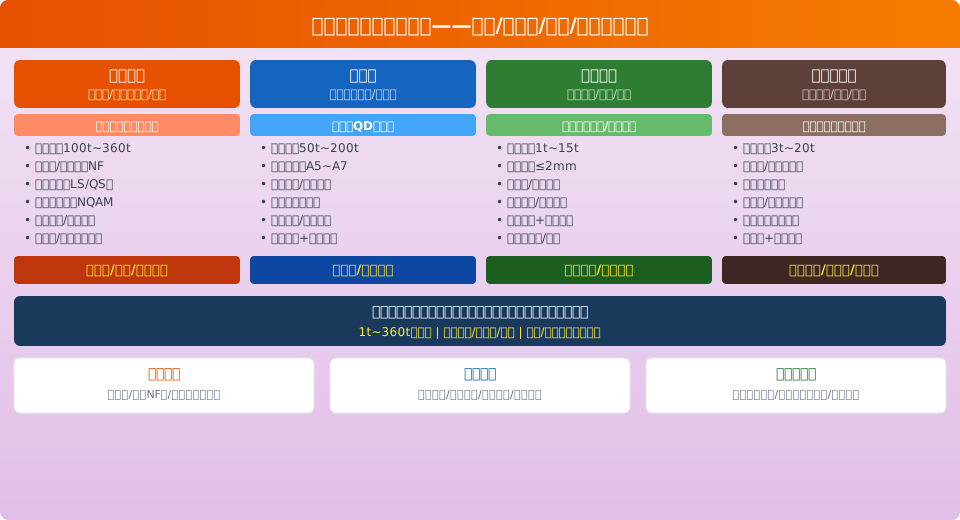
Scene 1: Nuclear Island Area
• Lifting capacity: 100 t to 360 t; bridge cranes specifically designed for nuclear power plants
• Radiation Resistance/Seismic Resistance Rating NF
• Safety Level: LS/QS
• Nuclear Power Quality Assurance System NQA/M
• Dual-crane lifting / synchronized alignment correction
• Krude Heavy Industries Has Passed Certification for the Nuclear Power Quality Assurance System
Radiation- and Shock-Resistant | Nuclear Safety Grade | Dual-Crane Lifting
Scene 2: Conventional Island
• Lifting capacity: 50 t to 200 t, QD-type overhead crane
• Job Grade A5–A7
• Variable-frequency speed control / Micro-motion control
• Optional dual-trolley configuration
• Precision Installation / Large-Item Turning
• Krude Heavy Industries is equipped with a redundant braking system
High-Capacity 50–200 t | Variable-Frequency Micro-Motion | Redundant Braking
Scene 3: Fuel Area
• Lifting capacity: 1 t to 15 t; special-fuel crane
• Positioning accuracy ≤ 2 mm
• Fall Protection / Secondary Braking
• Underwater Operations/Extended-Handle Tools
• Video Surveillance + Remote Control
• Krude Heavy Industries offers radiation-resistant motor and cable solutions
Precision Positioning ≤ 2 mm | Fall Protection | Remote Control
Scene 4: Waste Disposal Area
• Lifting capacity: 3 t to 20 t; radiation-proof remote-controlled crane
• Fully enclosed/leak-proof design
• Remote control operation
• Corrosion-resistant/easy-to-clean surface
• Redundant Safety Braking System
• Krude Heavy Industries Stainless Steel + Special Coating Solution
Radiation Protection | Remote Control | Stain-Resistant Surface
Comparison of Selection Parameters for the Four Zones
| Parameter Items | Reactor Island Area | Conventional Island | Fuel Area | Waste Disposal Area |
|---|---|---|---|---|
| Recommended Models | Bridge-Type for Nuclear Power Plants | QD-Type Bridge | Special-Purpose Fuel Crane | Radiation-Proof Remote-Controlled Crane |
| Lifting Capacity Range | 100 metric tons to 360 metric tons | 50 metric tons to 200 metric tons | 1 t to 15 t | 3 metric tons to 20 metric tons |
| Security Level | LS/QS Class | Standard Industrial Grade | Nuclear Safety-Related | Radiation Protection Grade |
| Special Requirements | Radiation-Resistant/Shock-Resistant | Precision Installation | Positioning accuracy ≤ 2 mm | Leak Protection / Remote Control |
| Control Method | Cab + Remote | Cab + Remote Control | Remote Control | Remote Control |
| Krude's Advantages | Nuclear Power Quality Assurance Certification | Redundant Braking System | Radiation-Resistant Motors/Cables | Stainless Steel + Special Coating |
Nuclear Island Cranes—Equipment Subject to the Highest Level of Nuclear Safety Standards
Nuclear island cranes (reactor building cranes) are the lifting equipment with the highest safety classification in a nuclear power plant; they must meet numerous requirements specific to the nuclear power industry, including radiation resistance, NF-class seismic resistance, anti-seizing mechanisms, and redundant braking systems. The nuclear-grade overhead cranes designed by Krude Heavy Industry feature a redundant dual-brake configuration, radiation-resistant motors and special cables, and a seismic-resistant design capable of withstanding SL-2-level seismic conditions; their quality assurance system complies with the NQA/M nuclear power quality assurance standards. With lifting capacities ranging from 100 metric tons to 360 metric tons, these cranes are capable of performing critical lifting tasks such as installing reactor pressure vessel tops and replacing steam generators.
Features of the Lifting Configuration in the Conventional Island and Fuel Areas
QD-type double-girder overhead cranes may be used in the conventional island steam turbine building, but they must be equipped with redundant braking and anti-jamming designs. The fuel handling area has the most stringent positioning accuracy requirements—the positioning accuracy for lifting fuel assemblies must be ≤2 mm—and therefore requires the use of specialized fuel hoists equipped with a two-stage anti-fall braking system. Krud Heavy Industries has equipped the fuel hoist with radiation-resistant motors, long-handled operating tools, and underwater operation capabilities to meet the requirements for transferring fuel assemblies within the storage pool.
Radiation-Shielded Remote Control Systems for Waste Treatment Areas and Full Lifecycle Services for Nuclear Power Plants
Cranes in the waste treatment area must be operated remotely in high-radiation environments; a fully enclosed, leak-proof design and a surface treatment that is easy to clean are essential requirements. The radiation-shielded remote-controlled crane designed by Krude Heavy Industries features a fully enclosed structure, stainless steel with a special radiation-shielding coating, and a remote video control system, allowing operators to safely complete all lifting operations from outside the shielded area. Krude Heavy Industries provides full-lifecycle operation and maintenance services for nuclear power plants, including periodic inspections, spare parts supply, and radiation-induced aging testing.
Krud Heavy Industries—Advantages of Nuclear Power Plant Crane Services
Krude Heavy Industry is a specialized manufacturer of nuclear power plant cranes and holds a Civil Nuclear Safety Equipment Manufacturing License (HAF604). Its products have passed design and manufacturing reviews by the National Nuclear Safety Administration and cover a full range of ring cranes for the nuclear island and gantry cranes for the conventional island in 1-million-kilowatt-class pressurized water reactor (PWR) nuclear power plants. The company has supplied lifting equipment to six nuclear power bases in China.
Frequently Asked Questions
Q: What seismic design rating must nuclear power plant cranes meet?
Answer: The seismic design of nuclear power plant cranes must meet NF-class requirements (Safe Shutdown Earthquake, SSE), meaning they must maintain structural integrity and functional availability under SL-2 seismic conditions. Krud Heavy Industry conducts seismic verification of all load-bearing components through finite element analysis and installs anti-jump devices and derailment-prevention blocks to ensure that the crane does not derail or fall during an earthquake.
Q: Why do nuclear island cranes require redundant brakes?
Answer: Nuclear island cranes are used to lift high-value nuclear safety equipment such as reactor pressure vessel heads and steam generators; any drop could result in a nuclear leak. The redundant braking system automatically activates the auxiliary brakes in the event of a main brake failure. Each set of nuclear power brakes manufactured by Krude Heavy Industry can independently bear 1.5 times the rated load, and when both brakes are applied simultaneously, the braking distance is reduced by more than 50%.
Q: How is the positioning accuracy of the fuel crane ensured?
Answer: The positioning accuracy of the fuel crane is achieved through variable-frequency speed control combined with closed-loop encoder control—both the main and auxiliary hoists are equipped with incremental encoders that provide real-time position feedback to the PLC-based fully closed-loop control system. Krud Heavy Industry’s fuel cranes achieve positioning accuracy of ±1.5 mm under load conditions and are equipped with laser rangefinding for redundant verification to prevent cumulative encoder errors.
Q: Why is the crane in the scrap handling area designed to be easy to clean?
Answer: In nuclear waste processing areas, radioactive dust or liquid leaks may contaminate equipment surfaces. Krude Heavy Industries employs a fully enclosed design combined with a stainless steel body and a Teflon coating process, with a surface roughness of Ra ≤ 0.8 μm, allowing for easy removal with standard decontamination agents. All weld seams are ground to eliminate blind spots, and the electrical enclosures are fully sealed to IP65 standards, ensuring no accumulation of radioactive material in hard-to-reach areas.
