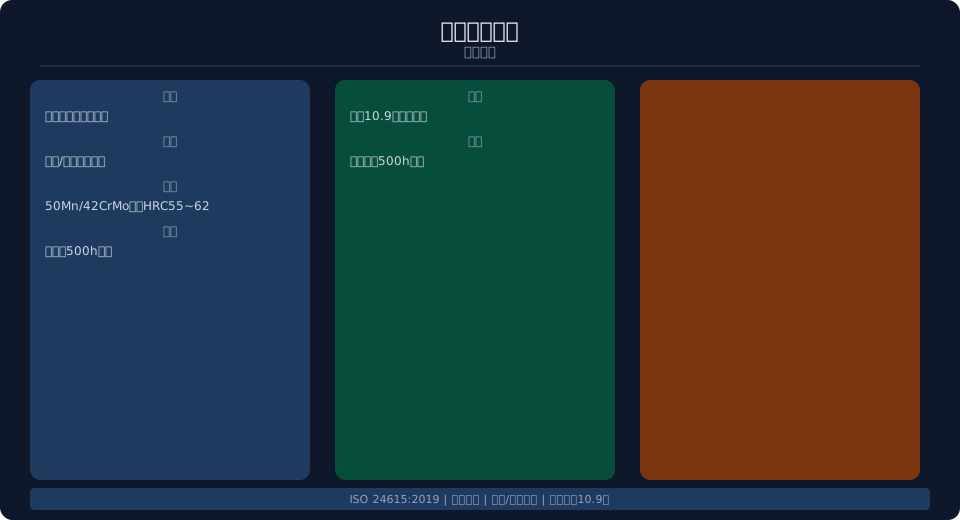

ISO 24615:2019 Crane Slewing Bearings Standard Interpretation
ISO 24615:2019 "Cranes — Slewing Bearings" is the international standard governing the selection, installation, and maintenance of slewing bearings for cranes. The standard specifies the classification, technical requirements, installation methods, maintenance practices, and discard criteria for slewing bearings — applicable to slewing bearings on all types of cranes with slewing mechanisms, including tower cranes, portal cranes, truck cranes, crawler cranes, and floating cranes.
Slewing Bearing Types and Configurations
ISO 24615:2019 classifies crane slewing bearings into three types: single-row ball slewing bearings — consisting of an inner ring, outer ring, and a set of steel balls that roll in arc-shaped raceways. These offer moderate load-bearing capacity (axial force + overturning moment) and are suitable for small to medium tower cranes and truck cranes with a load moment of ≤1000 kN·m. Cross-roller slewing bearings — comprising an inner ring, outer ring, and a set of cylindrical rollers arranged in a crossed pattern, with adjacent roller axes perpendicular to each other. These provide high load capacity (axial force + radial force + overturning moment), excellent rigidity, and precision — making them ideal for medium tower cranes and portal cranes with a load moment between 1000 and 5000 kN·m. Three-row roller slewing bearings — featuring three independent raceways: the upper row of rollers handles axial loads and overturning moments, the lower row handles reverse axial loads and overturning moments, and the middle row handles radial loads. These offer the highest load capacity and are used in large tower cranes, portal cranes, and ship-to-shore (STS) cranes with a load moment of ≥5000 kN·m. The fixing method for slewing bearings — the inner ring is bolted to the slewing platform (lower structure) while the outer ring is secured to the rotating platform (upper structure) using high-strength bolts. The standard specifies key dimensional parameters, including raceway diameters (ranging from Φ400 mm to Φ5000 mm across more than 20 sizes), roller/ball diameters and quantities, and the pitch circle diameter and number of mounting bolts. The gear ring on the slewing bearing — either machined on the outer circumference of the outer ring or the inner circumference of the inner ring — meshes with an external drive pinion to achieve slewing motion. The standard requires a tooth surface hardness of HRC 50–55 for the gear ring.
Materials and Heat Treatment
The standard sets the following requirements for slewing bearing materials and heat treatment: inner and outer rings — manufactured from 50Mn, 42CrMo, or 40CrNi2Mo alloy steel, quenched and tempered to HB 280–340. Raceway surfaces must undergo induction hardening or flame hardening with a hardened layer depth of ≥3 mm and a surface hardness of HRC 55–62. A transition zone between the hardened layer and the base material is required to prevent raceway spalling caused by abrupt hardness changes. Gear teeth — induction hardened to a depth of ≥2 mm with a tooth surface hardness of HRC 50–55. Rolling elements — steel balls made of GCr15 bearing steel (quenched and tempered to HRC 60–65) and cylindrical rollers made of GCr15SiMn bearing steel. Cages — stamped steel cages made of Q235B (≈S235JR) steel strip or nylon cages, the latter offering self-lubricating properties and light weight, suitable for low to medium slewing speeds. Quenching quality — tempering stability test: after holding at 150°C for 4 hours, the hardness drop must not exceed 1 HRC. Non-destructive testing — ultrasonic testing (UT) of inner and outer ring forgings is mandatory; no individual defect larger than Φ3 mm is permitted, and the total defect area per part must not exceed 10 mm². The standard emphasizes that raceway surfaces must be free of cracks — any crack, regardless of how fine, is unacceptable. Raceway cracks are the only non-repairable defect that mandates immediate scrapping of the slewing bearing.
Installation and Adjustment
The standard specifies the following installation and adjustment requirements: mounting surface — the flatness of the mounting base (the mating surfaces of the slewing platform and the rotating platform) must be ≤0.15 mm/m, measured with a spirit level in the diametral direction. Excessive deviation causes additional deformation of the slewing bearing after installation, leading to localized raceway overload and reduced service life. Mounting bolts — grade 10.9 or 12.9 high-strength bolts must be used, tightened to the torque values specified by the manufacturer (approximately 500 N·m for M24 bolts, 800 N·m for M30, and 1200 N·m for M36), in a diagonal sequence over 2–3 passes. Torque marking — after tightening, a reference line should be drawn between the bolt head and the mounting surface to facilitate visual inspection for loosening. Clearance adjustment — certain slewing bearing models are equipped with adjustment devices (eccentric sleeves or adjusting shims) to set the raceway clearance, primarily on cross-roller types. The clearance should be adjusted to "zero clearance" — the rollers show no visible play in the raceway while still rotating freely. Lubrication — after installation, the slewing bearing must be filled with grease using extreme-pressure lithium-based grease (NLGI 2), injected through the grease fittings. The fill volume should fill 80% of the raceway and gear ring cavity. Excess grease is expelled during rotation, while insufficient grease leads to inadequate lubrication. The standard recommends an initial fill volume of approximately 1.5 times the raceway cavity volume, with the excess being expelled during initial operation. After the first 50 hours of operation, the expelled grease should be cleaned off and the bearing re-greased to the normal level.
Inspection and Discard Criteria
The standard defines the following inspection and discard conditions: daily inspection (weekly) — visually inspect the seal rings for damage or extrusion (seal failure allows dust and moisture to enter the raceway, accelerating wear) and check that the reference marks on the connection bolts are aligned (misalignment indicates loosening and requires immediate re-tightening). Monthly inspection — measure the slewing resistance torque by pulling the boom with a dynamometer under no-load conditions and recording the starting torque. An increase of more than 50% over the initial value indicates abnormal raceway wear or rolling element damage. Also check the mesh clearance between the gear ring and the drive pinion — increased clearance causes impact loading and accelerated tooth wear. Quarterly inspection — measure the axial clearance of the slewing bearing using a feeler gauge or dial indicator. Apply a 100 kN axial force to the bearing end face under no-load conditions and measure the separation gap. An increase exceeding 0.5 mm over the original clearance warrants attention; an increase exceeding 1 mm requires replacement or overhaul. Annual inspection — magnetic particle inspection (MPI) of the raceway. Remove the drive pinion and seal rings, then perform MPI to detect fatigue spalling and cracks on the raceway surface. Any crack found requires immediate scrapping. A slewing bearing must be scrapped under the following conditions: cracks on the raceway surface (cracks of any depth are unacceptable), fatigue spalling covering more than 10% of the total raceway area, axial clearance increase exceeding 1 mm over the original clearance (when not adjustable), tooth flank wear exceeding 15% of the original tooth thickness or tooth breakage, or a significant increase in overall noise accompanied by impact and vibration (indicating advanced internal damage). Kelude heavy industry cranes are equipped with high-quality slewing bearings.
| Slewing Bearing Type | Applicable Models | Features | installation requirements |
|---|---|---|---|
| Single Row Ball Type | Small to Medium Capacity | High Load Capacity/Low Cost | bolt pretightening torque Precise |
| Three Row Roller Type | large tonnage | Maximum Load Capacity | Gear Surfaceregular lubrication |
| Cross Roller Type | Medium Capacity | Accuracy High/Excellent Rigidity | Preload Uniform |
| Double Row Ball Type | Small to Medium Capacity | Slewing Smooth | Mounting Surfaceflatness≤0.2mm |
| Parameter | Single Row Ball Type | Three Row Roller Type |
|---|---|---|
| Load Bearing Type | Axial+Radial | Axial+Radial+Overturning |
| applicable tonnage | ≤100t | ≥100t |
| Slewing Torque | ≤500kN·m | ≥500kN·m |
| Mounting Bolt | 10.9Grade M24 | 10.9Grade M30 |
FAQ: Slewing Bearing Selection, Bolts, Lubrication & Inspection
Q: What are the main slewing bearing types covered by ISO 24615?
A: Common configurations include single-row ball bearings (four-point contact, suited for small to medium cranes), double-row ball bearings (higher load capacity), and three-row roller bearings (designed for large-tonnage cranes capable of withstanding high overturning moments). Bearing selection is determined by lifting capacity, work duty classification, and slewing torque requirements.
Q: What are the installation bolt requirements for slewing bearings?
A: Installation bolts must be Grade 10.9 high-strength bolts. Pre-tightening torque must strictly follow the design values — approximately 800 N·m for M24 bolts and 1,200 N·m for M30 bolts. Apply thread-locking adhesive to all bolted connections. Re-check and re-torque the bolts every 500 hours of operation.
Q: What lubrication is required for slewing bearings?
A: Use lithium-based grease. Relubricate every 500 hours of operation, and completely flush and replace the grease every 2,000 hours. Clean the area around the grease fittings before lubricating. Keep gear teeth adequately lubricated during operation to ensure even tooth flank wear. The bearing should run smoothly with no abnormal noise or binding.
Q: What are the inspection and scrapping criteria for slewing bearings?
A: Check gear mesh clearance and running smoothness every 500 hours of operation. The bearing must be scrapped if any of the following conditions are found — spalling or indentation on raceways, tooth flank wear exceeding 20% of the original tooth thickness, fracture of rolling elements or the cage, or bolt fracture or loosening. Installation bolts must never be reused.