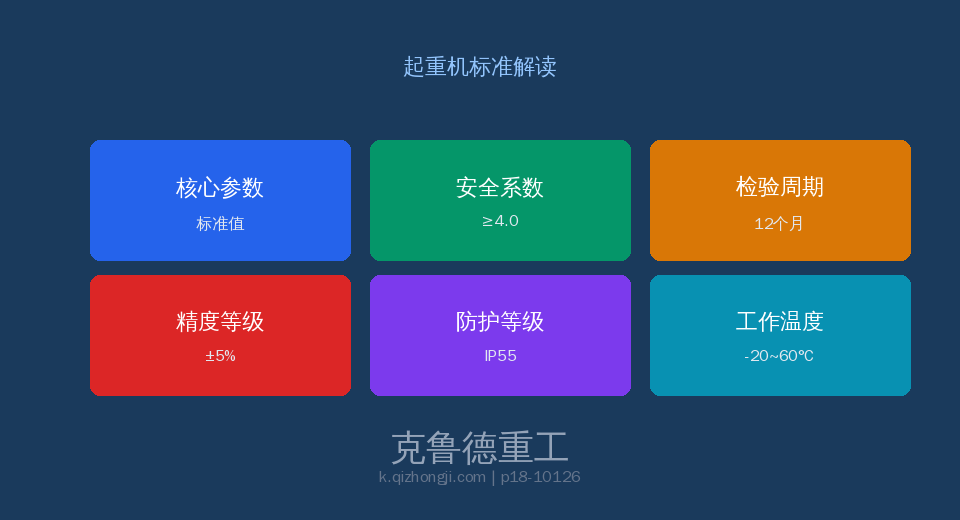

GOST 22584 Electric Hoist Technical Specification Explained
GOST 22584 "Electric Hoist Technical Specification" is a key technical standard in the crane industry. Developed by the Russian Federal Agency for Technical Regulation and Metrology, it defines the technical requirements for electric hoists.
The standard provides a unified technical basis for design personnel, inspection bodies, and end users. Kelude strictly adheres to its requirements throughout product development and manufacturing.
Scope and Application of the Standard
GOST 22584 "Electric Hoist Technical Specification" establishes the technical requirements and safety indicators for electric hoists used in lifting appliances with a rated lifting capacity above 0.5 t. The standard covers not only the design and manufacturing of new equipment but also provides clear technical guidance for the inspection, maintenance, and modification of units already in service. As a key component of the crane standard system, it aligns with the EN 13001 Crane Safety Standard series and ISO 4309 Wire Rope Inspection Standard to form a comprehensive technical framework. The clearly defined technical parameters and safety factor requirements give design personnel a solid design basis, while also providing quantifiable acceptance criteria for third-party inspection bodies conducting type tests and factory inspections.

Core Technical Parameters and Requirements
Under GOST 22584, the design and manufacturing of electric hoists must satisfy a stringent set of technical parameters. These values are derived from extensive test data and safety engineering principles, covering everything from material selection to structural design. The safety factor ranges specified in the standard account for fatigue life and limit load conditions under severe operating environments. In engineering practice, design personnel translate these standard requirements into concrete design parameters to ensure that the load capacity of every component meets the required safety requirements.
Comparative Analysis of Key Technical Parameters
| Item | technical requirements | Description |
|---|---|---|
| Lifting Capacity Scope | 0.5~32t(Standard Series) | 1t/2t/3t/5t/10t/16t/20t/32t |
| Lifting Height | 6~30m(Standard), Reach60m(Special) | Customized on Request |
| Safety factor | Rope≥5.0/Brake Per Unit≥1.5 | Double Brake Configuration |
| Protection Rating (IP) | Motor IP54, Control Cabinet IP54 | Outdoor IP55 |
| Insulation Class | FClass(temperature rise≤105K) | Optional HClass(temperature rise≤125K) |
| Duty Classification | S3~40%/or S4~40%+120Cycles/h | For Frequent Starting S4 |
Inspection Requirements and Intervals
GOST 22584 sets forth explicit inspection requirements for Electric Hoists, covering Factory Acceptance Test, Type Test, and periodic inspection. Factory Acceptance Test must be performed on every unit by the quality control department at the manufacturer's facility, and each approved unit must be accompanied by a detailed inspection report and a Certificate of Conformity. Type Test is required when a new product enters initial production, when manufacturing is transferred to another facility, or when significant structural changes are introduced. The periodic inspection interval for equipment in service is determined by its Work Duty / Classification and operating environment, generally not exceeding 12 months. For heavy-duty cranes operating continuously at A7~A8 level, the inspection interval should be shortened to 6 months as appropriate.
| Item | technical requirements | Description |
|---|---|---|
| Wire Rope | Diameter/wire break/Wear | Monthly+Shrinkage>7%or Breakage>10%Discard |
| Brake | Friction lining/Clearance/Torque | Monthly+Remaining<50%Replacement |
| Motor | insulation/temperature rise/Noise | Quarterly+FNormal Class |
| Load test | 1.25Timesstatic load/Dynamic1.1Times | Factory+Annual |
Safe Operation and Management Requirements
Safe operation and routine management play a critical role in the implementation of GOST 22584. The standard places strong emphasis on operator qualification and training, requiring that all operators complete specialized training and obtain the necessary certification before being allowed to operate the equipment. User units are required to establish a comprehensive equipment file management system that documents the full lifecycle of the equipment, including installation, usage, maintenance, and inspection. Any safety hazards identified must be addressed through the rectification procedure specified in the standard, ensuring that equipment remains in a safe and controllable condition at all times. Additionally, the standard imposes restrictive requirements on equipment usage under extreme operating conditions.
FAQ
Q: What are the safety factor requirements for electric hoists under GOST 22584?
A: Wire rope ≥5.0, brake ≥1.5 times per unit. With dual brake, either independent brake must provide 1.0 times.
Q: Duty classification and motor selection?
A: Standard duty S3 up to 40% — for frequent starting, select S4. Class F insulation with temperature rise ≤105K.
Q: Inspection intervals and scope?
A: Monthly — wire rope and brake inspection. Quarterly — motor inspection. Annual — load test.
Q: Special requirements for low-temperature environments?
A: At -40°C, use cold-resistant grease and cold-resistant cables. Impact energy ≥34J.
Kelude Heavy Industry — Specialized in crane design and manufacturing, with products strictly adhering to the GOST 22584 standard system.