
BS 7121-2 Crane Inspection, Testing & Examination Standard Explained
Standard Overview: BS 7121-2, the Code of Practice for Inspection, Testing and Examination of Cranes, is the dedicated standard within the BS 7121 series covering statutory crane examinations. It specifies the inspection items, examination intervals, and inspector competency requirements for cranes before first use, during periodic service, and after special operating conditions. This standard serves as the technical backbone for the UK's Lifting Operations and Lifting Equipment Regulations 1998 (LOLER).
From the moment a crane leaves the factory floor to its retirement after 30 years of service, it will undergo dozens of statutory examinations. BS 7121-2 categorizes these into three distinct types: thorough examination before first use, periodic thorough examination, and special examinations—each with clearly defined scope, depth, and acceptance criteria.
Pre-Service Thorough Examination
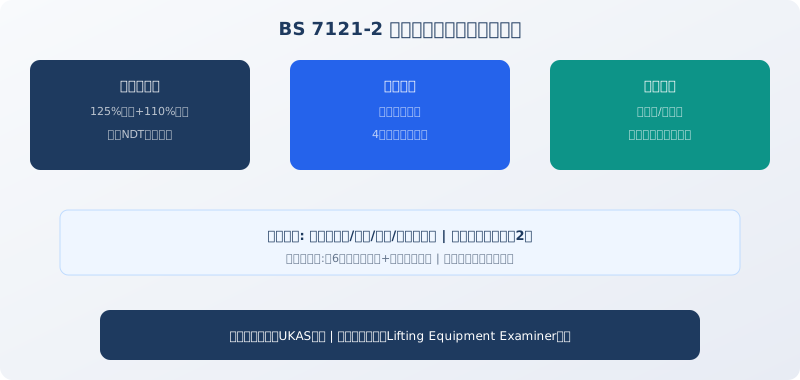
Newly installed cranes, or those relocated from another site, must undergo a comprehensive examination before being put into service. The scope includes: load testing—a static load test at 1.25 times the Safe Working Load (SWL) (held for 10 minutes, with permanent main girder deflection measured after unloading and not exceeding L/1000), followed by a dynamic load test at 1.1 times SWL (each mechanism operated three times). All critical weld seams on primary structures such as the main girder and outriggers require 100% NDT (UT or RT). Every safety device must be functionally verified—emergency stop, limit switches, overload limiter, and load moment limiter (LML) are each tested individually. The entire electrical system undergoes an Insulation Resistance Test using a 500V Megohmmeter (Insulation Tester), with insulation resistance required to be ≥1MΩ. Examinations must be carried out by an inspection body accredited by UKAS (United Kingdom Accreditation Service), and the inspectors must hold the relevant lifting equipment examiner qualifications.
Periodic Thorough Examination
BS 7121-2 defines a two-tier approach to periodic examinations. The thorough examination—conducted every 12 months—covers approximately 80% of the pre-service examination scope (omitting load tests and 100% NDT, but retaining safety device functional testing and a 20% sampling of critical weld seams). Wire rope inspection—carried out every 6 months—is performed by an authorized wire rope inspector in accordance with ISO 4309 Wire Rope Inspection Standard, using Visual Testing (VT) and magnetic rope testing (MRT) segment by segment, with particular attention to wire breaks and wear at the drum entry point and pulley bends. Every 4 years, a load test is added to the thorough examination to verify that the crane's structural load-bearing capacity has not significantly degraded over the operating period.
Inspection Reports & Record Keeping
A formal inspection report must be issued after every examination, containing at minimum: the date and location of the examination, the standard applied (BS 7121-2), the scope of examination and testing methods used, every defect found with its severity classification (graded as: rectify immediately / rectify within 30 days / rectify before next examination), and the examination conclusion (satisfactory / satisfactory with conditions / unsatisfactory). The report must be signed by the examiner, with a copy retained by the owner for 2 years after the equipment is decommissioned. Once rectification is complete, the same inspection body must re-examine the crane to confirm the defect has been resolved, and the rectification record is attached to the original inspection report for archival.
Frequently Asked Questions
Q: What is the relationship between LOLER and BS 7121?
A: LOLER 1998 (Lifting Operations and Lifting Equipment Regulations) is UK law—it carries mandatory legal force, and non-compliance can lead to criminal prosecution. BS 7121 is a technical standard—not law in itself, but it can be cited in court as "recognized good industry practice." Compliance with BS 7121 provides technical evidence of meeting LOLER's legal requirement to "take appropriate measures to ensure the safety of lifting equipment." In simple terms: LOLER states that periodic examination is mandatory, while BS 7121 defines how to examine, what to examine, and how often.
Q: What does a "thorough examination" involve, and how does it differ from a daily inspection?
A: A daily inspection is a quick visual check carried out by operators and maintenance staff on a daily or weekly basis—looking for obvious cracks, deformation, oil leaks, or abnormal noise. A thorough examination, by contrast, is a systematic and in-depth examination performed by an independently qualified examiner—this includes opening access covers to inspect internal gears and bearings, using instruments (UT/MT/vibration analysis) for quantitative detection, and functional verification such as load testing. Daily inspections cannot replace periodic thorough examinations—the depth of scrutiny and legal standing of the two are fundamentally different.
Q: If a defect is found during examination but does not affect safety, can the crane remain in service?
A: BS 7121-2 classifies defects into three categories. Class A (dangerous defects)—those that could cause an immediate accident, such as cracks in main girder weld seams, excessive wire breaks in the wire rope, or brake failure—require immediate shutdown and rectification; the crane must not be used until re-examination confirms the defect is resolved. Class B (major defects)—those that do not currently affect safety but are likely to deteriorate in the short term, such as localized corrosion reaching 15% of wall thickness or bearing abnormal noise with normal temperature—must be rectified within 30 days. Class C (minor defects)—those where the safety margin is adequate but the condition does not fully meet the standard's requirements, such as illegible nameplate markings or minor bolt corrosion—must be rectified before the next periodic examination. The inspection report must clearly state the classification and rectification deadline for each defect.
Q: What inspections are required for equipment manufactured in China and exported to the UK?
A: Cranes manufactured in China and exported to the UK must complete at least the following inspections: ① Factory testing at the manufacturing stage—static and dynamic load tests carried out in accordance with Chinese national standards (ISO 4301 Crane Design Standard and FEM 1.001) with bilingual (Chinese/English) test reports issued; ② UKCA (UK Conformity Assessed) conformity assessment—which replaces the CE mark as the mandatory market access requirement in the UK from 2025, and must be carried out by a UKAS-recognized body; ③ Pre-service thorough examination after installation—conducted by a UKAS-accredited lifting equipment inspection body in accordance with BS 7121-2, and the crane may not be legally put into service until a satisfactory report is issued. Kelude's export cranes undergo pre-inspection in China before shipment, and then coordinate with local inspection bodies for on-site examination upon arrival in the UK, saving time on site rectification.
Kelude Heavy Industry: Overhead & Gantry Crane Solutions
Kelude Heavy Industry specializes in the design, engineering, and manufacturing of heavy-duty overhead cranes, gantry cranes, and electric hoists. With a strong focus on safety, reliability, and performance, we deliver tailored material handling solutions for a wide range of industrial applications, including steel, shipbuilding, power generation, and general manufacturing.
Engineered for Performance and Safety
Our cranes are built to meet the most demanding operational requirements. We utilize high-grade steel and advanced manufacturing processes to ensure long-term durability and consistent performance. Each crane is rigorously tested to comply with international safety standards, including ISO 4301 for crane classification and IEC 60204-32 for electrical equipment, ensuring safe and efficient operation in diverse environments.
Customized Solutions for Every Application
We understand that every facility has unique material handling needs. Whether you require a low-headroom double-girder crane for a confined space, an explosion-proof hoist for hazardous areas, or a large-capacity gantry crane for heavy lifting, our engineering team works closely with you to design and manufacture a solution that precisely fits your operational workflow and load requirements.
Key Technical Features and Benefits
Our cranes incorporate advanced features designed to enhance productivity and safety:
- High-Performance Hoists: Equipped with self-locking motors and precision gearboxes for smooth, accurate load control.
- Advanced Control Systems: Variable frequency drives (VFD) provide precise speed control and reduce mechanical stress.
- Enhanced Safety Mechanisms: Features include overload protection, anti-sway technology, and emergency stop functions to ensure maximum operator safety.
- Durable Construction: Built with robust steel structures and corrosion-resistant coatings for extended service life.
Global Support and Service Network
We provide comprehensive after-sales support, including installation, commissioning, operator training, and preventive maintenance programs. Our global service network ensures rapid response times and minimal downtime, helping you maintain continuous, efficient operations.
Contact Kelude for Your Crane Requirements
Ready to enhance your material handling capabilities? Contact our team of experts today to discuss your project requirements and receive a customized quotation. We are committed to providing reliable, cost-effective crane solutions that drive your success.