
Lightweight Cranes & Electric Hoists for Solar Plant Expansions
Key Insights
Capacity expansion across photovoltaic modules, lithium batteries, and energy storage systems is emerging as one of the most stable growth drivers for the crane industry. From 2025 to 2026, PV cell and module production is shifting toward next-generation TOPCon/HJT technologies, while lithium battery capacity is scaling past 300 GWh—directly fueling demand for light-duty cranes in clean workshops, electric hoists, and intelligent material handling systems. Unlike wind power, which drives demand for large-tonnage crawler cranes, the PV and storage supply chain primarily benefits small-to-medium-tonnage bridge cranes, European electric hoists, and KBK light rail systems—a high-volume market with moderate entry barriers that represents a sweet spot for small and mid-sized crane manufacturers.
Unlike the wind power sector, which concentrates demand on thousand-ton crawler cranes, the PV and storage industries require cranes that are broad in application, moderate in tonnage, and suited to clean, dust-controlled environments. This article breaks down the crane configuration requirements for each stage of PV and lithium battery manufacturing.
PV Plants: Hoisting Needs from Silicon Wafers to Modules
The PV supply chain spans four stages—polysilicon, wafers, cells, and modules—and each stage demands cranes and hoisting equipment tailored to its specific specifications:
| Process Stage | Hoisting Requirement | Recommended Model | Quantity per Line |
|---|---|---|---|
| Wafer Slicing Workshop | Ingot Loading(200~500kg/pcs), Wire Replacement for Slicer, Grinding/Polishing Loading Cutting | 3t~5t European Electric Hoist + KBKLight Duty Crane Rail | 8~12unit Electric Hoist + 200~400mCrane Rail |
| Solar Cell Workshop | Cassette/Quartz Boat Handling, PECVDEquipment Maintenance Hoisting, Chemical Tank Replacement | 2t~5t Cleanroom Crane (Dustproof+Anti-Static) | 6~10unit/Production Line |
| Component Encapsulation Workshop | laminating machine Ingot Loading, Glass Cover plate Hoisting, Finished Product Component Palletizing and Framing | 3t~5t European Standard (EN)Single Girder Crane + Vacuum Lifter | 3~5unitcrane/Wire Replacement for Slicer |
| Finished Product Warehouse | Component Pallet In/Out of Warehouse(1.5~2.5t/pallet), Container Truck Loading | 5t~10t Bridge Crane / Overhead Crane + Electric Flat Car | 2~4unitcrane |
A typical 10GW PV module plant requires a total crane configuration investment of approximately RMB 3–6 million (about $450,000–$890,000). Based on the estimated 200–300GW of new PV cell and module production capacity slated to come online nationwide in 2025–2026, the PV sector alone represents an incremental market of roughly RMB 600 million to 1.8 billion (about $89–267 million) for the crane industry. This figure excludes demand from auxiliary material plants producing PV glass, encapsulant film, backsheets, and frames.
Battery Plants: Cleanliness and Explosion Protection Are the Key Barriers
Lithium battery manufacturing imposes stringent cleanliness and explosion-proof requirements on production line environments. Taking mainstream LFP and NMC battery chemistries as examples:
① Slurry Mixing & Coating Workshop — The lifting and replacement of anode/cathode slurry drums (1–2t per drum) requires explosion-proof electric hoists with an explosion protection class of Ex d IIB T4 or higher. The NMP solvent recovery area demands even stricter compliance. A single 2GWh production line is typically equipped with 4–6 explosion-proof electric hoists.
② Calendering, Slitting & Winding Workshop — Handling electrode rolls (300–800kg per roll) for loading and unloading requires KBK light crane systems paired with precision electric hoists to ensure smooth, damage-free transport that protects electrode edges. Cleanliness must meet ISO Class 7–8, and cranes must use enclosed chains and stainless steel lifting spreaders.
③ Electrolyte Filling & Formation Workshop — This area supports electrolyte injection equipment maintenance and formation cabinet loading/unloading. Classified as Explosion-proof Zone 2, cranes here must carry explosion-proof certification and be fitted with static discharge devices.
④ Module & PACK Assembly Line — Battery modules (50–200kg each) are handled and inserted into cases using aluminum-rail KBK systems with intelligent lifting devices. Unlike PV plants, the cleanliness and explosion-proof demands of battery facilities effectively rule out low-end electric hoists. European Standard (EN) electric hoists, with their fully enclosed design and IP55+ protection rating, have become the mainstream choice.
Energy Storage System Integration: A New Growth Driver for Large-Tonnage Cranes
Energy storage system integration plants represent a significantly heavier-duty application than cell or PV module facilities — containerized ESS units (20ft/40ft standard containers) can weigh 30–45t in total, pushing crane capacity requirements directly into the 30t–50t range:
Container ESS Assembly Line — Processes such as battery rack insertion, PCS installation, and liquid cooling pipe connection require 2–4 double-girder bridge cranes rated at 30t–50t. These cranes typically need twin trolley synchronized lifting to handle off-center loads on long container frames — a clear growth opportunity for medium and large crane manufacturers.
ESS Container Storage Yard — Stacking and truck loading of finished ESS containers requires 40t–50t gantry cranes. With domestic new energy storage installations projected to exceed 40GW/100GWh in 2026 — equivalent to roughly 20,000–30,000 containerized systems (based on 5MWh per unit) — yard crane demand is estimated at 300–500 units.
Market Outlook: The Combined Crane Opportunity in PV, Storage, and Battery
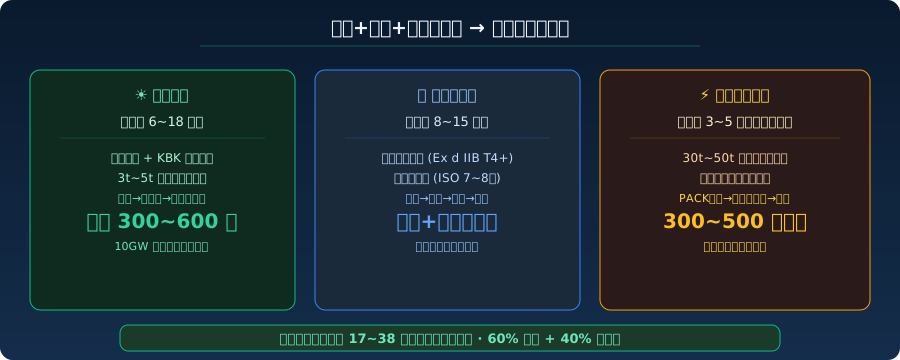
| Segment | Primarycrane Type | Annual Incremental Market(Estimate) | Growth Trend |
|---|---|---|---|
| Photovoltaic Manufacturing | Electric Hoist+Single Girder Crane+KBK | 6~18100 million CNY | Stable Growth Rate |
| Lithium Battery Manufacturing | Explosion-proof electric hoist+Cleanroom Crane+KBK | 8~15100 million CNY | High Growth Rate |
| energy storage system Integration | 30t~50tDouble Girder+Gantry Crane | 3~5100 million CNY | Rapid Growth Phase |
| Total | — | Approx.17~38100 million CNY/Year | — |
Note: Market estimates are based on publicly announced capacity expansion plans for 2025–2026, covering crane main structures, crane rails, lifting spreaders, and installation services.
Key takeaway: The PV + energy storage + lithium battery supply chain generates approximately RMB 1.7–3.8 billion in incremental crane market demand annually, with roughly 60% attributed to electric hoists and light-duty cranes (single girder, up to 20t) and 40% to medium- and large-capacity double girder and gantry cranes. This market complements the wind power sector perfectly — wind energy drives demand for large-tonnage cranes, while PV and storage boost the mid- and small-tonnage segment.
FAQ: Crane Requirements for PV, Battery & Storage Plants
Q: What special requirements do PV factories have for cranes?
A: Cell production workshops require cleanroom-grade dustproof operation — cranes must not generate dust or oil drips. Fully enclosed chain electric hoists with stainless steel lifting spreaders are recommended. Module assembly lines need vacuum lifters for handling glass cover plates. Wafer cutting workshops demand extremely smooth hoisting to minimize breakage rates.
Q: What certifications are required for explosion-proof cranes in lithium battery plants?
A: Electric hoists must hold an Explosion Proof Certificate (Ex d IIB T4 and above), and the complete crane must pass explosion-proof CCC certification. Electrolyte filling and formation workshops are classified as Explosion-proof Zone 2 — all electrical components (motors, control boxes, travel switches) must be explosion-proof and fitted with static-conductive copper straps.
Q: Why is a twin trolley configuration needed for energy storage container hoisting?
A: A 40ft energy storage container is approximately 12m long. Lifting with a single trolley creates off-center loading and tipping risks. Twin trolleys with electrical synchronization control provide four-point balanced lifting — this is the standard configuration. Some projects also require independent trolley traverse to accommodate varying container lifting point spacing.
Q: Will this market be dominated by large crane manufacturers?
A: No. Cranes used in PV and lithium battery plants are predominantly light-duty units under 10t — precisely the sweet spot for small and mid-sized manufacturers. The competitive barrier lies not in tonnage capacity but in quality: dustproof cleanroom design, explosion-proof certification, and low failure rates are what win orders. Manufacturers with European Standard (EN) production capabilities hold a clear advantage.
Related Reading: Wind Power & Industry Data
Wind Power Installation Demand — Wind crane market overview
Industry Semi-Annual Report — Full industry data
Data sources: CPIA (China Photovoltaic Industry Association) | GGII (Gaogong Industry Institute) | EESA (Energy Storage Alliance) | Compiled by Kelude Heavy Industry Market Department