
Brake Lining Wear Limit & Replacement Interval
Brake linings are critical friction components that ensure the safe operation of lifting appliances. In practical maintenance, many operators misunderstand the wear limits of these linings—a common issue identified by Kelude Heavy Industry’s technical service team during on-site surveys. When lining thickness wears down to 50% of its original dimension (e.g., from 20mm to 10mm), the friction coefficient drops significantly. Statistics show that over 15% of crane failures involve load slipping due to excessive lining wear. Establishing a rational replacement interval can typically keep unplanned downtime under 3,000 hours. This article details the basis for setting wear limits and replacement criteria across different operating conditions.
Before discussing specific standards, it is essential to clarify the foundational requirements of national standards. According to FEM 1.001 Crane Design Specification and TSG 51-2023 Safety Technical Supervision Regulation, the braking torque must meet safety margin requirements. The condition of the brake lining directly determines the reliability of this torque and the overall operational safety of the equipment.
Starting from the physical wear mechanism of brake linings, this article analyzes the quantization of wear limits. It then breaks down differentiated replacement intervals for diverse environments such as metallurgical and port operations, providing practical guides for selection cost control and fault diagnosis to help you establish a robust preventive maintenance system.
Defining Wear Limits & Engineering Measurement Methods
The wear limit of a brake lining is not a vague empirical value but a strict physical boundary derived from tribology principles and equipment dynamics calculations. As lining thickness decreases, heat dissipation capacity drops, causing surface temperature to rise and leading to thermal fade in the friction coefficient. At the critical point, the brake cannot provide sufficient braking torque, directly threatening production safety.
To intuitively understand the impact of wear on braking performance, consider this engineering case study. Assume a Crane Travel Mechanism with an initial braking speed of v=60m/min (1m/s) and a design deceleration of a=0.5m/s². Based on kinematic formulas, the theoretical braking distance is s=v²/(2a)=1²/(2×0.5)=1m. If lining wear reduces the friction coefficient by 20%, the actual deceleration drops to 0.4m/s², extending the braking distance to s=1²/(2×0.4)=1.25m. This extra 0.25m of travel in a densely arranged workshopHigh risk of equipment collision (highly likely to cause collision accidents).
"According to relevant design specifications, when the wear amount of the brake wheel lining reaches 50% of its original thickness, it must be replaced. For the Hoisting mechanism, this value directly affects the reliability of suspended loads; exceeding this limit is strictly prohibited."
During actual measurement, maintenance personnel must master correct measurement methods. Lining wear is often uneven, with significant differences in wear amount between the center and edge areas. Therefore, judging the overall state based on a single data point is insufficient.
⚠️ Note
When measuring remaining lining thickness, use a vernier caliper to measure the edge of the rivet hole or severely worn areas. Do not estimate remaining thickness via visual inspection of the surface condition. For grooved linings, measure the remaining thickness at the bottom of the groove.
Differentiated Replacement Criteria by Operating Condition
The replacement interval for brake linings cannot follow a one-size-fits-fixed schedule; it must be dynamically adjusted based on the specific application scenarios of the crane. Environmental factors such as ambient temperature, humidity, dust concentration, and operating frequency decisively influence the wear rate.
In standard workshop environments, ambient temperature typically remains between 20°C and 30°C with low dust levels and a low Cyclic Duration Factor (CDF) for the brake. Under these ideal conditions, the recommended replacement interval for conventional resin-based brake linings is approximately 3,000 hours. However, in metallurgical casting workshops, ambient temperatures often exceed 150°C with substantial metal dust.
"Industry measured data shows that in metallurgical workshops with ambient temperatures above 150°C, thermal fade in resin-based linings intensifies. Their effective service life shortens by approximately 60% compared to normal temperature environments, requiring the replacement interval to be strictly compressed to within 800 hours."
Beyond temperature, operation mode is a key variable determining replacement cycles. For Grab Cranes or portal cranes handling Containers that require frequent Inching operation, the brake undergoes high-frequency engagement and disengagement. Rapid heat accumulation causes the lining wear rate to increase exponentially.
💡 Tip
For cranes with frequent Inching operation, where the Duty Factor (ED) exceeds 40%, it is recommended to shorten the conventional replacement interval by 30%. Increase the frequency of infrared temperature measurement inspections to ensure the Brake wheel surface temperature does not exceed 120°C.
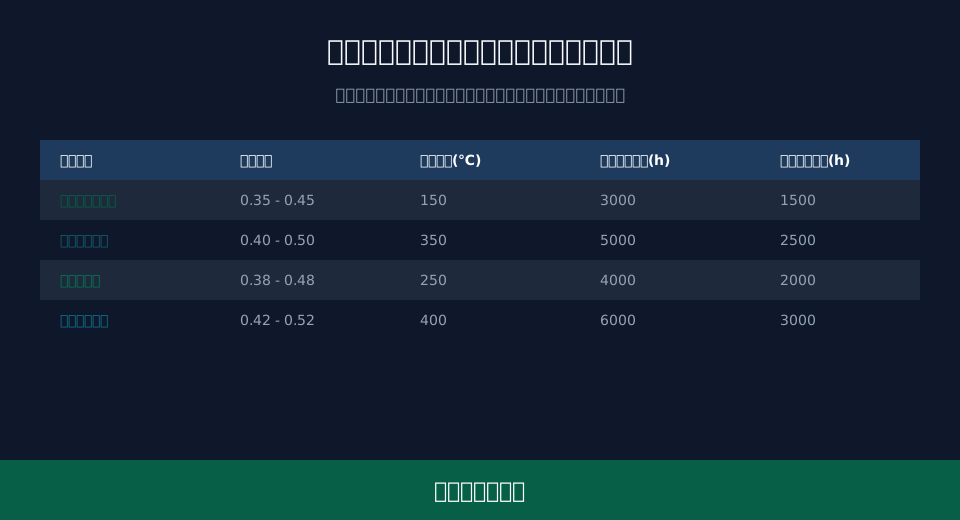
The following table provides a detailed comparison of the physical properties and Application Scenarios for three mainstream brake lining materials, offering data support for subsequent selection.
📊 Comparison of Physical Properties and Operating Condition Compatibility for Mainstream Brake Lining Materials
| Material Type | Ambient Temperaturefriction coefficient | Temperature ResistanceLimit(℃) | applicable working conditions |
|---|---|---|---|
| resin-based composite material | 0.35 - 0.45 | 150 | StandardWorkshop、warehousingLogistics |
| powder metallurgy material | 0.40 - 0.50 | 350 | metallurgicalCasting、High-Temperature Environment |
| semi-metallic material | 0.38 - 0.48 | 250 | Port Terminal、OutdoorHeavy load |
Based on the material properties outlined above, the following table quantifies the recommended Replacement Interval for various Brake Lining types across different operating environments, serving as a reference for developing your maintenance plan.
Recommended Brake Lining Replacement Intervals by Operating Environment
| operating conditionType | Resin-Based Cycle(h) | PowdermetallurgicalCycle(h) | Semi-Metallic Cycle(h) |
|---|---|---|---|
| StandardLight loadWorkshop | 3000 | 5000 | 4000 |
| PortHeavy loadDock | 1500 | 2500 | 2000 |
| metallurgicalHigh TemperatureCasting | 800 | 1800 | 1200 |
Optimizing Brake Lining Selection: Cost Control and Material Matching
When selecting brake linings, balancing cost control with material compatibility is critical. Many enterprises focus solely on the initial purchase price, overlooking the life cycle cost (LCC). This short-sighted approach often leads to frequent downtime for replacements under heavy-load or severe working conditions, ultimately costing far more than the initial savings.
While traditional resin-based linings have a lower upfront procurement cost, they wear out quickly in high-temperature service or heavy-load scenarios. In contrast, powder metallurgy linings, though approximately 30% more expensive initially, offer superior heat resistance. Under equivalent extreme operating conditions, their service life can increase by over 40%, significantly reducing long-term expenses.
In a major retrofit project for a Container Gantry Crane at a large port, upgrading the Hoisting mechanism linings to powder metallurgy increased the single-unit procurement cost by about 30%. However, when factoring in labor costs for replacement and downtime cost, the overall life cycle cost was reduced by 22%.
Kelude Heavy Industry has extensive experience in customizing solutions for heavy-tonnage applications. We recommend conducting detailed operating condition surveys and economic calculations before upgrading materials. Selection should consider not only the friction coefficient but also the hardness match between the lining and the Brake wheel surface to prevent abnormal wear caused by improper contact.
⚠️ Note
Do not blindly pursue linings with excessively high friction coefficients. Excessive friction can increase braking impact and accelerate wear on the Brake wheel wheel flange. Specific parameter matching must be subject to the actual contract and verified through rigorous dynamic calculations.
Routine Inspection Key Points and Fault Diagnosis for Abnormal Wear
Establishing a robust inspection system is fundamental to extending the service life of brake linings and ensuring safe operation. Inspections should go beyond checking remaining thickness to evaluate the overall operating status of the braking system, including brake clearance, spring tension, and the response time of the hydraulic push rod.
Measuring brake clearance is particularly critical during routine inspection. The standard setting is typically around 2mm. If the clearance is too large, it causes latency in braking and increases the empty stroke distance; if too small, it may cause dragging, leading to abnormal heating and wear of the lining. Additionally, inspect for uneven wear. If the wear amount exceeds 1.5mm, the root cause must be identified immediately.
Inspection records indicate that when ring grooves deeper than 1.5mm appear on the Brake wheel surface, the actual contact area of the lining decreases by 40%. This drastically increases local pressure, accelerating abnormal consumption of the lining.
When abnormal wear is detected, fault diagnosis should expand from the brake itself to the entire travel mechanism. The stability of the Crane Travel Mechanism or Trolley Travel Mechanism directly affects the stress state of the brakes.
💡 Tip
When troubleshooting brake uneven wear faults, in addition to inspecting the brake unit itself, you should also assess the anti-collision safety distance settings and the operating status of the AI anti-sway algorithm. This comprehensive evaluation helps determine the braking stability of the Crane Travel Mechanism and rule out external interference factors.
Risk Assessment of Lining Failure and Preventive Maintenance Systems for Heavy-Duty Cranes
For large-tonnage cranes with high Work Duty classifications, the risk of brake lining failure increases geometrically. Heavy-duty equipment generates immense kinetic energy during braking, subjecting linings to extremely high specific pressure. Once failure occurs, the consequences can be catastrophic. Therefore, a preventive maintenance system based on condition monitoring is essential.
Consider a heavy-duty Ladle Crane with a Lifting Capacity of 100t and a Lowering speed of 20m/min. During full load lowering braking, the instantaneous specific pressure on the Hoisting mechanism brakes is several times higher than that of a standard 10t crane. Under such extreme operating conditions, traditional periodic replacement strategies are insufficient to meet safety requirements; real-time monitoring methods must be introduced.
For heavy-duty cranes with a capacity exceeding 100t and a lowering speed of 20m/min, the specific pressure on brake linings is 2.5 times that of standard cranes. A preventive maintenance system based on condition monitoring must be established to shift from reactive repairs to proactive prevention.
The core of a preventive maintenance system lies in data acquisition and analysis. By installing thickness sensors and Temperature Sensors inside the brake, operators can monitor lining wear and thermal loads in real-time. When data reaches the warning threshold, the system automatically triggers a work order.
⚠️ Note
Preventive maintenance for heavy-duty equipment should not rely solely on time intervals. It is recommended to introduce thickness sensors for real-time monitoring of the wear amount. When the wear amount reaches the warning threshold, the system should automatically trigger main beam weld crack detection and interlock protection for the braking system to prevent structural impact damage caused by brake failure.
Managing the wear limit and replacement interval of brake linings is a systematic engineering challenge that requires balancing operating conditions, material properties, and maintenance costs. As an industry specialist, Kelude Heavy Industry provides full-process service—from condition analysis and material selection to customized heavy-load braking system solutions—ensuring your lifting equipment operates safely and efficiently.
Frequently Asked Questions
Q: At what remaining thickness must brake linings be replaced?
A: According to industry specifications, brake linings must be replaced when their remaining thickness wears down to 50% of the original design thickness. For example, a lining with an original thickness of 20mm reaches its limit at 10mm. For critical safety components like hoisting mechanisms, we recommend setting the replacement threshold earlier at 60% remaining thickness to maintain a sufficient safety margin.
Q: Is there a significant price difference between powder metallurgy linings and standard resin linings?
A: The purchase price of powder metallurgy linings is typically about 30% higher than that of standard resin linings. However, due to their high-temperature resistant performance and resistance to thermal fade, their service life can increase by over 40% in high-temperature service environments such as metallurgical applications. When factoring in downtime cost and labor for replacement, they offer a more competitive life cycle cost. Specific Quotation is subject to the actual contract.
Q: How long does it take to replace a set of brake linings?
A: Downtime depends on the crane capacity and Brake structure. For standard single girder cranes, replacing one set of linings takes approximately 2 to 3 hours. For large tonnage Double Girder cranes with multiple braking systems, which involve removing Brake wheels and performing adjustment, it typically requires 4 to 6 hours. We recommend scheduling this during planned maintenance periods.
Q: If slight grooves are found on the Brake wheel surface, must the linings be replaced immediately?
A: If the groove depth is less than 0.5mm, it can often be eliminated by running in new linings. However, if the groove depth exceeds 1.5mm or severe stepped wear occurs, the Brake wheel must be turned or replaced. In such cases, new linings must be installed simultaneously; mixing old and new parts is strictly prohibited.
