

QD Series Double-Girder Bridge Cranes: Specifications, Prices, and Selection Guide for Various Tonnage Models
The QD-type double-girder bridge crane is one of the most common types of heavy-duty lifting equipment used in industrial plants and warehousing and logistics settings. It features a double-girder box-type structure combined with an independent hoist trolley, with lifting capacities ranging from 5 metric tons to 320 metric tons and spans of up to 35 meters. Compared to single-girder cranes, the QD type offers significant advantages in load-bearing capacity, operational stability, and duty class, making it suitable for heavy-duty material handling applications in industries such as metallurgy, machinery manufacturing, hydroelectric power plants, ports, and warehousing. This article systematically organizes selection information for the QD-type double-girder bridge crane across five dimensions—product structure, technical specifications, price references, applicable scenarios, special equipment management, and key selection criteria—to help procurement personnel make more accurate decisions when faced with varying tonnage requirements.
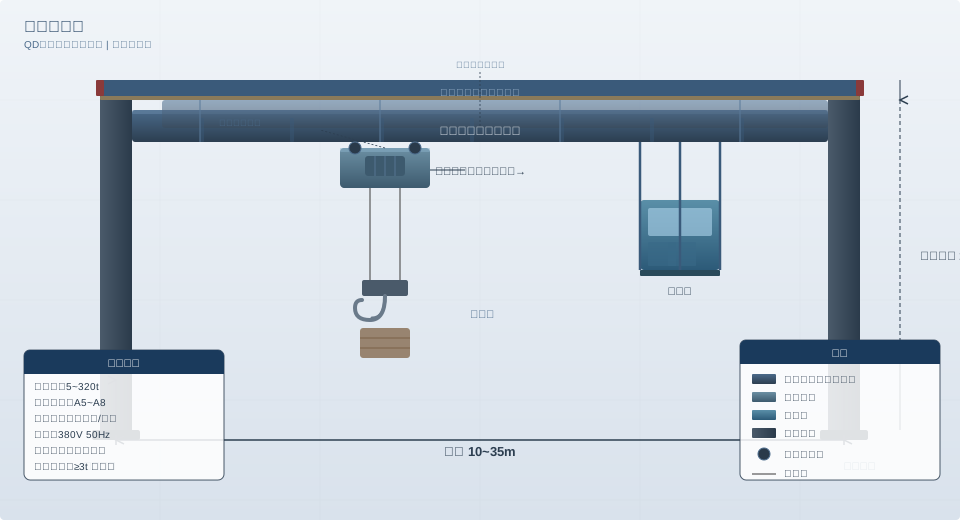
Figure: Schematic diagram of the QD-type double-girder bridge crane (double main girders + hoist trolley + operator's cab)
Introduction to the QD Product Line
The QD-type double-girder overhead traveling crane belongs to the heavy-duty series of general-purpose overhead traveling cranes. It consists of five major components: the bridge (double main girders + end beams), the hoist trolley, the main travel mechanism, the trolley travel mechanism, and the electrical control system.
Unlike the LD-type single-girder crane, which uses an electric hoist as its hoisting mechanism, the QD-type employs an independent winch trolley—the hoisting mechanism, trolley travel mechanism, and drum are integrated into a single trolley that moves laterally along the main girder track. This design gives the QD-type crane a higher lifting capacity and a longer service life. The main girder features a box-section or truss structure (box-section is commonly used for high-capacity models) and is fabricated from welded steel plates, providing high flexural stiffness and strong load-bearing capacity.
The operator's cab is typically mounted beneath one end of the main beam; the operator can control the machine manually or remotely using a remote control. The QD model can be equipped with either the operator's cab or the remote control—or both—to accommodate different operating styles under various working conditions.
Technical Specifications and Price Guide for QD Series in Various Tons
The standard load capacity range for QD-type double-girder overhead cranes is 5 t, 10 t, 16 t, 20 t, 32 t, 50 t, 75 t, 100 t, 150 t, 200 t, and 320 t. The following lists the key specifications and market reference prices for commonly used load capacities. Actual prices are subject to factors such as span, lifting height, duty class, and non-standard configurations; specific prices are subject to the manufacturer’s quotation.
| Model | Lifting Capacity (t) | Span (m) | Lifting Height (m) | Job Level | Price Guide (10,000 yuan) |
|---|---|---|---|---|---|
| QD5 | 5 | 10~28 | 12~20 | A5–A6 | 10~18 |
| QD10 | 10 | 10~31 | 12~24 | A5–A6 | 15~25 |
| QD20 | 20 | 10~31 | 12~24 | A5–A7 | 20~35 |
| QD32 | 32 | 13~31 | 12~24 | A5–A7 | 30~50 |
| QD50 | 50 | 13~35 | 16~30 | A6–A8 | 50~80 |
Note: The prices listed above represent the market reference range for 2025–2026. Starting prices for the 5-metric-ton class are approximately 100,000 yuan, while those for the 50-metric-ton class start at approximately 500,000 yuan. Prices for large-capacity QD-type cranes of 100 metric tons or more typically range from 800,000 to 1,500,000 yuan. Models of 200 metric tons or more must be custom-built based on factory conditions, with prices assessed separately. Krude Heavy Industry offers custom manufacturing services to optimize structures for specific spans, lifting heights, or duty cycles.
Key Technical Features of the QD Model
The core technical features that distinguish the QD-type double-girder overhead crane from light and small-scale lifting equipment are concentrated in three areas:
Double-girder structures have a high load-bearing capacity.The double-girder box-type structure gives the crane a larger section modulus for bending resistance for the same span, enabling a lifting capacity of up to 320 metric tons. Reinforcing plates are installed inside the main girders to prevent local buckling, making the crane suitable for frequent starting and stopping and heavy-load operating conditions.
Variable-frequency speed control and smooth lifting.The hoisting mechanism uses variable-frequency speed control (VVVF), allowing for stepless adjustment of the main hook’s hoisting speed within the range of 1–10 m/min. The bridge travel speed is 20–90 m/min, and the trolley travel speed is 10–45 m/min. Variable-frequency speed control reduces inrush current during startup, minimizes load sway, and extends the service life of mechanical and electrical components.
PLC control system.Most QD-type cranes are equipped with programmable logic controllers (PLCs) to enable safety and automation functions such as hoist overload protection, travel limit switches, emergency braking, and multi-actuator interlocking. When used in conjunction with variable frequency drives, parameters such as brake delay and anti-drift hook can also be configured to enhance operational safety.
Applicable Scenarios and Selection Recommendations
The QD-type double-girder overhead crane is suitable for the following typical applications:
- Metallurgy Shop:The lifting and handling of high-temperature, heavy-load materials such as steel billets, steel coils, and ingots requires a duty class of A7–A8; it is recommended to install thermal insulation and high-temperature-resistant cables.
- Machinery Manufacturing Plant:For the transport of molds, large machined parts, and assembled components, the span requirements are relatively standard (16–28 m), with work classes A5–A6 available.
- Hydroelectric Power Plants/Pumping Stations:The installation and maintenance of large equipment such as water turbines and generators typically involve lifting capacities of 50 to 200 metric tons and require a high degree of precision during slow positioning.
- Warehousing and Logistics Center:For the loading and unloading of heavy steel, large pipe fittings, and containerized cargo, we recommend using remote-controlled operations to improve operational efficiency.
- Shipbuilding/Ports:The hoisting of hull sections and main engines has specific requirements regarding span and lifting height, so custom-made equipment is often used.
Key Considerations for Selection:First, determine the weight of the heaviest load to be lifted and allow a safety margin of 10% to 20%; second, measure the factory span (center-to-center distance between columns) and determine the crane span after subtracting the safety margin; Then, select the duty class based on the frequency of operation—A5 for 2–4 hours per day, A6–A7 for 4–8 hours per day, and A8 for continuous heavy-duty 24-hour operation. The lifting height must account for the sum of the lifting tackle height, the height of the load, and the safety clearance.
Management and Inspection Cycles for Special Equipment
In accordance with the *Law on the Safety of Special Equipment* and TSG 51-2023, *Technical Regulations for the Safety of Lifting Machinery*, bridge cranes with a lifting capacity of 3 metric tons or more are subject to regulation as special equipment. The entire QD series (5 metric tons and above) must be registered for use and undergo periodic inspections.
Inspection Frequency Requirements:
- Once a year: Bridge cranes in use must undergo an annual inspection.
- Every two years: Cranes that have been out of service for more than one year, or that have been reactivated, modified, or overhauled, or that have been involved in an accident, must pass an inspection before being put back into service.
- Monthly Self-Examination: The operating unit must conduct monthly inspections of safety devices, brakes, wire ropes, hooks, and other components, and keep records of these inspections.
Upon delivery of the QD-type double-girder overhead crane, Krude Heavy Industry provides a type test certificate, a supervisory inspection report, and an operation and maintenance manual along with the equipment. Users must obtain a usage registration certificate from the local special equipment safety supervision and administration department before putting the equipment into service.
Data at a Glance
5–320 metric tons
Lifting Capacity Range
10–35 m
Span Range
Starting at 100,000 yuan
Starting Price
≥3 t
Thresholds for Special Equipment
A5–A8
Job Level
Indoor/Outdoor
Applicable Scenarios
The QD-type double-girder bridge crane product line, provided by Krude Heavy Industry, offers a full range of solutions from 5 metric tons to 320 metric tons, supporting both quick delivery of standard models and custom designs. For accurate quotes based on load capacity and model selection recommendations, please refer toEncyclopedia of Bridge Crane TechnologyLearn about the technical principles and structural details, or browseThe Complete Guide to Customizing Non-Standard CranesObtain the evaluation process for non-standard solutions. For selecting electrical control system options, please refer toDesign of the Electrical Control System for an Overhead CraneUnderstand the configuration schemes for variable frequency drives, PLCs, and safety circuits.
Frequently Asked Questions
Q: What is the difference between QD-type and LH-type electric hoist double-girder overhead cranes?
Answer: The QD type uses an independent winch trolley, with a hoisting mechanism consisting of a motor, a gearbox, and a drum assembly. It offers higher structural strength and a longer service life, with a maximum lifting capacity of 320 metric tons and a duty class of up to A8. The LH type uses an electric hoist as its hoisting mechanism, resulting in a relatively lightweight structure. Its lifting capacity typically does not exceed 32 metric tons, and its duty class is generally A3 to A5. For applications involving more than 4 hours of daily operation or lifting capacities exceeding 20 metric tons, the QD type is recommended as the preferred choice.
Q: Does the QD-type double-girder overhead crane require a foundation or embedded anchors?
Answer: Yes. The main girder track of a QD-type crane is installed on the factory crane beam, which is typically connected to the factory columns via embedded anchors or corbels. For new factory buildings, embedded anchors for track installation should be provided during the civil engineering phase. For retrofit projects, an assessment must be conducted to determine whether the load-bearing capacity of the existing crane beam meets the wheel load requirements of the new crane. It is recommended that the manufacturer provide wheel load data during the selection phase so that the design firm can perform the necessary calculations.
Q: Does the remote-controlled QD model still require a control room?
A: It depends on the operating conditions. In a purely remote-controlled configuration, the operator cab can be omitted, reducing equipment costs by approximately 20,000 to 40,000 yuan; this is suitable for scenarios with unobstructed visibility and clear operating paths. However, for applications such as metallurgy and hydroelectric power plants—where precise positioning is required or visibility is obstructed while moving a load—retaining the operator cab is safer and more efficient. Krud Heavy Industry supports a dual-mode configuration combining remote control and the operator’s cab, allowing operators to switch between modes flexibly.
Q: What is the typical service life of a QD-type crane?
Answer: Under normal operating conditions and with regular maintenance, the design service life of a QD-type double-girder overhead crane is typically 20 to 30 years. Key influencing factors include: whether the actual duty cycle matches the design specifications; whether daily lubrication and wire rope inspections are properly carried out; and whether aging electrical components are replaced in a timely manner. Once the design service life is reached, a safety assessment must be conducted to determine whether the crane should continue in service, be downgraded for use, or be decommissioned.
