
ISO 9374-2:1991 Mobile Crane Information Requirements Explained

ISO 9374-2:1991, "Cranes — Information to be provided — Part 2: Mobile cranes," defines the scope of technical information that mobile crane manufacturers must supply to users. The standard covers nameplate data, technical specifications, operation manuals, and spare parts information.


Nameplate Data Requirements

ISO 9374-2:1991 requires the mobile crane nameplate to include the manufacturer's name and address, model and serial number, year of manufacture, the rated lifting capacity chart (showing capacities at various working radii for at least two operating conditions: fully extended outriggers and retracted outriggers), maximum load moment, crane dead weight and counterweight weight, work duty classification, and the applicable design standard designation. The nameplate shall be made of stainless steel or aluminum alloy (anti-corrosion and rust-resistant), fixed in a prominent position on the left or right side of the chassis (easily visible from outside the cab), with a minimum letter height of 5 mm.

The standard also requires an operating conditions placard inside the operator cab, showing the rated lifting capacity tables for each outrigger extension combination and for each boom length and pulley ratio combination. In addition, the center of gravity position mark and the rated lifting capacity of the lifting lugs must be indicated on the slewing platform or counterweight. Nameplate data must match the actual parameters of the equipment. If the crane is retrofitted after leaving the factory (e.g., engine replacement or auxiliary boom installation), the corresponding nameplate data must be updated.


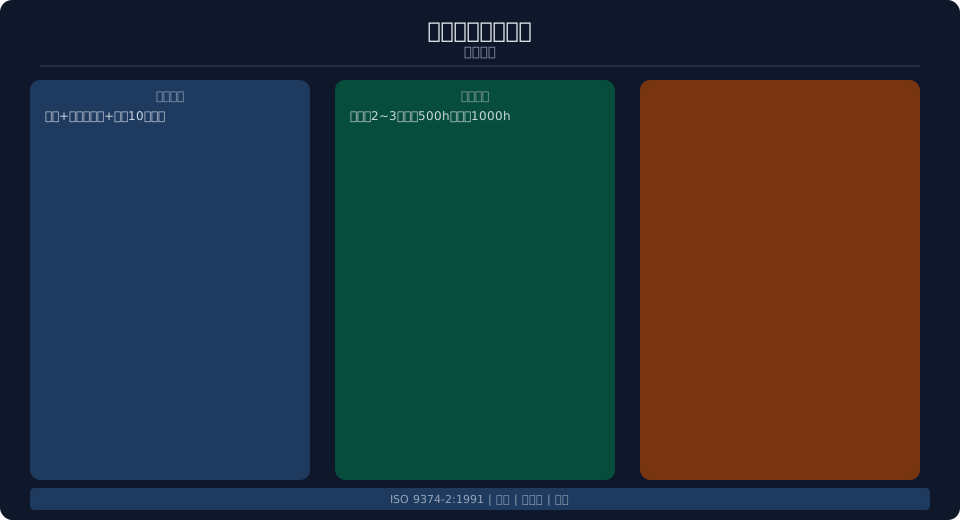
Standard interpretation diagram


Technical Specifications Documentation

The standard requires the technical specifications document to include machine dimensions (overall dimensions, wheelbase, wheel track, outrigger span, and minimum ground clearance), weight data (total dead weight, front/rear axle loads, counterweight weight, and shipping weight of individual components), engine specifications (model, power, and emission standard), hydraulic system parameters (hydraulic pump model and swept volume, system working pressure, and hydraulic oil tank capacity), and electrical system parameters (generator power and battery capacity).

Lifting performance parameters include the load capacity chart showing rated lifting capacities at various boom lengths and working radii (covering fully extended and retracted outrigger conditions, as well as traveling and partially extended outrigger conditions), the lifting height curves (showing the relationship between maximum lifting height and working radius for each boom length), and the working speed table (lifting speed, luffing time, slewing speed, travel speed, and boom telescoping time). Parameter tables must be presented in clearly readable table and curve chart formats, with a copy permanently posted at the cab operating position for easy reference by the operator.

Nameplate Material
Stainless Steel / Aluminum Alloy
Parameter Categories
8 Major Categories
Load Charts
≥2 Operating Conditions
Height Curves
For Each Boom Length
Manual
Bilingual Chinese-English
Spare Parts Coverage
≥10 Years
Information Category Content Delivery Format Application Location
Nameplate Model/Parameter/Serial No. Stainless Steel Nameplate Frame Outer Side
Load Chart Eachoperating conditions Lifting Capacity Laminated Paper Operator Cabin Inner
Height Curve Boom Length/load-radius curve Laminated Paper Operator Cabin Inner
technical specifications Dimensions/Weight/Parameter Manual+Electronic technical documentation
Operation Manual Operation/Safety/maintenance A4Binding Operator Cabin+Archive

Operation and Maintenance Manual

The manufacturer must supply a complete operation and maintenance manual. The Operation Manual section should cover safe operating practices, including pre-operation inspection, safety regulations, and prohibited actions; control device descriptions with illustrated functions of each joystick and button; step-by-step operating procedures for driving, lifting operations, outrigger setup, and emergency operation; instructions for using the Load Chart to determine the Rated Lifting Capacity based on boom length and working radius; and emergency handling procedures for situations such as engine failure, hydraulic system pressure loss, and boom overload.

The Maintenance Manual section should include a daily inspection and lubrication schedule covering daily, weekly, monthly, and annual inspection items and acceptance criteria; a lubrication diagram identifying all lubrication points, recommended lubricant types, and service intervals; hydraulic and electrical system schematics; and a Wear Parts List specifying wire rope dimensions, filter element part numbers, brake lining sizes, and other consumable components. Every Kelude mobile crane ships from the factory with a complete documentation package: a Stainless Steel nameplate, Load Chart and curve diagrams inside the Operator Cabin, a bilingual Chinese-English operation and maintenance manual (A4 bound), a Spare Parts List, and after-sales contact information.


Spare Parts and After-Sales Service

The standard requires the manufacturer to provide a Spare Parts List covering at least 10 years of equipment operation. Critical spare parts—such as wire rope, filter elements, friction linings, seals, and sensors—must be identified with original part numbers and ordering information. The manufacturer must also provide national or regional service network details, including service hotlines, maintenance center locations, and spare parts warehouse addresses, with a commitment to supply critical spare parts within 48 hours. Kelude Heavy Industry's nationwide service network for mobile cranes delivers rapid technical support and reliable spare parts supply.

Spare parts Type Recommended Replacement Interval stock rate Supply Time
Wire Rope 2~3Year 100% 24h
Hydraulicfilter element 500h 100% 24h
brake friction lining 1000h ≥80% 48h
Seal 2000h ≥80% 48h
Sensor On Demand ≥80% 48h

Frequently Asked Questions

Q: What does ISO 9374-2:1991 require for mobile crane nameplates?

A: The nameplate must include the manufacturer, model and serial number, year of manufacture, rated lifting capacity chart, maximum load moment, dead weight, and counterweight weight. It must be made of Stainless Steel or aluminum alloy and fixed to the outer side of the chassis. Letter height on the nameplate must be ≥5mm. An operating conditions placard must also be displayed inside the Operator Cabin.

Q: What information should the technical specifications cover?

A: The specifications should cover overall machine parameters (dimensions, wheelbase, Wheel Base), weight parameters, engine parameters, hydraulic system parameters, and electrical parameters. The Load chart must include Load Capacity Charts for both fully extended and retracted Outrigger operating conditions, along with height curves. One copy of all parameter documents is kept in the Operator Cabin and another in the archives.

Q: What are the main sections of the Operation Manual?

A: The manual covers safe operation instructions, control device descriptions, operating procedures, instructions for using the Load chart, and emergency handling procedures. It is compiled in accordance with ISO 9928-1. Kelude's Operation Manual is a bilingual Chinese-English edition, spiral-bound, and includes a quick reference table and a QR code linking to an electronic version.

Q: What is the Spare parts supply commitment?

A: The manufacturer must provide a Spare Parts List covering at least 10 years of demand, with Critical spare parts available for supply within 48 hours. Kelude's nationwide service network offers rapid technical support, and Critical spare parts are kept in sufficient inventory.

Related News

contact

contact us

phone:
+86 13903802779

mail:3915269@qq.com

Working hours: Monday to Friday

Wechat
Wechat
SHARE
TOP