

Crane Selection Plan for Steel Production Lines—Four Processes: Ironmaking, Steelmaking, Continuous Casting, and Rolling
In a nutshell:Krud Heavy Industry provides crane configuration solutions for steel smelting enterprises covering the four major processes of ironmaking, steelmaking, continuous casting, and steel rolling. These solutions are available for lifting capacities ranging from 10 to 320 metric tons and spans from 16 to 42 meters, with total investment in crane equipment for an entire plant ranging from approximately 10 to 20 million yuan. The ironmaking area is equipped with foundry cranes (50–100 metric tons) for handling molten iron and maintaining the tapping yard. the steelmaking area utilizes metallurgical cranes (75–320 metric tons) to handle converter charging and molten steel pouring, while the continuous casting area is equipped with specialized lifting equipment (16–50 metric tons) to facilitate the replacement of tundishes and molds, while the rolling mill area uses heavy-duty bridge cranes (20–50 metric tons) to support rolling mill assembly and roller table maintenance, meeting the extremely high safety standards required for handling molten metal at high temperatures in the steelmaking process.
🔥 Crane Selection Plan for Steel Smelting Production Lines
✅ Ironmaking Process | ✅ Steelmaking Process | ✅ Continuous Casting Process | ✅ Steel Rolling Process
In steel production—from ironmaking, steelmaking, and continuous casting to steel rolling—each process has entirely different requirements for crane lifting capacity, duty class, heat resistance rating, and specialized lifting attachments. Krud Heavy Equipment holds specialized design and manufacturing certifications for metallurgical cranes and can provide steel enterprises with comprehensive crane solutions covering the entire production process, from the blast furnace tapping area to the finished steel rolling mill warehouse.
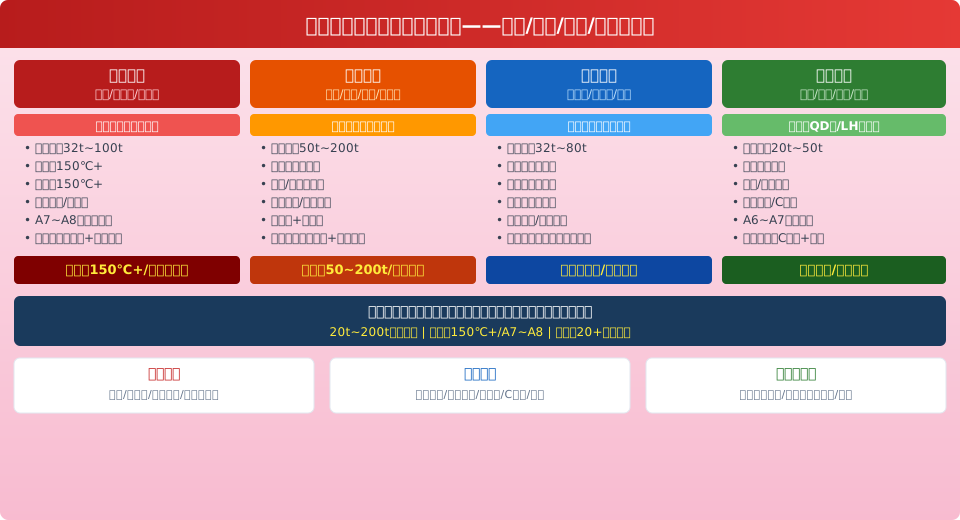
Scenario 1: Ironmaking Process
• Lifting capacity: 32 t to 100 t; bridge cranes specifically designed for the metallurgical industry
• Heat-resistant up to 150°C+ / Heat-insulating design
• Hydraulic grab/magnetic lift
• A7–A8 heavy-duty duty cycle
• Tapping Yard/Blast Furnace Maintenance
• Krude configuration with thermal insulation + forced cooling system
High-temperature resistance: 150°C+ | Heavy-duty A7–A8 | Hydraulic grab/magnetic disk
Scenario 2: Steelmaking Process
• Lifting capacity: 50 t to 200 t; bridge cranes specifically designed for the metallurgical industry
• Scrap steel feeding / Molten iron handling
• Ladle/Intermediate Tank Transfer
• Variable-frequency speed control / Smooth control
• Dual Braking + Fall Arrest
• Krud-configured ladle scale + electronic anti-sway system
Heavy-duty 50–200 metric tons | Ladle Transfer | Dual-Brake Anti-Fall System
Scenario 3: Continuous Casting Process
• Lifting capacity: 32 t to 80 t; specialized cast-iron overhead crane
• Specifically designed for replacing fan-shaped segments
• Preheating and hoisting of the intermediate tank
• Lifting and Hoisting for Mold Maintenance
• Precise Positioning/Slow-Speed Control
• Krud configuration with anti-sway precision positioning
Sector Replacement | Precise Positioning | Slow-Speed Control
Scenario 4: Steel Rolling Process
• Lifting capacity: 20 t to 50 t, QD/LH-type overhead cranes
• Lifting for Roller Replacement
• Handling of Steel Coils/Steel Sheets
• Electromagnetic Chuck/C-Hook
• Job Levels A6–A7
• Krud Configuration: C-Hook + Disc Lifting Device
Roll Replacement | Coil Handling | C-Hooks/Magnetic Discs
Comparison of Selection Parameters for the Four Zones
| Parameter Items | Ironmaking | Steelmaking | Continuous Casting | Steel Rolling |
|---|---|---|---|---|
| Recommended Models | Specialized Bridge Cranes for the Metallurgical Industry | Specialized Bridge Cranes for the Metallurgical Industry | Special-Purpose Casting Gantry Crane | QD/LH-Type Bridge |
| Lifting Capacity | 32 metric tons to 100 metric tons | 50 metric tons to 200 metric tons | 32 metric tons to 80 metric tons | 20 metric tons to 50 metric tons |
| Job Level | A7–A8 | A7–A8 | A6–A7 | A6–A7 |
| Temperature Resistance Requirements | 150°C+ | 100°C+ | 80°C+ | 60°C+ |
| Special Lifting Devices | Hydraulic Grab/Magnetic Disk | Ladle Scale / Electronic Anti-Sway System | Sector-Shaped Lifting Device | C-Hook / Electromagnetic Chuck |
| The Krud Plan | Thermal Insulation + Forced Cooling | Ladle Scale + Anti-Sway System | Anti-sway positioning | Custom C-Hook + Disc |
Ironmaking Process—Crane Selection for High-Temperature, Heavy-Load Environments
Temperatures at the blast furnace tapping area can exceed 150°C, and molten iron splashes and high-temperature radiation pose severe challenges to the crane’s structure and electrical systems. Metallurgical-grade overhead cranes must be equipped with H-class insulated heat-resistant motors (temperature resistance up to 180°C), heat-insulating protective panels plus forced-air cooling fans, and heat-resistant cables (silicone rubber insulation with a temperature resistance of up to 200°C). The duty class must be A7–A8 (heavy-duty/extra-heavy-duty), with lifting capacities ranging from 32 t to 100 t, and equipped with hydraulic grabs or electromagnetic discs for handling slag and molten iron at the furnace head. Krude Heavy Industry’s thermal insulation and forced cooling solution ensures that the internal temperature of the electrical enclosure is maintained below 55°C.
For the blast furnace iron-tapping area, 50/10-metric-ton or 75/20-metric-ton foundry cranes (YB/T 7013 standard) are recommended; the main hook is used for replacing molten iron ladle tilting seats (15–30 metric tons) and slag guns (8–12 metric tons). Given the high temperatures (80–120°C) and heavy dust at the blast furnace head, a fully enclosed, air-conditioned operator’s cab, water-cooled electrical control cabinets, and high-temperature-resistant steel wire ropes are required. Since maintenance of the slag and iron troughs requires the crane to lift and transport refractory materials, it is recommended that the entire area above the tapping yard be fully covered. This crane also covers the replacement of hot blast stove heat exchangers (15–40 t) and the replacement of vibrating screens for ore and coke hoppers (3–8 t).
Steelmaking and Continuous Casting Processes—Ladle Transfer and Segment Replacement
The core lifting tasks in the steelmaking process are the handling of ladles and molten steel, as well as the charging of scrap steel, with lifting capacities ranging from 50 metric tons to 200 metric tons. Variable-frequency speed control is used to ensure smooth starts and stops. The ladle weighing system provided by Krude Heavy Industry displays the molten steel weight in real time, while the electronic anti-sway system reduces the amplitude of sway during lifting by more than 70%. Replacing the sector segments in the continuous casting process is a critical task in routine maintenance. It requires specialized 32- to 80-metric-ton casting overhead cranes, working in conjunction with sector-specific lifting attachments, to ensure precise alignment and installation.
The core lifting equipment for converter steelmaking consists of charging cranes (75–150 t) and casting cranes (100–320 t), which feature a triple safety protection system comprising dual brakes, redundant hoisting mechanisms, and anti-fall safety hooks. The safety factor is no less than 5, and the duty class is A7–A8. Continuous casting intermediate ladles (15–40 t) and molds (5–15 t) are replaced every 4–8 runs; 32/5 t or 50/10 t metallurgical-grade overhead cranes (with variable-frequency micro-speed control at 0.5 m/min) are recommended to ensure rapid and safe replacement of intermediate ladles. Crane coverage is also required for maintenance of sector sections (straightening machines, 20–40 t).
Steel Rolling Process—Roll Replacement and Coil Handling
Cranes in the steel rolling area must meet two key requirements: frequent roll replacement and efficient handling of steel coils and steel plates. The QD-type 20- to 50-metric-ton overhead cranes are equipped with specialized C-hooks for lifting steel coils and electromagnetic lifting pads (magnetic discs) for loading and unloading steel plates. The A6–A7 duty classes meet the requirements for continuous, high-frequency operations. Krude Heavy Industry can customize C-hooks and magnetic disk systems based on coil specifications (outer diameter, width, and weight) to ensure that coil handling does not damage the coil surface.
In the steel rolling mill, for the replacement of finishing mill stands (30–80 t), support rolls (15–30 t) and work rolls (3–10 t) in the steel rolling mill’s finishing mill stands. We recommend 50/10 t or 100/20 t heavy-duty overhead cranes (A7), equipped with variable-frequency speed control (gantry speed: 5–50 m/min, trolley 3–25 m/min) and anti-sway functionality. Krude Heavy Industry’s rolling mill cranes are equipped with C-hooks and U-shaped lifting attachments specifically designed for rolling mill rolls, allowing for the replacement of a single support roll in just 30–45 minutes. For coil storage yards (coils weighing 10–30 metric tons), we recommend bridge cranes equipped with electromagnetic discs or C-hook lifting devices, along with an automatic coil identification and inventory management system.
Krude Heavy Industries—Advantages of Our Steel Smelting Crane Services
Krude Heavy Industry has been deeply involved in the steel and metallurgy lifting sector for many years and holds a Class A manufacturing license for metallurgical cranes. Its product range covers a full series of metallurgical-specific cranes, including foundry cranes, charging cranes, clamp cranes, and slab cranes, among others. Our products comply with the YB/T metallurgical crane standards and the TSG Q7012 inspection regulations, and we have served more than 30 domestic steel enterprises to date.
