
KS B 6240 Safety Requirements for Bridge and Gantry Cranes Explained
Standard Overview: This standard specifies general technical requirements for the safe operation of cranes, covering core safety elements such as safety device configuration, operator qualification, daily inspection, and periodic inspection. It is a key component of the crane safety regulatory system in the applicable country/region.
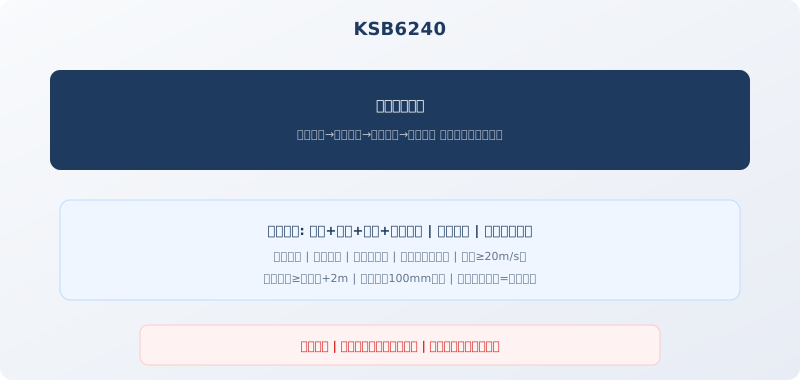
At its core, crane safety management relies on redundant protection—any single safety measure can fail, and only layered safety defenses can reduce accident probability to an acceptable level. This standard is built around a three-tier protection framework: safety devices, operating regulations, and inspection systems.
Safety Device Requirements for Cranes
The standard mandates that cranes be equipped with at least the following: a lifting capacity limiter (alarm and hoisting cutoff at ≥100% overload), a load moment limiter (for boom-type cranes), a hoisting height limit switch (with redundant deceleration and limit switches), a lowering limit switch (to prevent wire rope re-spooling), and an emergency stop device (red mushroom-head, ≥40mm, self-locking with twist-to-release, at least one per operating station). If any safety device fails, the crane must be taken out of service immediately for repair—operation with a faulty safety device is prohibited.
Safe Operating Regulations and Protocols
Operators must complete specialized training and pass qualification assessments. Before each shift, a pre-shift inspection is required—functional testing of every safety device, visual inspection of the wire rope, hook opening check, and verification that the crane rail is clear of obstructions. During operation, the "Ten No-Lift Rules" apply: no lifting overloads, no lifting with unclear signals, no lifting improperly secured loads, no lifting with personnel on the load, no lifting with malfunctioning safety devices, no lifting buried loads, no lifting with angled pulls, no lifting sharp-edged loads without padding, no lifting in insufficient lighting, and no lifting in winds of Force 6 or above.
Three-Tier Inspection System
The standard defines a three-tier inspection regime: Daily—the operator performs visual and functional checks and records findings in the operation log. Monthly—maintenance personnel verify fastener torque, perform insulation testing, and calibrate limit switches, with results documented in the maintenance record. Annual—a certified inspector conducts a 125% static load test, a 110% dynamic load test, NDT sampling of critical weld seams, and a full functional verification of all safety devices, issuing a formal inspection report.
| Period | Performed By | Content | Record |
|---|---|---|---|
| Daily | Operator | Appearance/Function/Abnormal noise | operation log |
| Monthly | Maintenance Worker | Torque/insulation/Limit Switch | maintenance record |
| Annually | Inspection Personnel | load test+NDT | inspection report |
FAQ
Q: Can a crane still be used if the overload limiter has a large deviation?
A: No. The trip error must stay within ±5%. Calibrate by loading test weights or a tension load cell sequentially at 50% / 75% / 100% / 110% of rated load and plot the response curve. For a quick daily check: the empty hook should read ≈0, then verify with a test block of known weight at the 50% load point — a deviation of ≤±5% is acceptable.
Q: Can a crane keep running with a fault?
A: If any safety device fails, the crane is considered faulty and must be taken out of service immediately. Non-safety items (a burned-out light, a cracked window, peeling paint) can be scheduled for repair. Judgment criteria: stop immediately if personal safety is at risk; continue operation and schedule a repair if performance is affected but safety is not compromised; defer cosmetic fixes. The operator has the authority to stop the crane — if the worst-case outcome of a wrong call could be injury or death, stop.
Q: Which matters more — inspections or records?
A: Both matter, but they serve different purposes. Inspection is the means — thorough inspections are what produce reliable records. Records are the legal evidence — an inspection without a record is legally the same as no inspection at all. A proper record should include: the problem found, a severity rating, the corrective action taken (immediate / scheduled / monitored), and verification of that action. If records repeatedly show "no abnormalities" while the equipment clearly has issues, the inspection process is just a formality.
Q: How do safety standards apply to non-standard cranes?
A: Use the risk analysis method per ISO 12100. The designer must identify all foreseeable hazards (mechanical, electrical, thermal, noise, radiation, materials, ergonomics), assess the risk level (severity × probability), and implement measures to reduce risk to an acceptable level. The entire process must be documented — this documentation is the core technical file that enables a non-standard crane to pass a statutory safety review.