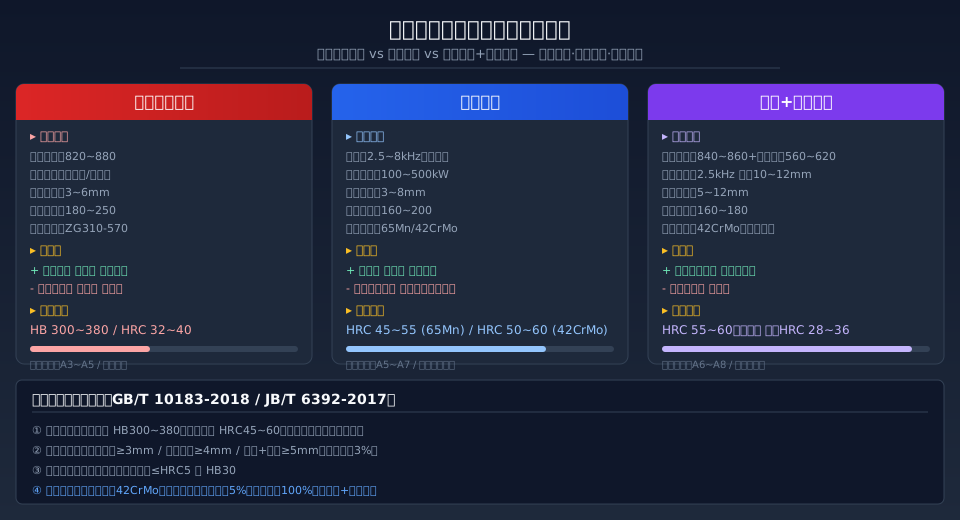

Crane Wheel Tread Hardening Process and Acceptance Standard
⚙️ Heat treatment is the single most critical factor determining crane wheel service life. Flame surface hardening, induction hardening, and quenching-and-tempering plus induction hardening each serve different application scenarios and hardness targets. Flame hardening offers low cost and suits ZG310-570 wheels in small-to-medium cranes; induction hardening delivers uniform hardness with minimal distortion, ideal for 65Mn and 42CrMo wheels in medium-to-large cranes; the Q&T plus induction route provides the best overall mechanical properties and is the preferred choice for large-tonnage, heavy-duty equipment. This article compares the process parameters, hardness ranges, and acceptance standards of all three methods.
After heat treatment, the tread surface and wheel flange of a crane wheel develop a high-hardness wear-resistant layer while the core retains good toughness — enabling the wheel to resist wear and absorb impact loads under heavy-duty operation. Kelude has refined three proven heat treatment process routes through years of production practice, configured flexibly according to equipment tonnage, work duty, and customer budget.
Flame Surface Hardening: Process and Parameters
Flame surface hardening is the earliest heat treatment process applied to crane wheels. An oxy-acetylene flame (approximately 3,100°C) rapidly heats the wheel tread to above Ac3 (820–880°C), followed immediately by water quenching to complete the martensitic transformation.
Process control points: Heating rate is held at 100–150°C/s, the flame nozzle-to-tread gap is 8–12 mm, and the hardening machine rotation speed is 30–60 r/min. Cooling water pressure is 0.3–0.5 MPa at 15–30°C, with spray delay not exceeding 2 seconds. Tempering is carried out either by self-tempering or in a low-temperature furnace at 180–250°C for 2–3 hours.
Advantages and limitations: The main strengths of flame hardening are low equipment investment and operational flexibility, making it well suited to small-to-medium batch production of wheels in various sizes. However, process quality depends heavily on operator skill, and temperature control is less precise than induction heating — which can lead to uneven tread hardness, localized overheating, or inconsistent hardened layer depth. Flame hardening also produces greater distortion (0.5–1.5 mm), requiring larger finish-machining allowances.
The microstructure after flame hardening consists of fine acicular martensite with a small amount of retained austenite, achieving a surface hardness of HB300–380. Per JB/T 6392-2017, the hardened layer depth of flame-hardened wheels must be no less than 3 mm. Kelude applies this process extensively to crane wheels rated below A5 and up to 32 t capacity, with years of field data confirming a normal service life of 5–8 years.
Induction Hardening: Precision and Repeatability
Induction hardening is now the mainstream heat treatment process for crane wheels. It uses electromagnetic induction to generate eddy currents that heat the wheel tread surface. Medium-frequency induction heating (2.5–8 kHz) provides adequate penetration depth, high heating efficiency, and excellent temperature uniformity.
Process parameters: The inductor-to-tread gap is 2–4 mm, power density is 1.5–3.0 kW/cm², and heating time is 8–20 seconds depending on wheel diameter. The quenchant is a 10%–15% PAG polymer solution or water-based quenchant. After heating, the wheel continues rotating while quench spray is applied for 10–15 seconds.
Key advantages of induction hardening: First, rapid heating (4–10°C/s) refines the grain structure for better material properties. Second, the hardened layer is uniform and precisely controllable — depth is regulated by adjusting frequency and power. Third, distortion is minimal (0.2–0.5 mm), allowing finish-machining allowances to be kept within 1 mm. Fourth, the process is highly repeatable, making it ideal for mass production.
Induction-hardened 65Mn wheel treads achieve HRC45–55, while 42CrMo reaches HRC50–60. Hardened layer depth per JB/T 6392-2017 is a minimum of 4 mm. Kelude supplies 42CrMo induction-hardened wheels as standard for overhead cranes from 32 t to 100 t and for equipment rated at A6 or above, with an annual output exceeding 5,000 units.
Quenching and Tempering Plus Induction Hardening
For heavy overhead cranes above 100 t or equipment operating at A7 or higher with frequent duty cycles, induction hardening alone cannot simultaneously deliver the required core toughness and tread wear resistance. The combined Q&T plus induction hardening route first applies quenching and high-temperature tempering to develop sound core mechanical properties, then induction hardening to create a high-hardness wear-resistant layer on the tread.
Quenching and tempering: Forged 42CrMo wheels are oil-quenched at 840–860°C, then high-temperature tempered at 560–620°C to produce a tempered sorbite structure. Core hardness is controlled at HB260–320, tensile strength at 950–1050 MPa, elongation ≥12%, and impact energy Akv ≥63 J at -20°C.
Secondary induction hardening: After Q&T and finish machining, the tread and flange undergo medium-frequency induction hardening (2.5 kHz). Hardened layer depth is controlled at 5% of wheel diameter, with a minimum of 5 mm. Tread hardness reaches HRC55–60 and flange hardness HRC48–55. A soft zone design (8–12 mm wide) is applied at the flange root transition area to prevent stress concentration and cracking in service.
42CrMo wheels produced by Kelude using this process have been in service on 320 t foundry cranes at major steel plants (including Shougang and Baowu) for over 12 years with zero tread spalling or failure incidents recorded.
Heat Treatment Process Comparison: Key Parameters at a Glance
Kelude Heavy Industry: Overhead & Gantry Crane Solutions
Kelude Heavy Industry specializes in the design, engineering, and manufacturing of overhead cranes, gantry cranes, and electric hoists for demanding industrial applications. With decades of experience and a commitment to quality, we deliver reliable material handling equipment tailored to your operational needs.
Overhead Cranes Built for Performance and Safety
Our overhead crane range covers single-girder and double-girder configurations, offering lifting capacities from 1 ton to 100 tons. Designed in accordance with ISO 4301 and ISO 12480 standards, these cranes ensure safe, efficient operation in workshops, warehouses, and production lines. Key features include:
- Low-headroom designs for space-constrained facilities
- Explosion-proof options for hazardous environments
- Anti-sway control systems for precise load positioning
- Self-locking mechanisms for enhanced operational safety
Gantry Cranes for Versatile Material Handling
Kelude gantry cranes are engineered for outdoor and heavy-duty applications, with capacities up to 300 tons. Available in full-gantry, semi-gantry, and portable configurations, they are ideal for shipyards, steel yards, and precast concrete plants. Our gantry cranes feature:
- Double-girder and single-girder options
- Variable frequency drives for smooth acceleration and deceleration
- Remote control operation for operator convenience
- Corrosion-resistant finishes for longevity in harsh conditions
Electric Hoists: Compact Power and Reliability
Our electric wire rope hoists and chain hoists deliver dependable lifting performance in a compact footprint. With capacities ranging from 0.5 tons to 50 tons, these hoists are suitable for standalone use or integration into overhead crane systems. Features include:
- Non-shrink, high-strength gearboxes for quiet operation
- Multi-pole motors with thermal protection
- Adjustable limit switches for precise travel control
- Low-maintenance design for reduced downtime
Customized Solutions and After-Sales Support
We understand that every facility has unique requirements. Our engineering team works closely with you to design custom crane solutions, including special spans, lifting heights, and control systems. We also provide comprehensive after-sales support, including installation, commissioning, training, and spare parts availability.
Frequently Asked Questions
Q: What is the typical lead time for a standard overhead crane?
A: Lead times vary depending on configuration and capacity, but standard models typically ship within 30-45 days. Custom-engineered solutions may require 8-12 weeks.
Q: Do you provide installation services?
A: Yes, our trained technicians can handle installation and commissioning on-site, ensuring your equipment is operational quickly and safely.
Q: Can your cranes be adapted for explosion-proof environments?
A: Absolutely. We offer explosion-proof hoists and cranes certified for use in hazardous areas, with components meeting IEC 60204-32 standards.
Q: What maintenance support do you offer?
A: We provide preventive maintenance programs, on-call repair services, and a full inventory of genuine spare parts to maximize your equipment uptime.
Contact Kelude Heavy Industry Today
A: Ready to enhance your material handling capabilities? Contact our team for a free consultation and quote. We serve clients across the United States and Europe with reliable, cost-effective crane solutions.
| Comparison Item | Flame Quenching | induction hardening | quenching and tempering+induction hardening |
|---|---|---|---|
| Heating Method | Oxy-acetylene Flame | Medium Frequency Electromagnetic Induction | Furnace+Induction |
| Heating Temperature | 820~880℃ | 880~950℃ | quenching and tempering840~860℃+Induction |
| hardened layer depth | 3~6mm | 3~8mm | 5~12mm |
| tread hardness | HB300~380 | HRC45~60 | HRC55~60 |
| Core Hardness | HB170~220 | HB230~280 | HB260~320 |
| Quenching Deformation Quantity | 0.5~1.5mm | 0.2~0.5mm | 0.3~0.6mm |
| Applicable Material | ZG310-570 | 65Mn/42CrMo | 42CrMo |
| applicable tonnage | 1~32t | 10~100t | 50~500t |
| Relative Cost | 0.6 | 1.0 | 1.5~2.0 |
| Work Duty / Classification | A3~A5 | A5~A7 | A6~A8 |
| Kruud Recommendation | Economy Solution for Small Tonnage | Mainstream General-Purpose Solution | Heavy load Optimal Solution |
Crane Wheel Heat Treatment: Acceptance Standards & Inspection Methods
Quality acceptance of heat-treated crane wheels is carried out in accordance with GB/T 10183-2018 Crane Wheels and Rails — Installation Tolerances and JB/T 6392-2017 Crane Wheels. Key inspection items include:
Hardness Test: Four measuring points are evenly spaced around the wheel tread circumference, tested with a Leeb hardness tester or a bench Rockwell hardness tester. For a single wheel, the maximum hardness variation across the four tread points must not exceed HB30 for flame-hardened wheels or HRC5 for induction-hardened wheels. Wheel flange hardness may be HRC2–5 lower than tread hardness.
Hardened Layer Depth Test: Measured on a test coupon etched with 4% nital solution and examined under a microscope. Minimum hardened layer depth: ≥3 mm for flame hardening, ≥4 mm for induction hardening, and ≥5 mm or 3% of wheel diameter (whichever is greater) for quench-and-temper plus induction hardening. The metallographic structure must be fine acicular martensite; coarse martensite or network carbides are not permitted.
Surface Quality Inspection: After hardening, the wheel tread and flange must be free from cracks, burns, spalling, or other defects. In mass production, 10% of each batch is sampled for Magnetic Particle Inspection (MPI) or dye penetrant inspection. Kelude Heavy Industry goes beyond standard requirements by performing 100% MPI on every wheel before it leaves the factory, guaranteeing zero cracks at shipment.
Deformation Check: Tread runout and face runout are measured after hardening and before finish machining. Runout must not exceed 1.5 mm for flame-hardened wheels or 0.5 mm for induction-hardened wheels. Wheels exceeding these limits must be straightened or corrected prior to finish machining.
FAQ: Crane Wheel Hardening & Hardness Requirements
Q: Is higher wheel hardness always better after quenching?
A: No. Higher hardness improves wear resistance, but excessive hardness reduces toughness, making the tread surface prone to spalling or even cracking under impact loads. Per ISO 4301, tread hardness must be matched to rail hardness (rail surface hardness × 0.85 ≤ wheel hardness ≤ rail surface hardness + HB50). Field experience shows that maintaining 42CrMo tread hardness at HRC50–55 meets the vast majority of operating conditions — there is no need to pursue ultra-high hardness above HRC60.
Q: How deep should the hardened layer on the wheel tread be?
A: Hardened layer depth depends on wheel diameter, work duty classification, and expected service life. Per JB/T 6392-2017, the minimum hardened layer depth is ≥3mm for flame hardening and ≥4mm for induction hardening. In practice, Kelude controls hardened layer depth at 3%–5% of wheel diameter: 12–20mm for a 400mm wheel and 21–35mm for a 700mm wheel. If the hardened layer is too shallow, hardness drops sharply after wear, leading to premature wheel scrapping.
Q: How to prevent quenching cracks on crane wheels?
A: Quenching cracks are mainly caused by excessive heating rates, improper cooling intensity, or material defects. Preventive actions include: preheating the wheel to 150–200°C before heating; keeping the quenchant temperature between 20–40°C; tempering immediately after quenching, with no more than 2 hours between the two operations; for 42CrMo material, tempering must be completed within 4 hours of quenching, otherwise crack risk rises sharply. Kelude's induction hardening lines are equipped with infrared temperature sensing and PLC-based automatic temperature control, holding temperature fluctuation within ±10°C.
Q: Can used wheels be re-hardened and repaired?
A: In principle yes, but under strict conditions. Before re-hardening a used wheel, the original material must be verified. The worn tread surface is removed by turning after annealing to soften the material, followed by quenching and tempering. However, the following limits apply: re-hardening is limited to no more than 2 cycles; the wheel diameter must not be less than 95% of the design dimension; ultrasonic testing (UT) must be performed before quenching to confirm there are no internal cracks. Kelude recommends re-hardening only when sufficient wheel diameter remains and UT results are sound; otherwise, replacing with a new wheel is more economical and safer.