

GB/T 24816-2009 Standard for the Design of Crane Drums: Parameters for Diameter, Length, Wall Thickness, and Rope Grooves
📌 GB/T 24816-2009, “Cranes—Drums for Hoisting Mechanisms,” is a specific standard for the design, manufacture, and inspection of crane drums. The standard specifies the drum diameter, wall thickness, shape and dimensions of the rope grooves, material selection, and testing requirements. The ratio of the drum diameter to the wire rope diameter directly affects the service life of the wire rope and the compactness of the hoisting mechanism. This article provides a detailed interpretation of the standard’s key provisions.
GB/T 24816-2009, “Cranes—Drums for Hoisting Mechanisms,” was issued and implemented in 2009. It specifies the types, dimensions, technical requirements, and inspection rules for crane drums. This standard applies to cast and welded drums for wire-rope cranes and serves as the direct basis for drum design. Krude Heavy Industry’s crane drums are designed and manufactured in accordance with this standard.
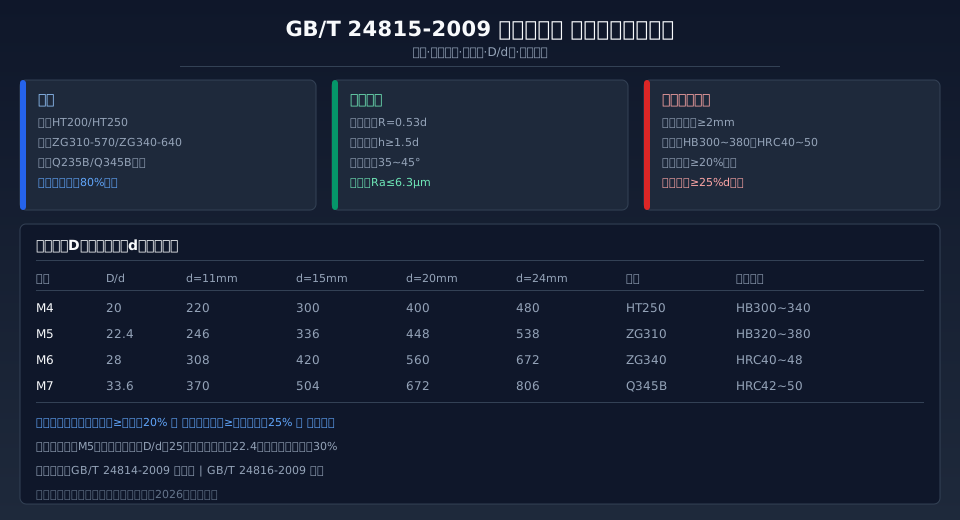
Reel Construction and Materials
Cast Reels:The material is HT200 or HT250 gray cast iron, suitable for small- to medium-sized drums with a diameter of ≤1200 mm. The advantages of cast drums include being formed as a single piece and requiring minimal machining allowance; the disadvantages are their relatively heavy weight and the potential for casting defects.
Welding Reel:Manufactured by rolling and welding Q235B or Q345B steel plates, these are suitable for large-diameter (>1200 mm) drums. Welded drums are 30% to 50% lighter than cast drums and carry no risk of casting defects. Currently, welded drums are widely used in heavy-duty cranes.
Coil wall thickness:The wall thickness of cast drums is selected to be between 1/15 and 1/20 of the diameter, while that of welded drums is selected to be between 1/24 and 1/30 of the diameter. Taking a 600-mm-diameter drum as an example, the wall thickness for a cast drum is 30–40 mm, and for a welded drum, it is 20–25 mm.
Drum Diameter and Wire Rope Compatibility
The ratio of the drum diameter D to the wire rope diameter d is determined based on the working class and is consistent with pulley standards: Class M4, D ≥ 18d; Class M5, D ≥ 20d; Class M6, D ≥ 25d; Class M7, D ≥ 30d; Class M8, D ≥ 35d.
Roll Length:The drum length depends on the total length of the wire rope, the number of winding layers, and the groove pitch. For single-layer winding, the drum length L = (Lw × d) / (π × D) + Lr, where Lw is the total length of the wire rope, D is the drum diameter, and Lr is the number of safety turns reserved (typically 3 turns). For multi-layer winding, the drum length can be reduced, but the rope arranger must be taken into account.
Rope groove:The pitch of the rope grooves on the drum is t = d + 2–3 mm. The depth of the rope grooves is h ≥ 0.35d. The radius at the bottom of the rope grooves is R = 0.53d. Recess grooves must be provided at both ends of the drum; the width of these recess grooves must be at least twice the diameter of the wire rope.
Scrap Standards for Rolls
A drum shall be scrapped if any of the following conditions are met: ① The drum wall wear reaches 20% of the original wall thickness; ② The wear depth in the rope grooves reaches 15% of the wire rope diameter; ③ Cracks appear in the drum (regardless of length); ④ The drum shaft exhibits bending deformation exceeding the design tolerance; ⑤ The drum flange has fractured.
Quick Reference Chart for Reel Specifications
| Wire Rope Diameter | M5 Reel D | M6 Reel D | Wall Thickness (Cast) | Wall Thickness (Welded) | Rope Groove Pitch | Recommended Lifting Capacity |
|---|---|---|---|---|---|---|
| 11 mm | 220 | 275 | 14 | 10 | 13~14 | ≤1 metric ton |
| 15 mm | 300 | 375 | 18 | 12 | 17~18 | ≤2.5 metric tons |
| 20 mm | 400 | 500 | 24 | 16 | 22~23 | ≤5 metric tons |
| 24 mm | 480 | 600 | 28 | 20 | 26~27 | ≤10 metric tons |
| The Krude Standard | Select a drum with a D/d ratio one grade higher than the national standard to extend the service life of the wire rope. | |||||
Frequently Asked Questions
Q: What precautions should be taken when winding multiple layers onto a reel?
Answer: During multi-layer winding, the wire rope experiences compression and friction at the intersections between layers, which accelerates wear. Standards require that the flange height of a multi-layer winding drum be ≥5 times the wire rope diameter, and that the drum be equipped with a rope guide. The number of winding layers should not exceed 4 (for fiber-core ropes) or 5 (for steel-core ropes). The CD1 electric hoist drum from Krude Heavy Industry features a 2-layer winding design and does not require a rope guide.
Q: At what level of wall thickness wear is a roll considered scrap?
Answer: A drum must be scrapped when its wall thickness has worn down to 20% of its original thickness. For example, for a cast drum with a wall thickness of 30 mm, the limit is reached when the thickness wears down to 24 mm. A drum should also be scrapped when the wear depth of the rope grooves reaches 15% of the wire rope diameter. Any visible cracks in the drum must result in its immediate scrapping, as stress concentration at the crack site may cause the drum to suddenly fracture during use.
Q: How is the pitch of the rope grooves on a drum determined?
Answer: The rope groove pitch t = d + (2–3) mm, where d is the wire rope diameter. If the pitch is too large, it will increase the length of the drum; if it is too small, the wire rope will be squeezed between adjacent turns. The standard groove base radius R = 0.53d, and the groove depth h ≥ 0.35d. The surface roughness Ra of the rope groove is ≤ 6.3 μm.
Q: What is the purpose of the safety rings at both ends of the roll?
Answer: The standard requires that no fewer than three safety turns (fixed turns) of wire rope be retained at both ends of the drum; the wire rope must never be completely unwound from the drum at any time. The purpose of the safety turns is to ensure that the rope-end clamping plate is not subjected to working tension, thereby preventing the wire rope from coming off the drum. The wire rope in the safety turns area typically wears out more quickly and should be a focus of routine inspections.
