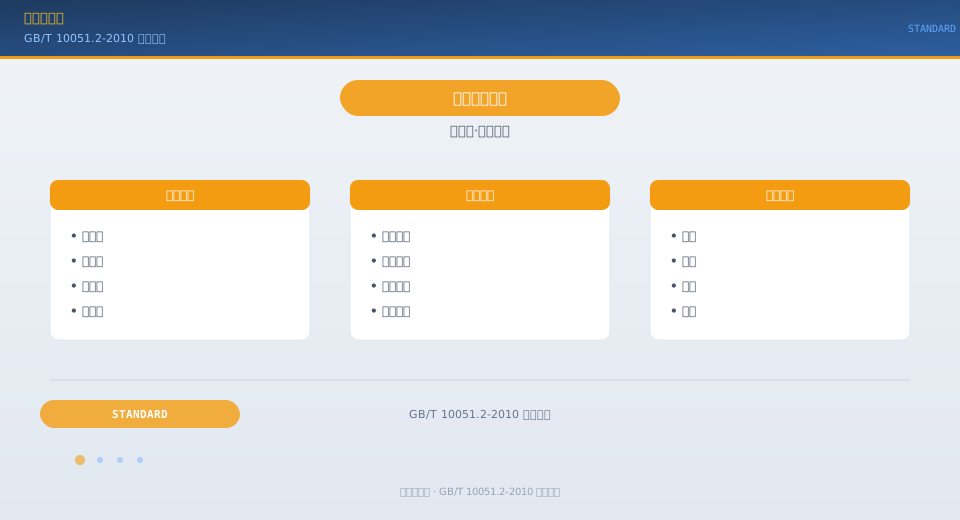

Forged Hook Material and Heat Treatment per GB/T 10051.2

GB/T 10051.2-2010, "Lifting Hooks — Part 2: Technical Specification for Forged Hooks," is the dedicated technical standard governing the manufacturing and acceptance of forged hooks. The standard defines the terminology, structural types, dimensional parameters, technical requirements, test methods, and inspection rules for forged hooks. It is used in conjunction with GB/T 10051.1 (General Technical Specifications) and GB/T 10051.3 (Product Standard for Forged Hooks), together forming a complete standard system for forged hooks.

GB/T 10051.2-2010 is Part 2 of the lifting hook series standard, specifically addressing the material heat treatment and dimensional tolerance requirements for forged hooks.

GB/T 10051.2-2010 Forged Hook Technical Specification


Scope and Application of the Standard

GB/T 10051.2-2010 is Part 2 of the GB/T 10051 "Lifting Hooks" series. This part sets forth the general technical specifications for forged hooks, covering design calculation basis, material selection principles, heat treatment process requirements, and dimensional tolerance standards. The standard is applicable to the manufacturing technical conditions of die-forged and free-forged hooks used in lifting appliances, with a rated lifting capacity range of 0.1 to 500 t. It covers the technical parameters of both straight-shank and ring-type hook configurations. Building on the general requirements of Part 1, this standard imposes more specific technical requirements on the forging process, heat treatment, and quality inspection of forged hooks.

# h2-2

Material and Heat Treatment Requirements

The standard specifies detailed requirements for the material and heat treatment of forged hooks: hooks must be die-forged from high-quality carbon structural steel or alloy structural steel, with common material grades being DG20 (No. 20 hook-specific steel) and DG34CrMo (alloy steel hook-specific grade). Carbon content must be ≤0.25%, with P and S contents ≤0.025%. After forging, hooks must undergo normalizing followed by tempering: normalizing at 850–900°C with air cooling, and tempering at 550–650°C with air or furnace cooling. The metallographic structure after heat treatment must be uniform ferrite + pearlite (DG20) or tempered sorbite (DG34CrMo), with a grain size rating of no less than Grade 6. Surface hardness of the hook body: HB 140–187 for DG20 material and HB 210–270 for DG34CrMo material.

# h2-3

Dimensional and Geometric Tolerances

The standard defines tolerances for the key dimensions of forged hooks: hook opening size deviation of ±2 mm (≤100 t) or ±3 mm (>100 t). Thickness deviation of the curved hook section: ±1.5 mm. Hook neck diameter tolerance: h9 grade. Hook thread tolerance: 6g grade (mating with the hook nut). Inner corner radius R deviation of the curved hook section: ±1 mm. Coaxiality between the hook centerline and thread centerline: Φ0.5 mm. Hook tip deflection (within the hook mouth plane): ≤3 mm. Surface roughness of the hook body: Ra≤6.3 μm (non-mating surfaces) or Ra≤3.2 μm (mating surfaces and threads). All dimensional and geometric tolerance inspections must be performed after heat treatment (deformation caused by heat treatment must remain within tolerance limits).

# cards

Material Grade
DG20/DG34CrMo
Carbon ≤0.25%
Heat Treatment
Normalizing 850–900°C
Tempering 550–650°C
Hook Body Hardness
DG20: HB 140–187
DG34CrMo: HB 210–270
Opening Deviation
≤100 t: ±2 mm
>100 t: ±3 mm
Neck Tolerance
Diameter: h9 grade
Thread: 6g grade
Coaxiality
Hook body vs. thread
Φ0.5 mm

# h2-4

Forging Process Specifications

The standard imposes strict requirements on the forging process: hooks must be die-forged with a forging ratio of no less than 3:1, ensuring the metal flow line runs continuously along the hook profile (flow lines must not be interrupted at critical sections). Forging temperature range: initial forging temperature 1150–1200°C, final forging temperature ≥850°C. After forging, hooks must be slowly cooled in air to room temperature (rapid cooling is prohibited). The forged surface must be free of cracks (confirmed by visual inspection plus Magnetic Particle Inspection), folds, overheating, and heavy scale. Flash must be removed before heat treatment, and the trimmed area must be ground smooth. Each forged hook must undergo visual inspection, dimensional inspection, and hardness inspection upon completion.

# h2-5

Inspection Rules and Routine Tests

The standard requires that each forged hook undergo visual inspection, dimensional inspection, hardness inspection, and a static load test before delivery. At least one hook from each batch (same heat number, same heat treatment state) must be subjected to tensile and impact tests. The static test load is 2 times the rated lifting capacity (for general-purpose hooks) or 2.5 times (for hooks used in lifting and transporting molten metal), with a holding time of ≥5 min. After the test, the residual deformation of the opening must not exceed 0.25% of the original opening size. The Factory Certificate must indicate the hook model, rated lifting capacity, material grade, heat treatment state, and test load value. Kelude forged hooks are manufactured and inspected strictly in accordance with the technical requirements of GB/T 10051.2.

# faq


Forged Hook Heat Treatment Comparison Table

The comparison table below lists the core parameter configurations for forged hook heat treatment, for reference by selection and operating personnel.

Kelude Heavy Industry: Overhead & Gantry Crane Solutions

Kelude Heavy Industry specializes in the design, engineering, and manufacturing of heavy-duty overhead cranes, gantry cranes, and electric hoists. With a strong focus on safety, performance, and longevity, our material handling equipment is built to meet the rigorous demands of industrial environments across the United States and Europe.

Engineered for Performance and Reliability

Our cranes are designed in strict accordance with international standards such as ISO 4301 and ISO 12480, ensuring compliance with global safety and design protocols. We utilize high-grade steel and premium components to deliver equipment that withstands continuous operation, heavy loads, and harsh conditions. Every crane undergoes rigorous quality testing to guarantee dependable performance and a long service life.

Customized Material Handling Equipment

We understand that every facility has unique requirements. Kelude offers fully customizable solutions, including single-girder and double-girder overhead cranes, gantry cranes, and low-headroom designs. Our engineering team works closely with clients to optimize crane configuration, lifting capacity, span, and lifting height, ensuring a perfect fit for your specific application. From standard models to complex, custom-engineered systems, we deliver equipment tailored to your operational needs.

Advanced Safety Features and Control Systems

Safety is paramount in our designs. Our cranes are equipped with advanced safety features, including explosion-proof options, anti-sway technology, and self-locking mechanisms. We integrate intelligent control systems that provide precise load handling and smooth operation. Variable frequency drives (VFDs) and remote-control options enhance operational efficiency and operator safety, meeting the latest IEC 60204-32 standards for electrical equipment.

Comprehensive After-Sales Support and Service

Beyond manufacturing, Kelude provides comprehensive after-sales support, including installation, commissioning, operator training, and maintenance services. Our global service network ensures quick response times and minimal downtime. We offer spare parts availability and technical assistance to keep your equipment running at peak performance throughout its entire lifecycle.

Frequently Asked Questions

Q: What types of cranes does Kelude manufacture?
A: We manufacture a wide range of overhead cranes, including single-girder and double-girder models, as well as gantry cranes and electric hoists. Custom configurations are available to meet specific lifting requirements.

Q: What standards do your cranes comply with?
A: Our cranes are designed and manufactured in compliance with major international standards, including ISO 4301 for crane classification and ISO 12480 for safe use. Electrical systems adhere to IEC 60204-32.

Q: Can you customize cranes for a specific application?
A: Yes, customization is a core part of our service. We can adjust lifting capacity, span, height, and control systems to suit your exact needs, including explosion-proof or low-headroom configurations.

Q: What kind of after-sales support is provided?
A: We offer full after-sales support, including installation, commissioning, training, maintenance, and a reliable supply of spare parts to ensure long-term operational efficiency.

Q: What is the typical lead time for a custom crane?
A: Lead times vary based on the complexity and specifications of the crane. Please contact our sales team with your requirements for a detailed timeline.

Q: Do you provide international shipping and installation?
A: Yes, we ship and install cranes globally, including throughout the US and Europe. Our team manages logistics and on-site installation to ensure a smooth startup.

Q: How do I request a quote?
A: You can request a quote by contacting us through our website or emailing our sales department. Please provide your load capacity, span, and application details for an accurate proposal.

Q: What is the warranty on Kelude cranes?
A: We offer a comprehensive warranty on all our equipment, covering defects in materials and workmanship. Specific warranty terms are provided with your quotation.

← Scroll left / right to view full table →
Hook Grade material grade heat treatment process Hardnessrequirements
MClass DG20 normalizing+Tempering HB140-187
PClass DG34CrMo quenching and tempering+High Temperature Tempering HB210-270
QClass DG34CrNiMo quenching and tempering+Surface Hardening HB240-300
SClass High Strength Alloy Steel quenching and tempering+Nitriding HB280-350

Frequently Asked Questions

Q: GB/T 10051.2 and GB/T 10051.3 are both forged hook standards — what's the difference?
A: GB/T 10051.2 is the "technical specification" standard for forged hooks, focusing on manufacturing process requirements — it specifies materials, forging, heat treatment, tolerances, and inspection methods. GB/T 10051.3 is the "product standard" for forged hooks, focusing on finished-product specifications — it defines the dimension series for each lifting capacity grade, marking methods, and static test loads. In short, one covers "how to manufacture" and the other covers "what the finished product should look like." Both must be met simultaneously in actual production.
Q: What does the 3:1 forging ratio mean for a forged hook, and why can't it be less than 3?
A: The forging ratio represents the change in cross-sectional area of the billet during the forging process (original cross-section / final cross-section). A 3:1 forging ratio requirement means the original steel billet's cross-sectional area must be at least three times that of the thinnest section of the finished hook body. An adequate forging ratio ensures: 1) The internal casting structure of the steel is thoroughly broken down and compacted, eliminating porosity and looseness; 2) The metal flow lines are continuously distributed along the hook profile (interrupted flow lines significantly reduce the hook's fatigue strength); 3) Uniform distribution of carbides. A forging ratio below 3:1 results in non-uniform internal structure and discontinuous flow lines, reducing the hook's load-bearing capacity and fatigue life.
Q: Why is a grain size rating of no lower than Grade 6 required for metallographic structure inspection after hook heat treatment?
A: Grain size is an indicator of the grain dimensions in steel — the higher the number, the finer the grains. Grade 6 corresponds to an average grain diameter of approximately 0.045 mm. The requirement for a grain size no coarser than Grade 6 exists because coarse grains (Grade 5 or below) lead to: 1) Lowering of both strength and toughness in steel (reduced fine-grain strengthening effect); 2) Increased susceptibility to fatigue crack propagation along grain boundaries (coarse grain boundaries have weaker bonding than fine ones); 3) Reduced hardenability (coarse grains result in incomplete transformation during normalizing or tempering). Inspection method for grain size: evaluation under a microscope at 100× magnification against a standard grain size comparison chart.
Q: How is the 0.25% residual deformation of the forged hook opening measured?
A: The hook opening residual deformation test is a key measurement item in the static load test. The measurement method is as follows: 1) Before the test, use a caliper to measure the original opening size L0 between two marked points on the inner side of the hook opening (accurate to 0.1 mm); 2) Apply a test load equal to 2 times the rated load and hold for 5 minutes; 3) After unloading, wait 3 minutes to allow complete recovery of elastic deformation; 4) Measure the opening size L1 at the same position again; 5) Calculate the residual deformation rate = (L1 - L0) / L0 × 100%. The requirement is ≤ 0.25%. If this value is exceeded, it indicates insufficient yield strength of the hook material or improper heat treatment process, and the hook should be deemed non-conforming.

Related News

contact

contact us

phone:
+86 13903802779

mail:3915269@qq.com

Working hours: Monday to Friday

Wechat
Wechat
SHARE
TOP