

Interpretation of the ISO 16625 Standard: “Guidelines for the Selection and Maintenance of Wire Rope Drums and Pulley Blocks”
📋 Standard Overview:ISO 16625, “Cranes—Guidelines for the Selection and Maintenance of Wire Rope Drums and Sheaves,” is a technical guidance document published by ISO/TC 96, the Technical Committee on Cranes. It systematically specifies the selection and calculation methods, material requirements, tolerances for rope grooves, installation and maintenance specifications, and criteria for determining when components are worn out. This standard is intended for use in conjunction with ISO 4308, “Cranes—Selection of Wire Ropes,” and together they ensure the safety and reliability of wire rope drive systems in crane hoisting mechanisms.
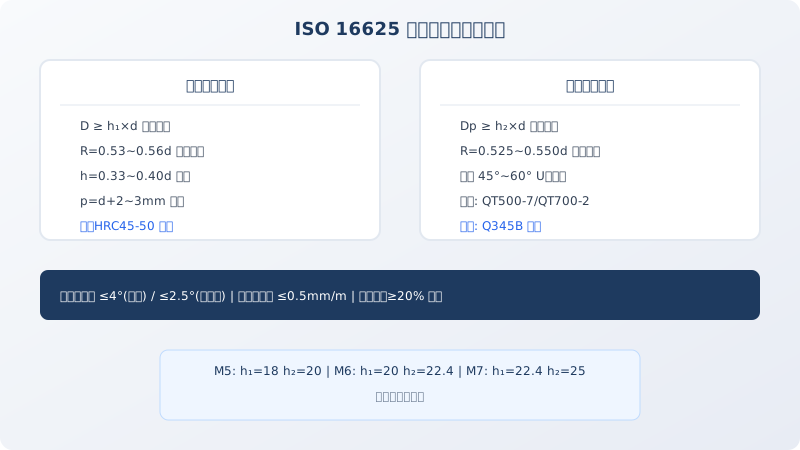
Wire rope drums and sheaves are the core transmission components of a crane’s hoisting mechanism; their selection and the quality of their maintenance directly affect the service life of the wire rope and hoisting safety. A deviation of more than 0.5 mm in the dimensions of the drum grooves can lead to irregular rope lay and localized compression damage; excessive wear in the pulley grooves may cause the wire rope to jump out of the groove and accelerate wire breakage. ISO 16625 provides standardized technical guidelines for the full lifecycle management of these two critical components.
I. Drum Selection and Rope Groove Design
ISO 16625 specifies the method for determining the drum diameter D: D ≥ h₁ × d (where d is the nominal diameter of the wire rope, and h₁ is the drum diameter coefficient corresponding to the hoist’s duty class). For hoisting mechanisms of service class M5, h₁ = 18; for class M6, h₁ = 20; and for the M7 service class, h₁ = 22.4. Taking a 10-metric-ton M5-class overhead crane as an example, if a 16-mm-diameter wire rope is selected, the minimum drum diameter D = 18 × 16 = 288 mm, which is rounded to the standard value of 320 mm.
For the rope grooves, the standard groove depth is h = 0.33d to 0.40d, the groove pitch is p = d + (2 to 3) mm, and the groove bottom radius is R = 0.53d to 0.56d. The surface roughness of the rope groove inner surface is Ra ≤ 3.2 μm; the groove bottom and walls must be hardened to HRC 45–50 to resist contact wear from the wire rope. The flange height on both sides of the rope groove must be ≥1.5d (≥1.0d when a rope guide is installed) to prevent the wire rope from slipping out of the groove.
II. Pulley Selection and Groove Requirements
The pitch circle diameter Dp of the pulley (the diameter of the circle through the centerline of the wire rope) is also determined according to Dp ≥ h₂ × d. The service factor h₂ for cast pulleys is as follows: M5 = 20, M6 = 22.4, M7 = 25. The pulley grooves have a U-shaped cross-section, with a groove bottom radius R = 0.525d to 0.550d and a groove angle of 45° to 60°. The surface roughness Ra of the groove sidewalls is ≤ 6.3 μm.
ISO 16625 specifies that pulley materials must be classified according to the strength class of the wire rope: when the tensile strength of the wire rope is ≤1770 MPa, the pulley may be made of QT500-7 ductile iron or ZG270-500 cast steel; When the tensile strength of the wire rope is >1770 MPa (e.g., the 1960 MPa class), the pulley grooves must be medium-frequency quenched to HRC 50–55, or ZG35CrMo alloy cast steel must be used with a wear-resistant layer applied by surfacing welding to the groove bottom. Double-row self-aligning roller bearings are the preferred choice for the pulley bearings, with H7/g6 tolerances to ensure smooth operation.
III. Installation and Concentricity Alignment
ISO 16625 requires that the deviation in parallelism between the drum axis and the axis of the fixed pulley block be ≤0.5 mm/m. The flatness of the drum bearing housing mounting surface must be ≤0.1 mm/500 mm, as verified using a feeler gauge. The angle of deviation of the wire rope on the drum (the angle between the centerline of the wire rope and the centerline of the rope groove) shall be ≤4° (for smooth drums) or ≤2.5° (for grooved drums). Exceeding this limit may cause the wire rope to press against the flange of the rope groove, accelerating wear or even causing the rope to come off the groove.
After installing the pulleys, rotate them by hand to check for smooth operation—pulleys smaller than M5 should rotate with one hand, while those M6 and larger should rotate easily with a lever wrench to be considered acceptable. All pulleys in the pulley block should lie in the same plane, and the flatness deviation of the groove center plane should be ≤ 1/1000 of the pulley spacing. After installation, conduct a 30-minute no-load test run to check whether the wire rope is laid out neatly and to listen for any abnormal friction noises.
IV. Wear Monitoring and Scrap Standards
The scrappage criteria for wear on drum rope grooves are specified in ISO 16625: The drum must be replaced when the wall thickness of the rope groove has worn down to less than 20% of its original thickness; if grooves or wire rope indentations with a depth of ≥1 mm appear on the bottom of the rope groove, the groove should be re-machined on a lathe (however, the wall thickness after machining must still be ≥ 80% of the original thickness).
Scrap criteria for pulley grooves: The pulley must be replaced when the wear on the bottom of the groove exceeds 25% of the wire rope diameter (for example, if a Φ16mm wire rope is used, the pulley must be scrapped when the wear depth at the bottom of the groove reaches 4mm); The pulley must be replaced when the wear on the groove sidewalls reaches 30% of the original thickness; the pulley must be replaced immediately if cracks or chips appear on the rim, regardless of size.
V. Lubrication and Routine Maintenance
The rope grooves on the drum and the grooves on the pulleys are self-lubricated during operation by the grease on the surface of the wire rope. ISO 16625 recommends lubricating the wire rope at least once every 200 hours of operation or once a month (whichever comes first), using a grease specifically designed for wire ropes that is free of acids and resins (NLGI No. 2 consistency). Pulleys’ bearings should be refilled with lithium-based grease once every 500 hours of operation; the lubrication interval must be shortened if the bearing temperature exceeds 70°C.
Daily Inspection Items: Visually inspect whether the wire rope is laid out neatly, check for abnormal wear or shiny marks in the rope grooves, verify that the pulleys rotate smoothly without unusual noise, and ensure that the bolts on the bearing end caps are not loose. Measure the wear on the rope grooves once per quarter using a vernier caliper or a gauge block, and maintain records and perform trend analysis.
| Job Level | Reel h₁ | Pulley h₂ | Rope diameter 16 mm → D | Rope diameter 20 mm → D |
|---|---|---|---|---|
| M5 | 18 | 20 | ≥288→320 | ≥360→400 |
| M6 | 20 | 22.4 | ≥320→355 | ≥448→450 |
| M7 | 22.4 | 25 | ≥358→400 | ≥500→500 |
Frequently Asked Questions
Q: Why is the wire rope not wound neatly on the drum?
Answer: There are four main reasons: ① The wire rope deflection angle exceeds the 2.5° upper limit specified in ISO 16625; the position of the fixed pulley must be adjusted or a rope guide added; ② The machining accuracy of the rope grooves is insufficient, and the groove spacing tolerance exceeds the ±0.3 mm range; the grooves must be repaired on a lathe; ③ Insufficient initial pretension; when installing a new rope, it must be wound 3–5 turns under a working load of 10%–15% to achieve pretension; ④ Wire rope twisting (an inherent characteristic of helical wire ropes); this can be addressed by using anti-rotation wire rope or installing a free-rotating coupling at the rope end to release the torque.
Q: What are the early signs of pulley bearing damage?
Answer: Early warning signs include: ① Unusual noise or a periodic ”clicking” sound from the pulley during no-load operation; ② The temperature at the bearing end cap is significantly higher than that of other pulleys (temperature difference > 15°C); ③ A sensation of sticking or uneven resistance when turning the pulley by hand; ④ Periodic oscillation of the pulley’s outer edge (runout > 0.5 mm). If any of the above signs appear, immediately shut down the machine for inspection. Use a vibration analyzer or stethoscope to confirm the condition of the bearings, and replace them if necessary to prevent wire rope breakage caused by dry friction between the wire rope and a seized pulley.
Q: Can the rope groove on a drum be repaired on-site?
Answer: Yes, but there are certain conditions. If grooves less than 2 mm deep appear in the rope grooves, they can be ground smooth on-site using an angle grinder; after grinding, the groove dimensions must be checked using a template ruler. If the rope groove wear exceeds 2 mm but the wall thickness remains greater than the original thickness of 80%, the drum must be removed and sent to the machine shop for re-machining of the rope groove on a large lathe. If, after re-machining, the rope groove wall thickness is reduced by more than 20% or the rope groove diameter increases such that the drum’s diameter coefficient h₁ no longer meets the requirements for the mechanism’s working class, the drum must be replaced with a new one. On-site welding repairs to rope grooves are not permitted under ISO 16625—the heat input from welding alters the surface hardness of the rope grooves and introduces the risk of microcracks.
Q: How do I choose between cast pulleys and rolled pulleys?
Answer: Cast pulleys (made of QT500-7 ductile iron or ZG270-500 cast steel) are suitable for small- to medium-diameter applications (≤800 mm) and standard lifting capacities. They feature low manufacturing costs, and the profile of the groove is ensured by the casting mold. Rolled sheaves (made from Q345B steel plate formed by spin-forming) feature uniform wall thickness and light weight, making them suitable for large-volume, standardized production; however, the dimensional accuracy of their grooves is slightly lower than that of cast sheaves. ISO 16625 recommends that, for applications with a working class of M6 or higher and wire rope diameters greater than 20 mm, cast steel pulleys should be prioritized, with the grooves subjected to medium-frequency quenching to extend their service life.
