
Harbor Crane Selection Guide for Port Terminals

In brief: Kelude Heavy Industry provides crane configuration solutions for port terminals covering container, bulk cargo, general cargo, and multi-purpose terminals, with lifting capacities from 5 to 100 tons and spans from 18 to 50 meters. Complete plant lifting equipment investments range from approximately $74,000 to $2.97 million. Container terminals are equipped with Ship-to-Shore cranes (40–65t) and rubber-tyred gantry cranes; bulk cargo terminals use grab-type portal slewing cranes (16–40t); general cargo terminals are fitted with multi-purpose portal cranes (25–50t); and multi-purpose terminals employ universal portal cranes with quick-change spreaders (40–100t) — all designed to meet the specialized, high-efficiency, and multi-purpose handling demands of modern port operations.

Port Terminal Crane Selection Guide

Container Terminals | Bulk Cargo Terminals | General Cargo Terminals | Multi-Purpose Terminals

Port terminals represent one of the most demanding applications for cranes — from container quay cranes to grab-type ship unloaders, from general cargo portal cranes to versatile mobile harbor units, every terminal type places extreme demands on lifting equipment efficiency and reliability. Kelude Heavy Industry supplies a complete range of port cranes and supporting components to meet these challenges.

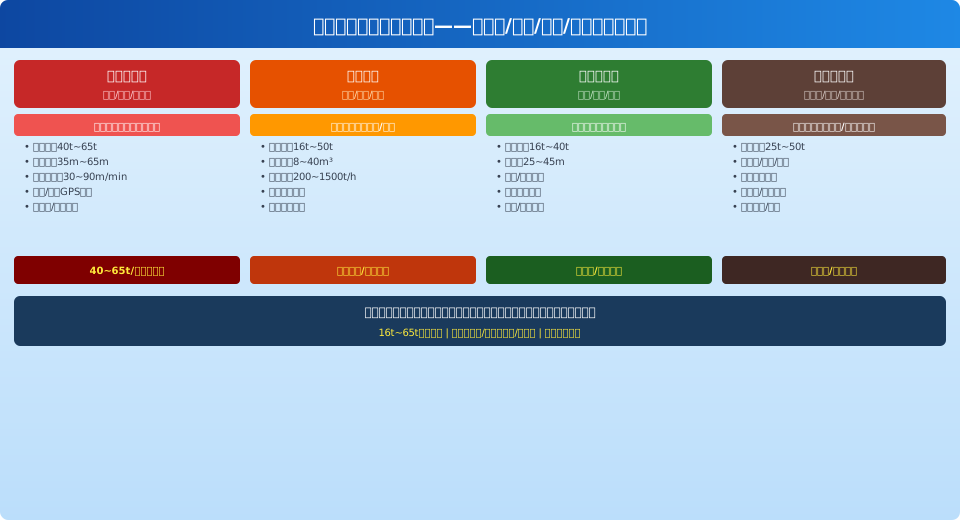
Port Terminalcrane selectionSolution——Container/Bulk Cargo/General Cargo/Multi-Purpose Class IV Terminal

Scenario 1: Container Terminals

• Lifting capacity 40t–65t, Ship-to-Shore (STS) crane

• Outreach 35m–65m

• Lifting speed 30–90 m/min

• Trolley/spreader GPS positioning

• Automation / remote operation

• Kelude supplies automated STS spreaders

40–65t Automated | GPS Positioning | Remote Control

Scenario 2: Bulk Cargo Terminals

• Lifting capacity 16t–50t, grab ship unloader / portal crane

• Grab bucket capacity 8–40 m³

• Unloading rate 200–1,500 t/h

• Wind protection system

• Integrated water spray dust suppression

• Kelude integrates grab bucket with anemometer interlock

Grab Unloading | High-Capacity Bulk Handling | Dust Suppression

Scenario 3: General Cargo Terminals

• Lifting capacity 16t–40t, portal slewing crane

• Working radius 25–45m

• Flexible luffing and slewing

• Wide cargo adaptability

• Dual hook/grab bucket configuration

• Kelude supplies specialized general cargo spreaders

Portal Crane | Flexible General Cargo Handling | Hook & Grab

Scenario 4: Multi-Purpose Terminals

• Lifting capacity 25t–50t, multi-purpose portal crane / mobile harbor crane

• Handles containers / bulk cargo / general cargo

• Quick-change spreader system

Multi-Purpose | Quick-Change Spreader | Versatile Handling

• Portable / flexible deployment

• Hydraulic luffing / slewing

• Kelude multi-purpose quick-change lifting spreader

Multi-purpose | Quick-change | Flexible mobility

Selection Parameters by Region: A Four-Way Comparison

Parameter ItemContainer TerminalBulk Cargo TerminalGeneral Cargo TerminalMulti-Purpose Terminal
recommended modelShip-to-Shore Crane (STS)Grab ship unloader/Portal CranePortal slewing craneMulti-Purpose Portal Crane/Mobile
Lifting Capacity40t~65t16t~50t16t~40t25t~50t
specialized spreaderContainer SpreaderGrab (grab bucket)Hook/Grab (grab bucket)Quick-Change Lifting spreader
Operating Modeautomation/RemoteCabin / Operator Cab+RemoteCabin / Operator CabCabin / Operator Cab+Remote
Kelude Solutionautomation Lifting spreaderAnemometer Interlocked OperationGeneral Cargospecialized spreaderQuick-Change Lifting spreader System
$0.7M–$3M
Total Plant Investment
5–100 t
Lifting Capacity Range
18–50 m
Span Range
A6–A8
Work Duty Classification
C5 Salt Spray
Marine-Grade Corrosion Protection
0.5–5M TEU/Year
Container Throughput

Container Terminal & Bulk Cargo Crane Solutions

The centerpiece of any container terminal is the Ship-to-Shore (STS) crane, with lifting capacities ranging from 40 to 65 tons and outreach of 35–65 m. Kelude's automated STS cranes integrate GPS-guided container spreaders for precise, hands-free container pick-up and placement. For bulk cargo terminals, grab ship unloaders and portal slewing cranes are the primary choices, with integrated water-spray dust suppression systems to meet environmental emission standards.

Break-Bulk & Multipurpose Terminal Crane Selection

Break-bulk terminals handle a diverse mix of cargo—steel coils, machinery, timber, and project cargo—where the luffing and slewing capabilities of a portal slewing crane offer maximum adaptability. Multipurpose terminals, on the other hand, demand rapid tool-changing capability. Kelude's quick-change spreader system allows operators to switch between container spreader, grab bucket, and hook in minutes, maximizing operational flexibility. Kelude Heavy Industry supplies the full range of port cranes and components, including STS cranes, ship unloaders, portal crane spreaders, wire ropes, and crane rail parts.

Kelude Heavy Industry: Service Advantages

With years of experience in port and terminal lifting equipment, Kelude Heavy Industry delivers a full range of cranes for container, bulk cargo, break-bulk, and multipurpose terminals—including portal slewing cranes, STS cranes, and gantry cranes. All equipment meets FEM and ISO standards, features C5-M marine atmospheric corrosion protection, and has been exported to Southeast Asia, the Middle East, Africa, and beyond.

High-Efficiency Container Terminal Solutions
For container terminals handling 0.5–5 million TEU annually, the STS crane is the workhorse—offering 40–65 t lifting capacity, 35–55 m outreach, and full-load hoisting speeds of 60–90 m/min. Kelude STS cranes feature AC inverter drives with supercapacitor energy feedback, cutting energy consumption per container by 20–30%. Equipped with an anti-sway system (swing ≤ ±50 mm) and truck positioning system, each crane achieves 25–35 container moves per hour.
Bulk Cargo Grab Crane Solutions
For bulk terminals handling coal, ore, and grain, Kelude recommends the MQ series portal grab crane—with 16–40 t lifting capacity and 20–35 m working radius. Grab bucket volume is optimized for material density (coal at 0.85 t/m³, iron ore at 2.2 t/m³, soybeans at 0.75 t/m³), and buckets are fabricated from NM400 wear-resistant steel with hard-alloy build-up welding. The hoisting and closing mechanisms use dual-motor individual drives, and single-line and four-line grab buckets can be swapped quickly.
Flexible Multipurpose Terminal Solutions
Multipurpose terminals need to handle containers, break-bulk, and bulk cargo with equal efficiency. Kelude's MQ series general-purpose portal cranes (40–100 t capacity, 25–45 m working radius) feature a quick-change spreader system that switches between container spreader, grab bucket, and hook in just 20 minutes. The hoisting mechanism offers two-speed operation (5 m/min at full load, 25 m/min at no-load), while luffing and slewing use variable-frequency speed control for smooth break-bulk handling and efficient container operations.

Frequently Asked Questions (FAQ)

Q: How do I select the lifting capacity and outreach for a Ship-to-Shore (STS) crane?
A: The lifting capacity is determined by the maximum container weight (a loaded 40-ft container weighs approximately 30.5t) plus the lifting spreader weight (about 10–15t), with a recommended range of 40–65t. The outreach is determined by the vessel beam plus the distance from the crane rail to the wharf edge — for the largest vessel beam of 43m (20 rows of containers), an outreach of 35–40m is required. Kelude provides a selection report based on the terminal's hydrological data and calling vessel types, covering both current needs and vessel upgrade requirements over the next 5–10 years.
Q: How do I select the right grab type for a portal crane at a bulk cargo terminal?
A: Grab selection is determined by the bulk material's density: ① Coal (0.85t/m³) — light multi-blade grab (3–6 m³ capacity); ② Iron ore (2.2t/m³) — heavy clamshell grab (1.5–3 m³ capacity); ③ Soybeans (0.75t/m³) — light double-blade grab (4–8 m³ capacity); ④ Cement clinker (1.4t/m³) — medium-duty grab (2–4 m³ capacity). Kelude Heavy Industry customizes grab capacity and shell opening design based on the actual material's density, particle size, moisture content, and other parameters.
Q: How does the quick spreader change system work on a multipurpose portal crane?
A: Kelude's multipurpose portal cranes are equipped with a fully automatic quick-change spreader system (QCS). From the operator cabin, the operator simply presses the changeover button, and the sequence runs automatically: ① the current spreader lowers onto the change-over rack and unlocks; ② the hoisting mechanism raises the spreader to the change height, then rotates to position directly above the new spreader; ③ the new spreader is lowered into place, locked, and the hydraulic and electrical connections are mated automatically; ④ the system runs a self-check (communications and load sensors) and is ready for operation once it passes. The entire changeover takes 20 minutes or less and can be completed by a single operator.
Q: What is the marine anti-corrosion coating system for harbor cranes?
A: Port terminals are exposed to a highly corrosive marine atmosphere (high salt spray concentration and humidity). The coating system is designed in accordance with ISO 12944 C5-M (high corrosivity) as follows: ① Sandblasting to Sa2.5 grade (surface roughness 75–100 μm); ② Epoxy zinc-rich primer (80 μm) + epoxy MIO intermediate coat (80 μm) + polyurethane topcoat (80 μm), with a total dry film thickness (DFT) of ≥240 μm; ③ Critical connections and bolts are protected with hot-dip galvanizing or Dacromet coating; ④ Electrical control boxes are made of SUS316L stainless steel or FRP. The design life of the coating system is 10–15 years.

Related News

contact

contact us

phone:
+86 13903802779

mail:3915269@qq.com

Working hours: Monday to Friday

Wechat
Wechat
SHARE
TOP