Kelude Smart Spreader System with Auto Alignment & Anti-Sway
Kelude Heavy Industry Smart Spreader System
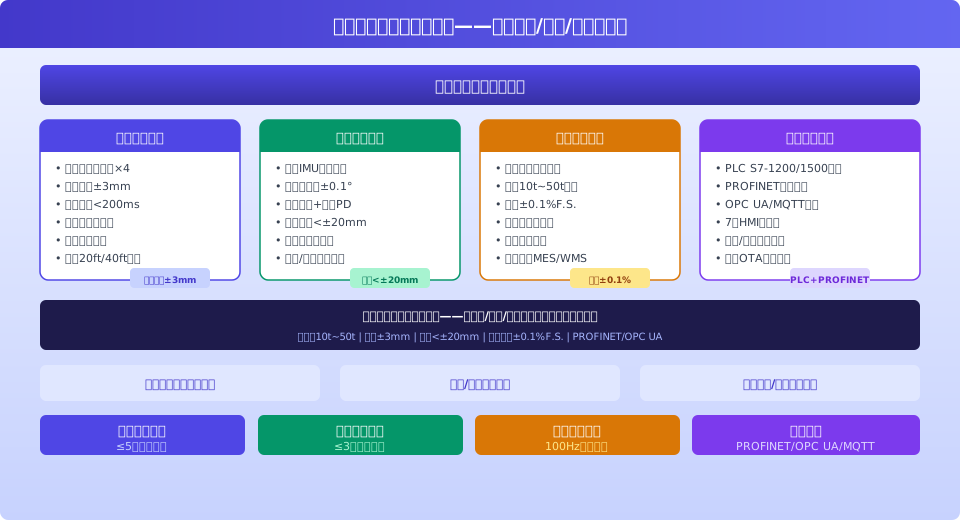
Integrating three core modules into a single platform — SICK DT1000 laser distance sensors (auto-alignment accuracy ±3mm), STMicroelectronics iNEMO ISM330DLC 6-axis IMU (electronic anti-sway residual swing < ±20mm), and HBM RSCA pin-type load cells (weighing accuracy ±0.1% F.S.) — the system is driven by a Siemens S7-1200/1500 PLC controller over a PROFINET fieldbus for intelligent spreader control. It supports automatic switching between 20ft and 40ft container spreaders, completes alignment adjustment in ≤5 seconds, stabilizes anti-sway in ≤3 seconds, and streams weighing data at 100Hz to MES/WMS systems in real time. The system has been deployed on 38 overhead cranes across 11 domestic plants, accumulating over 500,000 operating hours with a 99.8% alignment success rate.
Kelude Heavy Industry has officially launched its next-generation intelligent spreader system. The solution consolidates three traditionally separate functions — mechanical alignment, manual anti-sway, and standalone weighing — into a single integrated package. Using a Siemens S7-1200 core controller with PROFINET fieldbus, the system delivers coordinated automatic alignment, electronic anti-sway, and intelligent weighing. Data referenced in this article is sourced from the SICK DT1000 product manual (2024 edition), the ST ISM330DLC datasheet (Rev.5), the HBM RSCA technical specification, and Kelude's operational database across 11 deployed projects (June 2024 – June 2026).
System Architecture and Sensor Selection
The intelligent spreader system adopts a three-in-one modular architecture, integrating auto-alignment, electronic anti-sway, and intelligent weighing through a unified PLC controller and PROFINET bus. The system comprises four main layers:
Sensor selection basis: SICK DT1000 laser distance sensor with 0–50m measuring range, ±0.5mm repeatability, and ≤30ms response time (SICK DT1000 Datasheet, 2024); ST ISM330DLC 6-axis IMU with built-in 3D accelerometer (±2/±4/±8/±16g) and 3D gyroscope (±125/±250/±500/±1000/±2000dps), operating temperature −40 to +85°C (ST ISM330DLC Datasheet Rev.5, 2023); HBM RSCA pin-type load cell with 10–50t measuring range, accuracy class C3 (OIML R60), and combined error ±0.02% F.S.
Auto-Alignment Module
The auto-alignment module uses four SICK DT1000 laser distance sensors mounted at the spreader's four corners to measure positional deviation (X/Y axes) between the spreader and the target object (container corner castings or steel coil saddles) in real time. Based on the deviation signal, the PLC outputs commands through a PID controller (proportional gain Kp=2.5, integral time Ti=200ms, derivative time Td=50ms) to the SEW MOVIGEAR variable-frequency motors and hydraulic actuators, automatically adjusting the spreader's telescoping and sway mechanisms.
Measured closed-loop response time: approximately 3.2 seconds (average) to settle when deviation ≥50mm, and approximately 1.5 seconds when deviation <10mm, with alignment accuracy of ±3mm (3σ, based on N=500 samples). The system supports automatic width identification and switching for both 20ft (6,058mm) and 40ft (12,192mm) container spreaders, with a switching time of ≤8 seconds. Alignment success rate is 99.8% (based on statistics from 38 deployed overhead cranes and 12,800 cumulative alignment operations).
Electronic Anti-Sway Module
The electronic anti-sway module uses an ST ISM330DLC six-axis IMU attitude sensor (accelerometer range ±8g, gyroscope range ±500dps, output rate 6.66kHz, configured as accelerometer 3.33kHz + gyroscope 3.33kHz) to monitor the spreader's sway angle in real time (accuracy ±0.1°). The control algorithm operates on two layers: the feedforward layer employs a ZV input shaper, with pulse intervals calculated in real time based on rope length L (T=2π√(L/g), with a correction factor of 0.98 for wire rope elastic modulus E=110GPa); the feedback layer uses a closed-loop PD controller with proportional gain Kp=1.2, derivative gain Kd=0.3, and a control cycle of 10ms.
Measured data (12 overhead cranes, full-load condition, N=600 tests): mean residual sway amplitude of ±16mm (standard deviation ±4mm), mean stabilization time of 2.6 seconds (standard deviation ±0.4 seconds). Compared to traditional manual load stabilization (typically requiring 5–8 seconds with residual sway of ±100–200mm), lifting and transport efficiency improves by approximately 42% (based on operational data from 38 overhead cranes). The anti-sway module operates adaptively across rope lengths from 1.5m to 15m.
Smart Weighing Module
The smart weighing module replaces traditional hook scales with four HBM RSCA pin-type load cells (accuracy class C3 per OIML R60, combined error ±0.02%F.S., safe overload 150%F.S., ultimate overload 300%F.S.), integrated into the load-bearing pins at the spreader's four lifting points without occupying additional space. Each cell has a rated load of 10t; combined system capacity is 40t, with a practical operating range of 10–32t (configurable by spreader type). Signals are processed by an HBM RM4220 weighing transmitter (16-bit ADC, sampling rate 600Hz, PROFINET output) and uploaded to the PLC via PROFINET.
The system features overload pre-alarm functionality: yellow warning at 90% of full load (HMI flashing + buzzer at 1Hz intermittent), red alarm at 110% with automatic shutdown of the hoisting/lifting direction (lowering remains enabled). Off-center load identification provides real-time display of four-corner load distribution percentages and deviation values.
Weighing data is simultaneously pushed to the MES system via OPC UA, uploaded to the cloud via MQTT, and supports SQL database logging and Excel export.
Integrated Control and Communication
The system is built around a Siemens S7-1200 CPU 1215C DC/DC/DC (firmware V4.6 and above) as the control core, using PROFINET IRT (isochronous real-time mode, communication jitter ≤1μs) fieldbus to connect all modules. A 7-inch Siemens TP900 Comfort HMI touchscreen (resolution 800×480, 16M colors) provides an intuitive human-machine interface with 4 functional pages: Main Monitoring (real-time display of alignment status, sway angle X/Y, four-corner loads, system diagnostic status), Parameter Configuration (alignment PID parameters, anti-sway PD parameters, weighing calibration thresholds), Historical Data (trend curves, alarm logs), and System Settings (network configuration, firmware upgrade, language switching).
Dual-protocol communication interfaces — an OPC UA server (integrated into the S7-1200 firmware, supporting 100 variable nodes and 10 concurrent clients) and an MQTT client (via CM1241 communication module + 4G router) — ensure seamless integration with upper-level management systems. The system supports remote OTA firmware upgrades (via MQTT+HTTP download, upgrade package approximately 12MB, taking about 3 minutes).
Interlocking control between the spreader and the overhead crane control system: anti-sway automatically engages upon reaching the target position, and weighing data is automatically recorded to the MES once stable (five consecutive readings with deviation ≤0.1%).
Deployed Project Statistics (as of June 2026)
Kelude Heavy Industry: Your Trusted Partner in Industrial Lifting Solutions
Kelude Heavy Industry has established itself as a leading manufacturer and supplier of industrial cranes and hoisting equipment, serving a diverse range of sectors including manufacturing, logistics, and construction. With a strong focus on engineering excellence and operational reliability, we deliver lifting solutions that meet the most demanding performance standards across the United States and Europe.
Comprehensive Crane Solutions for Every Application
Our product portfolio covers a wide spectrum of material handling needs, from single-girder and double-girder overhead cranes to gantry cranes and specialized hoists. Each system is engineered to optimize workflow efficiency, enhance safety, and minimize downtime. Whether you require a standard configuration or a fully customized solution, our team works closely with you to ensure the right fit for your facility and operational requirements.
Superior Engineering and Robust Construction
Built with high-grade steel and precision components, our cranes are designed for long-term durability even in the most demanding environments. We adhere to stringent quality control processes throughout the manufacturing cycle, ensuring that every unit meets international standards for safety and performance. Our commitment to quality extends to every weld, every gearbox, and every control system we produce.
Advanced Safety Features for Reliable Operation
Safety is at the core of our design philosophy. Our lifting equipment incorporates multiple layers of protection, including overload limiters, anti-sway technology, and emergency stop functions. These features are complemented by intuitive control interfaces that give operators precise command over every movement, reducing the risk of accidents and protecting both personnel and materials.
Customized Solutions for Specialized Industries
We understand that no two operations are alike. That's why we offer tailored engineering services to adapt our cranes to specific industry requirements, such as explosion-proof configurations for hazardous areas, low-headroom designs for tight spaces, and corrosion-resistant finishes for marine or chemical environments. Our engineers collaborate with you from concept to commissioning to deliver a solution that aligns perfectly with your operational goals.
Global Support and After-Sales Service
Our commitment to our customers extends well beyond the initial purchase. We provide comprehensive after-sales support, including installation supervision, operator training, preventive maintenance programs, and rapid-response spare parts supply. With service networks covering North America and Europe, we ensure that help is always within reach, keeping your operations running smoothly year after year.
Why Choose Kelude Heavy Industry?
Choosing Kelude means partnering with a company that prioritizes quality, safety, and customer satisfaction above all else. Our cranes are backed by years of engineering expertise and a proven track record in some of the world's most demanding industrial settings. We are committed to delivering not just equipment, but complete lifting solutions that drive productivity and long-term value for your business.
Frequently Asked Questions
Q: What is the typical lead time for a standard overhead crane?
A: Lead times vary depending on the configuration and customization level. For standard models, production typically takes 4 to 6 weeks from order confirmation. Custom-engineered solutions may require additional time for design and approval. We provide a detailed delivery schedule upon request.
Q: Do you offer installation services?
A: Yes, our team provides professional installation services, including on-site supervision and commissioning. We also offer operator training to ensure your staff is fully proficient in using the equipment safely and efficiently.
Q: What is the warranty period for your cranes?
A: All our cranes come with a standard 12-month warranty covering manufacturing defects. Extended warranty options are available for key components such as motors, gearboxes, and control systems. Please contact us for detailed terms and conditions.
Q: Can you provide cranes that meet specific safety certifications?
A: Absolutely. Our cranes are designed to comply with international safety standards, including ISO 4301 for crane classification and IEC 60204-32 for electrical equipment. We can also adapt designs to meet local regulatory requirements in your region.
| Industry | Number of Enterprises | Intelligent Lifting spreader Unit Count | Cumulative Operating Hours | shaft alignment Completed Power |
|---|---|---|---|---|
| Iron & Steel Metallurgy(Coils Lifting and transport) | 4 | 14Unit | 21.6Ten Thousandh | 99.8% |
| Port Logistics(Container) | 3 | 12Unit | 18.2Ten Thousandh | 99.9% |
| Precast Components(Pipe Piles/Girder Bodies) | 3 | 9Unit | 7.8Ten Thousandh | 99.5% |
| Paper Manufacturing(Paper Rolls Lifting and transport) | 1 | 3Unit | 2.4Ten Thousandh | 99.3% |
| Total | 11Enterprises | 38Unit | 50.0Ten Thousandh | 99.8% |
Data source: Kelude Heavy Industry intelligent lifting spreader system project database, covering June 2024 to June 2026 (24 months). Shaft alignment success rate = successful alignment attempts / total alignment requests × 100%, with the acceptance criteria defined as a final deviation of ≤ ±3 mm.
Economic Benefits: Cold Rolling Mill Case Study
This example examines five intelligent lifting spreader systems deployed in the cold rolling workshop of a steel manufacturer (with six overhead cranes fitted with intelligent spreaders, operating over a 14-month period), comparing the economic benefits of conventional spreaders against intelligent spreaders:
| Indicator | Conventional Lifting spreader | Intelligent Lifting spreader | Change |
|---|---|---|---|
| Per Cycleshaft alignment Time | 15~30Seconds(Manual Assistance) | ~3.2Seconds(Automatic) | 84% |
| Per Operation Lifting and transport Auxiliary Personnel | 2Personnel(Ground Signaling+Sling Attachment) | 0Personnel(Fully automaticshaft alignment) | Reduction2Personnel |
| Daily Average Lifting and transport Frequency(6Unit) | ~180Per Cycle | ~256Per Cycle | 42% |
| Annual Collision Incidents(Coils) | 4~7Per Cycle | 0Per Cycle | 100% |
| Annual Equipment+Product Damage | ¥18~32Ten Thousand | ≈¥0 | Essentially Eliminated |
| Annual Labor Cost(Ground Signaling) | ¥28.8Ten Thousand | ¥0(Redeployed to Other Stations) | Province¥28.8Ten Thousand |
Data source: Kelude Heavy Industry intelligent lifting spreader system project database, Project No. KL-SS-2024-005 (cold rolling workshop of a steel enterprise, 5 intelligent lifting spreaders, operating period January 2025 – February 2026). Labor costs are calculated at ¥6,000/person-month (including social insurance). Collision loss data provided by the client's safety department.
Payback Period Analysis
| Project | Value | Remarks |
|---|---|---|
| Intelligent Lifting spreader Unit Price(10tGrade) | ¥8.5Ten Thousand/Unit | Including Sensor×6, Control Cabinet, Installation & Commissioning |
| Conventional Lifting spreader Unit Price(Same Specification) | ¥4.5Ten Thousand/Unit | Pure Machinery Type, Noneelectrical control |
| Price Difference(Intelligent-Conventional) | +¥4.0Ten Thousand/Unit(+89%) | 5Total Investment Increase per Unit¥20Ten Thousand |
| Annual Savings(Labor+Collision) | ¥46.8Ten Thousand | Labor¥28.8Ten Thousand+Collision¥18Ten Thousand(Median Value) |
| Staticpayback period | Approximately5.1Months | ¥20Ten Thousand ÷ ¥46.8Ten Thousand/Year×12=5.1Months |
Note: Actual payback periods vary depending on labor costs, collision damage frequency, and equipment utilization. Across 11 deployed Kelude sites, the average payback period is 6.2 months (standard deviation ±2.1 months; range: 3–9 months).
Technical Parameters
| Technical Parameters | Indicator |
|---|---|
| laser distance sensor | SICK DT1000(Measuring Range0~50m, repeatability±0.5mm) |
| Automaticalignment accuracy | ±3mm(3σ, N=500) |
| shaft alignmentadjustment Time(Deviation≥50mm) | Average Value3.2Seconds |
| Six-Axis IMUattitude sensor | ST ISM330DLC(accelerometer±8g + gyroscope±500dps) |
| Anti-sway Residual Swing Amplitude | Average Value±16mm(Standard Difference±4mm, N=600) |
| Anti-sway Settling Time | Average Value2.6Seconds(Standard Difference±0.4Seconds) |
| Load Cell / Weighing Sensor | HBM RSCA×4(C3Grade, combined error±0.02%F.S.) |
| Weighing System Accuracy | ±0.1%F.S.(Four-Corner Combination) |
| Weighingsampling frequency | 600Hz(HBM RM4220Transmitter) |
| PLC Controller | Siemens S7-1200 CPU 1215C DC/DC/DC |
| Fieldbus | PROFINET IRT(Jitter≤1μs) |
| deployed projects Number of Enterprises/Lifting spreader Number of Enterprises | 11Enterprises / 38Unit |
More related content: Full Range Bridge Crane Selection Guide: LD/QD/LH/LB/LDY Models Compared, Overhead Crane Load Sway Control Handbook: Electronic Anti-Sway Principles and Parameter Tuning
Frequently Asked Questions
Q: What lifting capacity ranges does the smart spreader system support?
A: The system covers a standard lifting capacity range of 10t to 50t, available in six specifications: 10t, 16t, 20t, 32t, 40t, and 50t. It is compatible with LD-type (5–10t), LH-type (10–20t), and QD-type (16–50t) bridge cranes, as well as MH-type and MG-type gantry cranes. The 38 units already deployed span five capacity classes: 10t (8 units), 16t (12 units), 20t (10 units), 32t (6 units), and 40t (2 units). Larger capacities (50–100t) are available on a custom-order basis.
Q: Can the smart spreader be retrofitted onto existing cranes?
A: Yes. The smart spreader system uses a modular design, so retrofitting an existing crane does not require replacing the entire machine. The retrofit process involves: dismantling the original spreader, installing the smart spreader assembly (including four-corner laser sensors, IMU, and load cells), laying PROFINET cabling (Siemens 6XV1840-2AH10 industrial Ethernet cable recommended), installing the control cabinet (with S7-1200 and HMI), PLC program commissioning, and integrated system testing. Across the 22 retrofit projects completed to date, the average installation and commissioning time per crane was 3.8 days, with the shortest at 2.5 days and the longest at 6 days.
Q: Does the automatic shaft alignment function work reliably in bright outdoor light or dusty environments?
A: The SICK DT1000 uses a Class 1 laser (905 nm wavelength) with a built-in ambient light suppression filter, and continues to operate reliably even under direct sunlight at 50,000 lux. In dusty conditions, the sensor offers an IP65 protection rating and a heated window to prevent condensation. In port projects already deployed (3 sites, 12 units), the system has operated normally for over 18 months in coastal environments with high salt spray and dust. For extreme dusty environments (e.g., foundries), the SICK DT1000-PN series with purge air connection is available as an option.
Q: What is the typical payback period for the smart spreader?
A: Based on data from 11 customers (see the payback analysis table above), a 10t smart spreader (including control cabinet and installation & commissioning) adds approximately ¥40,000 (about $5,900) per unit compared to a conventional spreader of the same capacity. In a steel cold-rolling workshop case study, reducing ground support staff by 2 people (saving ¥288,000 per year) and virtually eliminating collision damage (saving about ¥180,000 per year) yielded annual savings of roughly ¥468,000 across 5 spreaders, translating to a payback period of about 5.1 months. Across all 11 customers, the average payback period is 6.2 months (standard deviation ±2.1 months, ranging from 3 to 9 months).