
ISO 12480-6:2012 Boom Crane Safe Use Standard Interpretation
ISO 12480-6:2012 "Cranes — Safe Use — Part 6: Jib Cranes" is the dedicated standard governing the safe use of jib cranes. Building on the general principles of ISO 12480-1, it specifies pre-operation inspection requirements, safe lifting procedures, and emergency handling protocols tailored to the operating characteristics of portal base, mast, deck, and floating jib cranes.
Jib Crane Operating Requirements
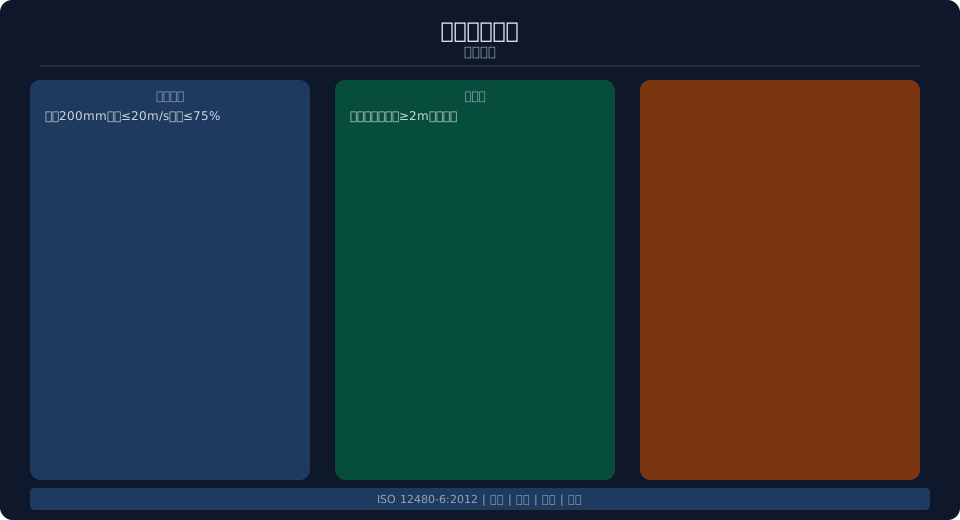
Operating a jib crane differs significantly from an overhead crane. During luffing, the center of gravity shifts as the boom moves, and the greater the change in working radius, the higher the bending moment imposed on the boom. When slewing, the suspended load generates centrifugal force—the larger the working radius and the faster the slewing speed, the greater the centrifugal force and the more severe the load swing. Wind affects jib cranes far more than overhead cranes because the boom's elevated height presents a larger wind-catching area. Working wind speed limits: portal base cranes ≤20 m/s, mast cranes ≤18 m/s, and floating cranes ≤15 m/s. During the trial lift, raise the load to 200 mm above the ground and hold for at least 30 seconds. After confirming no brake slippage, verify that the radius indicator reading matches the actual working radius within a deviation of ≤±2%. Also check the smoothness of the luffing mechanism during the trial lift—the boom should show no noticeable sagging or oscillation at the 200 mm height.
Multi-Crane Coordination and Special Conditions
When two or more jib cranes work in tandem, a dedicated lifting plan must be developed specifying each crane's positioning, working radius range, and the safety distance between booms when they cross. Each crane's load must not exceed 75% of its rated capacity, and a single coordinator directs all operations. The minimum clearance between booms must be at least 1.2 times the sum of the maximum working radii of the cranes involved. No other work is permitted within the zone where the booms of two jib cranes overlap. For special working conditions—when lifting large components with a substantial wind-catching area, a dedicated plan is required at wind force 4 (≥5.5 m/s), and hoisting must stop at wind force 6 (≥10.8 m/s). For marine operations, floating cranes must account for wind, wave, and current effects, with the vessel's heel limited to ≤5° and trim to ≤2°. For night operations, lighting must provide at least 50 lux of illumination over the load and the signal person's area. After each lift, lower the boom to its minimum radius or the designated anchoring position, raise the hook to at least 2 m below the boom tip, and detach the lifting spreader.
| safety elements | requirements | control measures |
|---|---|---|
| wind speed | ≤20m/s Portal base | Anemometeralarm and work suspension |
| Trial Lift | 200mm/30s | Brakingload drift≤10mm+Working radiusverification |
| multi-crane coordination | ≤75%+safe clearance | unified command under dedicated plan |
| Slewingoperation | ≤0.1rad/s² | smooth operation to prevent load swing-out |
| special working conditions | heavy loads in high wind/over water | dedicated safety plan |
| after operation | Boomanchoring/Hookhoisting up | cut off Power Supplydoor lock log |
Emergency Handling & Post-Operation Procedures
For jib cranes, emergency situations require specific responses. If wind speed suddenly exceeds the working limit, press the emergency stop, lower the boom to minimum radius, and anchor it to the ground anchoring points. In the event of hydraulic system pressure loss, activate the emergency lowering system—using the manual hydraulic pump or accumulator—to slowly lower the load to the ground, with manual release speed not exceeding half the rated speed. If abnormal wear or wire break is detected on the boom wire rope, stop operation immediately and lower the load using a spare rope or auxiliary system. After each shift, lower the boom to minimum radius, raise the hook to at least 2m from the boom head, detach the lifting spreader, cut the main power supply, lock doors and windows, and fill in the operation log. Shift handover includes a joint daily inspection with sign-off. Kelude Heavy Industry jib cranes are equipped with safety devices in compliance with ISO 12480-6:2012 for safe use.
| emergency situation | response measures | precautions |
|---|---|---|
| wind speed exceeded | Boomlower to Minimum radius+anchoring | —— |
| hydraulic pressure loss | emergency loweringsystem/Manual pump | speed≤50%rated |
| Wire Ropeabnormal | spare rope/lower via auxiliary system Load | out of service |
| Boomloss of control | Emergency Stop+caution zone | personnel exclusion zone |
Jib Crane FAQ: Safety Checks, Wind Limits & More
Q: What special checks are required during a jib crane trial lift?
A: In addition to checking the brake (with a maximum allowable drop of ≤10 mm), you must verify that the radius indicator reading matches the actual working radius within a deviation of ≤±2%. Inspect the luffing mechanism for smooth operation, ensuring the boom shows no noticeable sagging or sway. The trial lift should be held at 200 mm for at least 30 seconds.
Q: What are the wind speed limits for jib crane operation?
A: The limits are ≤20 m/s for portal base cranes, ≤18 m/s for mast-type cranes, and ≤15 m/s for floating cranes. When wind speeds reach Force 4 (≥5.5 m/s) and lifting a load with a large wind-catching surface, a dedicated lifting plan is required. All hoisting operations must stop at Force 6 winds (≥10.8 m/s). The anemometer is mounted at the boom tip for real-time monitoring.
Q: What are the safety requirements for multi-crane coordinated lifting?
A: A dedicated lifting plan must be developed. Each crane's load must not exceed 75% of its rated capacity. A single lift director coordinates all operations, and the clearance between booms must be at least 1.2 times the maximum working radius of any crane involved. No other work is permitted within the boom crossing zone. All crane movements are executed only upon the lift director's command.
Q: What is the proper shutdown procedure after jib crane operation?
A: Lower the boom to its minimum radius and secure it with anchoring. Raise the hook to at least 2 m below the boom head, detach the lifting spreader, and cut off the main power supply. Lock all doors and windows, then complete the operation log. During shift handover, perform a joint daily inspection and sign off. If the crane is out of service for 3 days or more, conduct a full daily inspection before putting it back into service.