

DMS System for Monitoring Crane Operator Behavior, Along with Cameras and Operational Logic-Based Safety Assistance Solutions
⚡ Overview of the Plan:This solution is a specialized technical solution for crane safety monitoring. By integrating sensors, AI algorithms, and edge computing technology, it enables real-time monitoring of the operational status of key crane components, fault prediction, and safety alerts. It represents a key technological pathway for the transition of industrial cranes from ”scheduled maintenance” to ”predictive maintenance.”
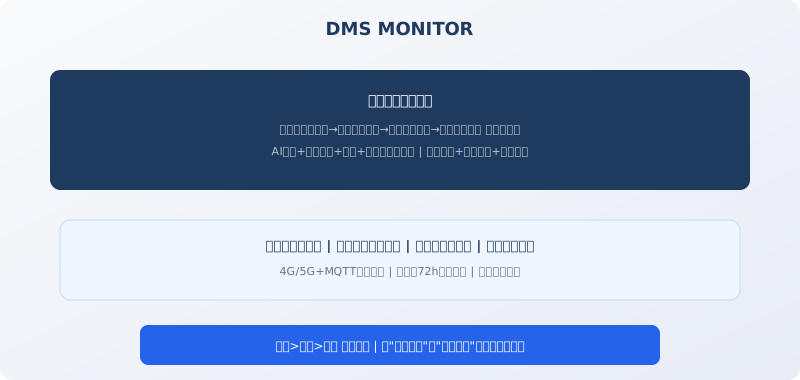
I. System Architecture
The crane safety monitoring system employs a three-tier ”end-edge-cloud” architecture. Perception Layer—Various types of sensors (vibration sensors, temperature sensors, current transformers, industrial cameras, microphone arrays, etc.) installed at critical locations on the crane continuously collect equipment status data at a sampling frequency of 1–10 kHz. Edge layer—Edge computing devices deployed on the crane (NVIDIA Jetson Orin NX or industrial-grade industrial PCs) perform real-time preprocessing of raw sensor data and AI model inference (such as vibration spectrum analysis, acoustic fingerprint recognition, and visual defect detection), enabling fault diagnosis for 90% and above to be completed at the edge without relying on the cloud. Cloud—Receives feature data and alarm information uploaded from the edge, performs long-term trend analysis, comparative analysis across multiple cranes, and equipment health scoring, providing data support for management decisions.
II. Key Monitoring Technologies
The system integrates multiple AI diagnostic technologies to enable comprehensive monitoring. Vibration spectrum analysis—IEPE accelerometers (range: ±50g, frequency response 0.5–10 kHz) on the reducer and motor bearing housings. Through FFT spectral analysis and envelope spectrum analysis, the system identifies characteristic frequencies of gear meshing faults and fault frequencies of bearing inner rings, outer rings, rollers, and cages, enabling the prediction of gear wear and bearing failures 2–6 weeks in advance. Acoustic Diagnosis—Install MEMS microphone arrays (4–8 channels) near the crane wheels to capture the friction acoustic signatures between the wheels and the track. Using a CNN (Convolutional Neural Network) model, the system identifies eight categories of rail-biting conditions (normal/mild/moderate/severe/unilateral/ bilateral/cyclical/intermittent), with an accuracy rate exceeding 95%. AI Visual Inspection—Utilizes the YOLOv8 deep learning model to perform real-time video analysis of the wire rope surface, detecting broken wires and wear (detection accuracy at the 0.1 mm level for broken wires), replacing manual visual inspections.
III. Early Warning and Coordinated Protection
The system is divided into three alert levels. Yellow Alert (Caution)—Monitored parameters exceed the normal range but remain within safe limits (e.g., vibration velocity of 2.8–4.5 mm/s). The system pushes an alert to the O&M personnel’s mobile app and the remote O&M platform, prompting them to schedule an inspection in the near future. Orange Alert (Warning)—Parameters are approaching safety limits (vibration 4.5–7.1 mm/s). The system automatically reduces speed to 50% of the rated speed and sends an emergency notification to the O&M supervisor. Red Alarm (Danger) — Parameters exceed safety limits (vibration > 7.1 mm/s or bearing temperature > 85°C). The system automatically cuts off the main circuits for hoisting and trolley travel and locks the system—power can only be restored manually after maintenance personnel confirm on-site that the fault has been resolved. The red alarm signal is directly connected to the crane’s safety relay circuit via hardwiring (relay contacts)—bypassing the PLC software logic—ensuring that the alarm protection function remains fully operational even if the PLC crashes.
Frequently Asked Questions
Q: How long will production be shut down while the monitoring system is being installed? Will this affect production?
A: The physical installation of the sensors can be completed in batches during the overhead crane’s routine downtime (shift changes, lunch breaks, or weekends)—vibration and temperature sensors are secured using magnetic bases or adhesive, requiring no drilling or welding on the crane. The installation time for all sensors on a single crane is approximately 4 to 6 hours (which can be completed in 2–3 sessions). Electrical wiring and control system commissioning require 1–2 days of downtime (scheduled for weekends or during off-peak production periods). Overall, the impact on normal production is manageable. In its installation plan, Krude Heavy Industry will confirm the downtime window with the customer in advance to minimize the impact on production as much as possible.
Q: Can retrofits be installed on old overhead cranes? The equipment is too old—can sensors be installed on it?
Answer: Yes. The suitability of retrofitting an older overhead crane (even one that is 10 to 20 years old or older) with a monitoring system primarily depends on: ① Electrical system—There must be an available 220V or 24V power source to supply power to the monitoring equipment; ② Safety relay circuit—There must be an emergency stop extension contact that can be connected in series (for automatic shutdown in response to a red alarm). If the old overhead crane lacks such an extension contact, an auxiliary contact module can be installed on the safety relay; ③ Installation space—the vibration sensor measures only φ20×30 mm, and the magnetic mounting base takes up virtually no additional space; a suitable installation location can be found on the vast majority of overhead cranes. Retrofitting an older overhead crane with a monitoring system is equivalent to adding ”digital senses” to the equipment, allowing for more precise assessment and management of its remaining service life.
Q: How do I resolve false positives? Frequent false positives are more annoying than not having the software installed at all.
Answer: False alarms are primarily caused by two factors: (1) Alarm thresholds are set too sensitively—since the duty classes and operating conditions of different overhead cranes vary significantly, using a single set of thresholds for all cranes will inevitably result in frequent false alarms for some of them. The solution is to enter ”learning mode” during the first 1 to 3 months after the system goes live—the system records the crane’s normal vibration and temperature fluctuation ranges, automatically generating a personalized baseline for that specific crane, and sets the alarm threshold to 1.5 to 2.0 times the baseline (rather than a fixed value); ② Transient sensor interference—such as electromagnetic interference from a welding machine operating nearby that affects the vibration sensors. The solution is to configure ”duration confirmation” in the software—a single instantaneous peak exceeding the threshold does not trigger an immediate alarm; an alarm is triggered only after the value exceeds the threshold continuously for 3–5 seconds (or for 3 consecutive sampling cycles), thereby filtering out the vast majority of transient interference.
Q: Where is the monitoring data stored? Is it secure?
A: The data uses a dual-storage architecture combining edge and cloud storage. Edge storage—the industrial control computer on the crane is equipped with a built-in 256GB SSD that saves full-resolution raw data at a rate of one record every 10 seconds (approximately 2KB per record), capable of storing approximately three years’ worth of data. Cloud-side—Compressed and de-identified feature data (spectral peak frequencies and their amplitudes, rather than the entire raw time-domain waveform) is uploaded via 4G/5G to privately deployed servers on platforms such as Alibaba Cloud or Huawei Cloud. Data is transmitted securely using TLS 1.3 encryption. Edge-side data is owned by the customer—the customer can export all raw data to a USB drive at any time. Cloud-based data is used solely for backup and remote diagnostics—the customer may request its deletion at any time. Krude Heavy Industries does not own or share customers’ equipment operation data.
