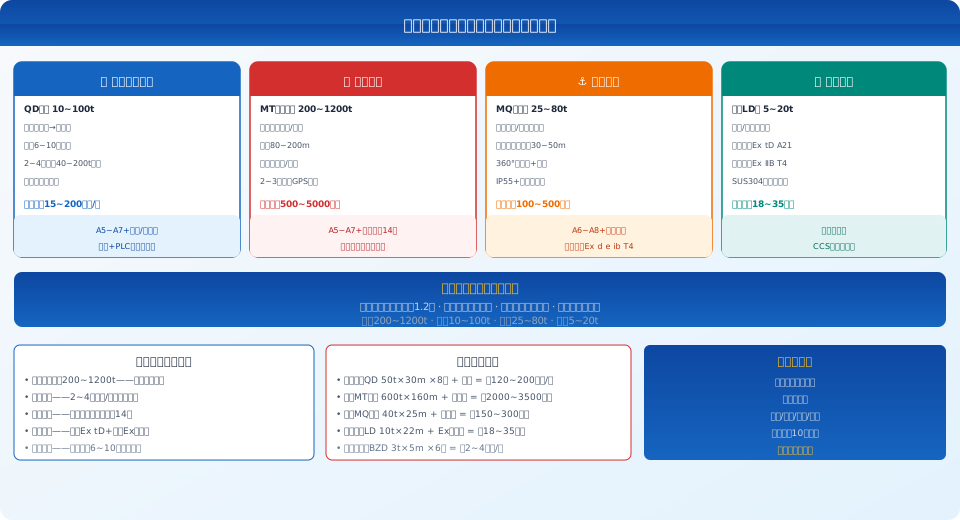

Shipyard Crane Selection Guide: Hull, Outfitting & Dock

Shipbuilding is one of the most demanding industries for crane applications in terms of lifting capacity and technical complexity. For block fabrication workshops, we recommend QD overhead cranes (10–100 t) operating in parallel or tandem-lift configurations; for final assembly in dry docks, MT-type shipbuilding gantry cranes (200–1,200 t) with twin-trolley synchronized lifting; for outfitting quays, MQ portal cranes (25–80 t); and for painting workshops, explosion-proof models are mandatory. Kelude Heavy Industry supplies a full range of gantry and overhead crane solutions tailored to shipyards.

Industry Solution · Shipbuilding
Crane Selection Guide for Shipbuilding
Four key applications: block fabrication, outfitting, painting, and quayside
Coverage: block fabrication · dry dock assembly · outfitting quay · painting workshop Capacity: 50–1,200 t ultra-large-tonnage gantry cranes + 10–50 t overhead cranes Configuration: twin-trolley synchronized lifting · multi-crane tandem lifting · anti-sway control · outdoor wind resistance

Shipbuilding is one of the most demanding industries for crane applications in terms of lifting capacity and technical complexity. From block fabrication to dry dock final assembly, from outfitting quay equipment installation to painting workshop operations, a coordinated fleet of lifting equipment ranging from 50 t to 1,200 t is required. Large shipbuilding gantry cranes — commonly known as "gantry cranes" — are the backbone of any shipyard, with lifting capacities up to 600–1,200 t and spans reaching 150–200 m, enabling the turnover, transport, and assembly of ultra-large blocks weighing 300–800 t. This guide provides a crane selection scheme for shipbuilding across four key scenarios: block fabrication, dry dock final assembly, outfitting quays, and painting workshops.

MarinemanufacturingIndustrycraneFour Major Scenariosconfiguration comparison

Shipbuilding Crane Configuration Comparison

← Scroll left / right to view full table →
Comparison ParameterSectionmanufacturing WorkshopDry Dock Final AssemblyOutfitting QuayPainting Workshop
recommended modelQD Typedouble-girder bridge craneMTShipbuilding Type Gantry CraneMQPortal slewing craneexplosion-proof type LDoverhead type
lifting capacity range10~100t200~1200t25~80t5~20t
Span/Radius28~42m80~200m25~40m(Luffing)18~28m
Lifting Height12~18m60~90m30~50m(Top)8~14m
control moderemote control+Cabin / Operator Cab Dual ControlMaster-Slave Linkage GPSPositioning360°Full Slewingexplosion-proof remote control
reference price15~8010k CNY500~500010k CNY80~30010k CNY18~3510k CNY

Shipbuilding Crane Applications: A Complete Overview

Block Fabrication Workshop
Steel plate pretreatment, cutting, sub-assembly, and final block assembly. Recommended: QD type overhead cranes, 10–100 t, with multi-crane parallel operation and tandem lifting.
Outfitting Quay
Equipment hoisting, piping installation, and mooring trials. Recommended: MQ portal cranes, 25–80 t, working in tandem with dock gantry cranes.
Painting Workshop
Block painting and sandblasting operations. Dust explosion-proof rating Ex tD A21. Recommended: explosion-proof LD type overhead cranes, 5–20 t.

Block Fabrication Workshop Cranes: Steel Plate & Block Handling

The hull block fabrication workshop — covering steel plate pretreatment, cutting, sub-assembly, and final block assembly — is the area with the highest crane density in any shipyard. A single block fabrication shop typically operates 10–30 QD type overhead cranes (10–100 t capacity), running in parallel within the same bay.

2.1 Multi-Crane Configuration in Block Workshops

  • Recommended model: QD type double-girder bridge crane (10–100 t), Work Duty A5–A7, span 28–42 m
  • Crane density: 6–10 QD overhead cranes per bay, spaced 12–18 m apart, each with its own dedicated work zone yet capable of coordinated tandem lifts
  • Tandem lifting: 2–4 QD cranes synchronized via master-slave control to handle large blocks (40–200 t, 10–30 m long)
  • Anti-collision system: Three-tier protection combining infrared, laser, and PLC-based anti-collision devices, with independently adjustable safety distance thresholds for each crane
  • Control mode: Dual control via remote control and operator cab (cab travels with the trolley for clear line-of-sight during block positioning)

2.2 Steel Plate Pretreatment & Cutting Lines

  • Recommended models: LD type single-girder bridge crane (5–16 t) or BZD column-mounted jib crane (2–5 t)
  • LD overhead cranes cover steel plate loading/unloading and intermediate transfer along the entire cutting line
  • BZD jib cranes are installed next to cutters for offloading finished plates and parts

Dock Assembly Gantry Cranes: Ultra-Large Shipbuilding Gantry Cranes

Dock final assembly represents the most demanding crane application in a shipyard. Ultra-large blocks (300–800 t, 20–50 m long) must be transported from the block storage yard to the dry dock using shipbuilding gantry cranes (MT type), where they are flipped, aligned, and joined.

3.1 Shipbuilding Gantry Crane (MT Type)

  • Lifting capacity: 200–1,200 t (by shipbuilding tonnage class: 200–400 t for ships under 100,000 dwt; 600–800 t for 100,000–300,000 dwt; 900–1,200 t for vessels above 300,000 dwt)
  • Span: 80–200 m (covering dock width plus storage areas on both sides)
  • Lifting height: 60–90 m (accommodating the elevation difference from ground level to dock floor)
  • Twin trolley configuration: Main trolley (high capacity) plus auxiliary trolley (lower capacity), operable independently or in tandem
  • Work duty: A5–A7 (determined by frequency of use and load spectrum)

3.2 Multi-Crane Tandem Lifting Control

For extra-large block assembly, two or even three shipbuilding gantry cranes may need to lift in coordination — for example, when handling the bow section of ultra-large container ships:

  • Multiple gantry cranes are synchronized via fiber-optic communication (control cycle <11 ms)
  • Three-axis synchronization error (hoisting, crane bridge travel, and trolley traverse) is held within ±10 mm across all cranes
  • Full GPS/RTK positioning system (accuracy ±2 cm) provides real-time display of each crane's spatial position
  • Multiple anemometers interlocked — voice alarm triggers when wind speed at any monitoring point exceeds Beaufort Force 6; hoisting operations automatically stop at Force 8 or above

Outfitting Quay Cranes: Portal Cranes & Gantry Crane Coordination

The outfitting quay is the primary work area after a vessel is launched — equipment hoisting, piping installation, mooring trials, and outfitting component installation. This area is dominated by MQ portal slewing cranes, supplemented by extended coverage from dock gantry cranes:

  • Recommended model: MQ portal slewing crane (25–80 t), Work Duty A6–A8, traveling on quay rails along the vessel's side
  • Lifting height: 30–50 m above quay level and 10–20 m below (covering the vessel's draft range)
  • Luffing mechanism: Hydraulic or rack-and-pinion luffing with a 15–30 m luffing range and load-luffing capability
  • Slewing mechanism: 360° continuous rotation at 0.1–0.5 rpm for precise positioning
  • Outdoor protection: IP55 protection rating, typhoon anchoring for summer storms, and winter freeze protection (grease rated to −30 °C)

Painting Workshop Cranes: Dust Explosion-Proof Environments

Ship painting workshops — including sandblasting and paint spray booths — are classified as dust explosion-proof zones. Sandblasting generates silica dust (Ex tD A21), while spray painting produces organic solvent vapors (Ex ⅡB T4). Cranes in these areas must be equipped with explosion-proof systems:

  • Recommended model: Explosion-proof LD type single-girder bridge crane (5–20 t), rated Ex d e ib ⅡB T4 Gb (gas) + Ex tD A21 IP6X (dust)
  • Material requirements: Main girder in stainless steel SUS304 or aluminum alloy (corrosion-resistant and rust-free); all fasteners in A4-80 stainless steel
  • Electrical protection: IP55 stainless steel control cabinet with conformal-coated PCBs; motors are Ex d ⅡB T4 explosion-proof type
  • Reference price: Explosion-proof LD 10 t/22 m with dual Ex certification: approximately $27,000–$52,000

Shipbuilding Crane Configuration Comparison

Comparison Parameter Sectionmanufacturing Dry Dock Final Assembly Outfitting Quay Painting Workshop
recommended model QDoverhead type10~100t MTGantry Crane200~1200t MQPortal base25~80t Explosion-proof LD 5~20t
Work Duty / Classification A5~A7 A5~A7 A6~A8 A4~A5
Open-air/Indoor Indoor Outdoor Outdoor Indoor
safety requirements Multiple Unitstandem lifting+anti-collision GPSPositioning+Wind Anchor+Multiple Unitstandem lifting Wind Protection+Lightning Protection Ex Explosion-proof+Ventilationinterlock
reference price 15~20010k CNY/Multiple Units 500~500010k CNY 100~50010k CNY 18~3510k CNY

Kelude Service Advantages for the Shipbuilding Industry

  • Large Gantry Crane Manufacturing Capability: Kelude Heavy Industry designs and manufactures shipbuilding gantry cranes with lifting capacities from 200t to 1,200t. The main girders are available in box girder or truss girder configurations, with span, lifting height, and twin trolley setups customized to the shipyard's specific site conditions and production processes.
  • Multi-Crane Tandem Lifting Control System: Kelude's interlocking control system supports master-slave synchronized operation of up to four cranes (combinations of bridge and gantry cranes) with a synchronization accuracy of ±10 mm. This system has been successfully deployed in extra-large block assembly operations at multiple shipyard projects.
  • Lifecycle Service: From initial shipyard planning and equipment installation & commissioning to operator training and annual maintenance, Kelude provides shipbuilding customers with a 2-year warranty on complete cranes (10-year warranty on main girders of large gantry cranes) and 7×24 after-sales service nationwide.
Selection Recommendations: The core principle for shipyard crane selection is "match the gantry crane to tonnage, match the bridge crane to the work process." The capacity of the final assembly gantry crane in the dry dock is determined by the heaviest block weight (a safety margin of 1.2 to 1.3 times is recommended). Bridge cranes in block fabrication workshops should support both independent operation and tandem lifting modes. Portal cranes at the outfitting quay require sufficient coverage for the vessel's freeboard. We recommend that Kelude's technical team conduct a site survey at the shipyard before issuing a complete plant solution.
1,200t
Max Gantry Crane Capacity
Ultra-large block assembly
200m
Max Gantry Span
Dry dock coverage
90m
Max Lifting Height
Dry dock assembly requirements
±10mm
Tandem Lifting Sync
GPS/RTK positioning
Level 8
Wind Speed Threshold
Outdoor operation safety
30 Units
Max Cranes per Workshop
Block workshop density

Frequently Asked Questions

Q: Should I use a gantry crane or an overhead crane for hull block fabrication?

A: For hull block fabrication (both flat panel and curved block production lines), a gantry crane is the recommended solution. Gantry cranes do not require factory building corbels or runway beams (shipyard fabrication shops typically use lightweight steel structures, and installing an overhead crane would require reinforcing the building columns). They also offer greater flexibility in span and capacity (common spans of 30–50m and lifting capacities of 50–200t) and can cover multiple stations, including block turning and welding positions, with a single crane. For dry dock final assembly, large gantry cranes (300–1,000t, spans of 120–180m) are used. However, overhead cranes (32–100t, spans of 22–34m) can be used in the indoor sections of block workshops. Recommended approach: use overhead cranes for indoor light-load block lines and gantry cranes for outdoor heavy-load block lines. Kelude Heavy Industry offers a full range of both gantry-type and overhead-type crane solutions for shipyards.

Q: What lifting height is required for cranes at an outfitting quay?

A: The required lifting height for outfitting quay cranes depends on the vessel's freeboard during the outfitting stage and the height of the outfitting components being lifted. For bulk carriers (50,000–100,000 DWT), freeboard is 8–12m, requiring a lifting height of 12–18m. For container ships (8,000–15,000 TEU), freeboard is 10–16m, requiring a lifting height of 16–24m. For large LNG carriers, freeboard is 12–18m, requiring a lifting height of 20–28m. The lifting height of a quayside portal crane must cover the vessel's maximum freeboard plus the outfitting component height plus the spreader height plus a safety margin of 3–5m. Tidal effects must also be considered (in areas with large tidal ranges, an additional 2–3m of lifting height margin is required). Kelude Heavy Industry provides portal crane and gantry crane solutions based on specific dry dock and quay parameters.

Q: Do cranes in a painting workshop require explosion-proof protection?

A: Shipyard painting workshops (including sandblasting and spray-painting sections) are classified as explosive atmospheres, so the cranes used there must be explosion-proof. Per GB 50058: the spray-painting area (with solvent vapor from thinners) is classified as Zone 1 or Zone 2, requiring Explosion Protection Class Ex d e mb IIB T4 (for xylene/toluene-based solvents); the paint mixing room is Zone 1, also requiring Ex d e mb IIB T4, with online detection of flammable gas concentration. The sandblasting section has high dust levels but the media (steel shot/copper slag) is non-combustible, so no explosion-proof rating is needed—only dustproof protection (IP54 or higher). For painting workshop cranes, we recommend an explosion-proof electric hoist (BCD type) with a stainless steel manual trolley, and the electrical control cabinet should be located outside the explosion-proof zone. Kelude Heavy Industry provides explosion-proof crane solutions for shipyard painting workshops.

Q: How do shipyard cranes resist salt-spray corrosion?

A: Operating in coastal environments, salt-spray corrosion is the primary failure mode for shipyard cranes. Our protection solution includes: steel structure coating—Epoxy Zinc-Rich Primer (zinc content ≥80%) + Epoxy MIO Intermediate Coat + Polyurethane Topcoat, with a minimum total dry film thickness of 280 microns (C5-M grade). Bolted connections are sealed with sealant and fitted with stainless steel caps. For electrical protection—the control cabinet is rated IP56 or higher (stainless steel or stainless steel-clad), motors are IP55 or higher (outdoor motors come standard with a rain cover), and all connectors are stainless steel or naval brass. For lubrication—we use seawater-resistant grease (calcium sulfonate complex grease), and exposed lubrication points are fitted with sealed dust covers. Kelude's coastal shipyard cranes come standard with C5-M grade anti-corrosion coating.

Related News

contact

contact us

phone:
+86 13903802779

mail:3915269@qq.com

Working hours: Monday to Friday

Wechat
Wechat
SHARE
TOP