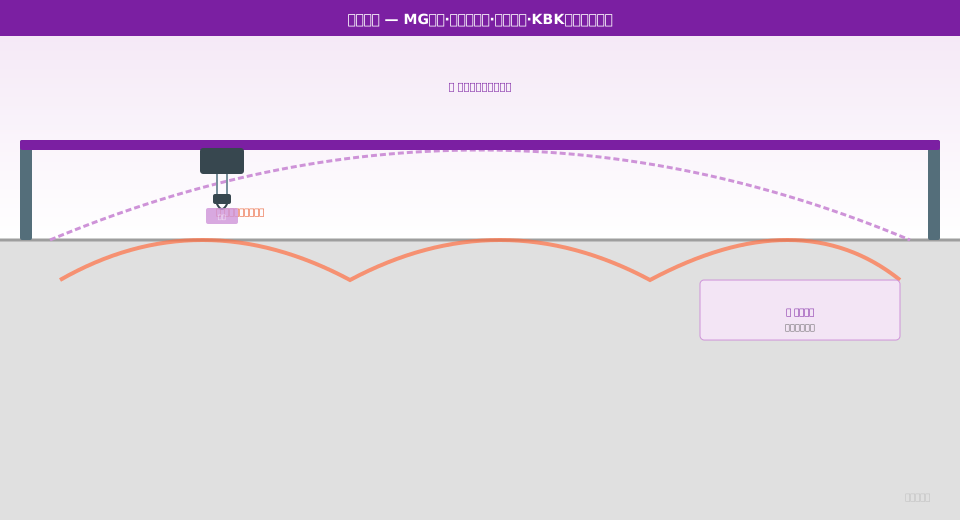

Crane Configuration for Sports Venues & Amusement Equipment
Crane configurations for stadiums, amusement ride manufacturing, and stage production must address three distinct applications — for stadiums, overhead electric hoists in the 2–5 t range (roof maintenance); for amusement rides, QD overhead cranes from 16–50 t (track section turnover and tack-up); and for performance stages, KBK flexible systems from 0.5–2 t (rigging for lighting and audio). Kelude can tailor the crane rail layout to your venue's span.
The stadium and amusement ride sector presents unique demands for overhead lifting equipment. During stadium construction and maintenance, long-span gantry cranes are required for steel truss erection and suspension system installation. Amusement ride manufacturers (roller coasters, Ferris wheels, carousels, etc.) rely on medium-duty cranes in fabrication workshops for steel structure welding and mechanism assembly. Stage production systems — including lighting and audio rigging — need crane-assisted installation and maintenance. This article outlines crane configuration solutions across three key scenarios: stadium construction, amusement ride manufacturing, and stage production systems.
Crane Configuration Comparison for Sports & Amusement
| Comparison Parameter | Stadium Construction | Amusement Ride Equipmentmanufacturing | Performing Arts Stage |
|---|---|---|---|
| recommended model | Suspended Type Electric Hoist | QD Typedouble-girder bridge crane | KBK flexible system |
| Lifting Capacity Scope | 2~5t | 16~50t | 0.5~2t |
| Operating Characteristics | Roof Structuretruss Crane Rail Operation | Crane Rail Segment Tippingtack-up | Lighting & Sound Suspension |
| Positioning Accuracy | ±20mm | ±1mm(Crane Rail Docking) | ±10mm |
| control mode | Remote Control | variable frequency micro-speed+tandem lifting | Manual Push-Pull |
| reference price | 10~3010k CNY | 30~10010k CNY | 3~810k CNY/Set |
Stadium Construction Cranes: Large-Span Steel Truss Hoisting
Roof systems for sports venues (stadiums, arenas, natatoriums) typically use large-span steel truss structures (spans of 60–120 m, truss weights of 20–100 t). Crane requirements during steel erection include hoisting of steel columns, steel trusses, purlins, and the roof system itself:
- Erection gantry/crawler cranes: Large crawler cranes or truck cranes are typically used for stadium steel erection (outside the scope of this guide — these are mobile-type cranes, not overhead or gantry cranes). However, maintenance cranes installed after stadium completion (maintenance access cranes suspended from the roof truss lower chord) are standard overhead/underslung cranes.
- Roof maintenance cranes: A maintenance rail plus electric hoist (1–5 t) is typically installed beneath the stadium roof for installation and maintenance of lighting, audio, ventilation ductwork, and fire protection equipment. The rail runs along the truss bottom chord, with coverage spanning the full roof area.
- Outdoor anti-corrosion: Stadium roof maintenance cranes operate in semi-outdoor/outdoor environments (sheltered by the roof but exposed to wind and rain), requiring C4–C5 anti-corrosion coating, IP55 protection, and corrosion-resistant stainless steel fasteners.
Amusement Ride Manufacturing Cranes: Structural Welding & Track Assembly
Amusement ride manufacturing (roller coasters, Ferris wheels, carousels, pendulum rides, drop towers, etc.) centers on steel structure welding and mechanism assembly. Structural components — roller coaster track columns and runway beams, Ferris wheel rims and lift car frames — are long (6–18 m), moderately heavy (2–20 t), and demand high welding and tack-up accuracy:
- Welding workshop: QD-type double-girder bridge cranes (16–32 t) handle tack-up welding, flipping, and transfer of amusement ride steel structures. Configure 3–5 units per bay at 15–20 m spacing.
- Track assembly area: Roller coaster track sections (6–12 m per segment) require precise alignment during assembly (track joint offset ≤1 mm). Cranes need variable frequency micro-speed control (minimum speed 0.3–0.5 m/min), with a laser alignment tool assisting track segment mating.
- Final assembly/commissioning area: LH-type bridge cranes (10–20 t) are used for final assembly and commissioning — e.g., Ferris wheel rim assembly (segment lifting onto assembly jigs) and carousel platform hoisting.
- Reference price: QD-type 20 t/24 m: approximately $37,000–$59,300; LH-type 10 t/22 m: approximately $22,200–$32,600.
Stage & Performance Venue Cranes: Rigging Installation
Large performance venues (theaters, concert halls, broadcast studios, multi-purpose arenas) require lighting battens, audio rigging systems, stage curtain tracks, and stage machinery (lifts, turntables, wagons). Installing and maintaining this equipment calls for cranes above the stage area:
- Recommended model: Bridge crane (10–50 t) with a span covering the stage width (typically 20–40 m), installed at the catwalk/grid level above the stage.
- Variable frequency micro-speed: Precise positioning is critical when installing lighting and audio rigging (fixture spacing and speaker angle adjustments require accuracy). The crane needs variable frequency micro-speed control (minimum 0.2–0.5 m/min).
- Specialized spreader: Lighting batten installation uses a long cross beam spreader (6–12 m with adjustable lifting points); audio rigging uses a dedicated lifting frame with adjustable suspension point spacing to suit different speaker line-array brands and models.
- Time-shared usage: Stage cranes are not typically used around the clock (only during equipment installation and major maintenance), but must remain ready for use at all times. Recommended configuration: variable-frequency speed control plus two-speed modes — two-speed (fast/slow) for routine maintenance, variable frequency (stepless speed regulation) for major installations.
Kelude Service Advantages for Sports & Amusement Industries
- Large-span gantry crane experience: Kelude has the Design & Manufacturing capability for MG-type gantry cranes (50–200 t, spans of 30–50 m), meeting the large gantry crane needs of stadium steel truss erection and amusement ride manufacturing facilities.
- Variable frequency micro-speed accuracy: Amusement ride track alignment demands high accuracy (joint offset ≤1 mm). Kelude's variable frequency micro-speed system delivers 0.2 m/min low-speed control with millimeter-level positioning accuracy.
- Outdoor anti-corrosion expertise: Stadium roof maintenance cranes and gantry cranes in open-air amusement ride fabrication yards operate in outdoor environments year-round. Kelude provides outdoor anti-corrosion solutions with C4–C5 coating, IP55 protection, and stainless steel fasteners.
FAQ
Q: What lifting capacity is required for a stadium roof maintenance crane?
A: The required lifting capacity is determined by the heaviest component that needs servicing. Stage lighting and audio equipment typically weighs 50–200 kg per unit, HVAC units range from 200 to 2,000 kg, sports lighting (field lighting luminaires) falls between 50 and 150 kg, and retractable seating/telescopic stand mechanisms weigh 500–3,000 kg. In practice, a 2–5 t capacity covers over 95% of maintenance tasks. For mega-stadiums (seating 60,000–100,000), where large advertising boards or temporary installations may need to be hoisted beneath the roof, a 10 t class maintenance crane is recommended. Kelude offers an under-hung electric hoist solution that travels along rails mounted on the lower chord of the roof truss, with rail coverage spanning the full stadium width. A single system, including rail, hoist, and power supply, is typically priced between $15,000 and $45,000.
Q: What special requirements do roller coaster track fabrication cranes need to meet?
A: Roller coaster track is built from prefabricated segments (6–12 m long, 2–5 t each) that are tacked up and welded together in the fabrication shop. Alignment accuracy between segments is critical: surface mismatch must not exceed 1 mm after weld grinding, and cross-section twist is limited to 2 mm. Kelude's crane solution addresses these demands in three ways: ① Overhead cranes in the welding area are equipped with variable frequency micro-speed drives (creep speed down to 0.3 m/min), allowing operators to lower track segments onto the tack-up fixture with precision, guided by a laser alignment tool to confirm joint position; ② The main and auxiliary hooks work together to flip track segments — each segment must be welded on one side, turned over, and welded on the other; ③ Long track assemblies (built up from 3–5 segments, 20–50 m in length) are moved using two overhead cranes in tandem — synchronized hoisting and traveling moves the complete assembly from the fabrication area to storage or shipping.
Q: How is a studio stage crane different from an industrial crane?
A: The main difference between cranes installed above studio/theater stages and industrial cranes comes down to four factors: ① Noise control — stage cranes may be operated during performances (e.g., rigging temporary scenery), so running noise must stay at or below 45 dB(A), compared to 80 dB(A) for typical industrial units. This requires low-noise motors, flexible couplings, vibration-damping mounts, and wire rope dampers. ② Aesthetics — the stage area is visible to the audience, so the crane is finished in matte black, gray, or a color coordinated with the interior décor, rather than the standard yellow/red safety colors. ③ Speed control — precise micro-speed control down to 0.1 m/min is essential for installing and commissioning lighting and audio equipment. ④ Dual-brake safety — since the crane operates directly above performers and audience areas, a dual redundant braking system is mandatory to guarantee that a suspended load can never drop unexpectedly.
Q: What is the typical investment in cranes for an amusement ride manufacturer?
A: For a mid-sized manufacturer producing 50 large amusement rides per year (roller coasters, Ferris wheels, carousels, etc.), a typical crane investment breaks down as follows: ① Welding workshop — four QD Type 20 t overhead cranes at approximately $150,000–$240,000, used for structural component tack-up, welding, and flipping; ② Track assembly shop — two QD Type 16 t overhead cranes with variable frequency micro-speed drives at roughly $53,000–$89,000, for track segment alignment and welding; ③ Final assembly and commissioning bay — two LH Type 10 t overhead cranes at about $45,000–$65,000, handling complete machine assembly and testing; ④ Finished goods yard — one MG Type 32 t gantry crane at approximately $89,000–$148,000, for loading and shipping large rides. The total plant investment ranges from about $335,000 to $540,000. Kelude can provide whole plant solution design and volume purchase discounts.