Overhead Crane Configurations for Elevator Manufacturing

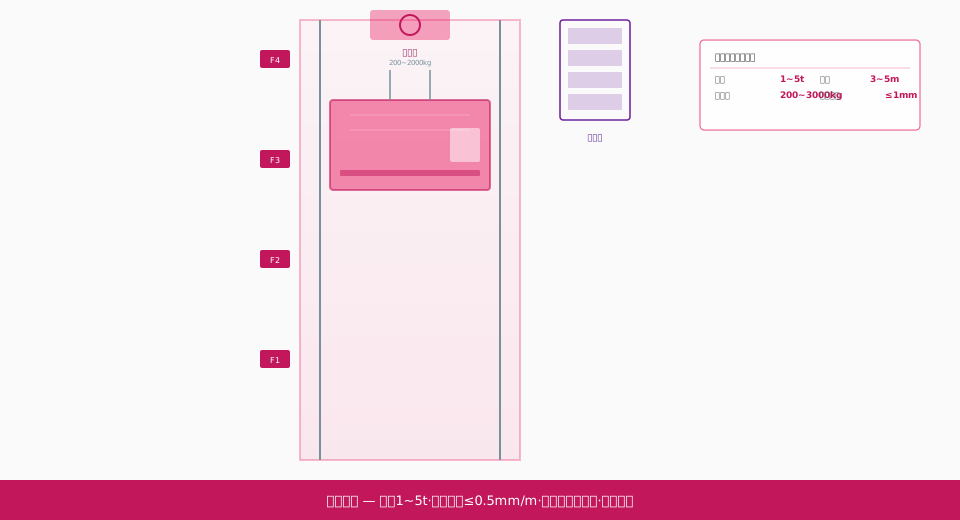
Elevator manufacturing (passenger, freight, escalator, and medical elevators) involves four key stages: car body welding and assembly, guide rail machining, traction machine assembly, and control cabinet assembly. Car bodies weigh 1–5 t, guide rails come in 3–5 m lengths (5–25 kg/m, or 15–125 kg per rail), traction machines range from 200 to 2,000 kg, and control cabinets from 100 to 500 kg. Recommended configuration: LD-type overhead crane (3–10 t) + KBK flexible system (0.25–1 t) + BZD jib crane (0.5–2 t). Kelude Heavy Industry offers tailored crane configurations for the elevator sector based on elevator type — passenger, freight, or escalator.

Industry Solution · Elevator Manufacturing
Crane Configurations for Elevator Manufacturing
Assembly lines for car bodies, guide rails, traction machines, and control cabinets
elevatormanufacturingcranelive view

Precision Welding & Assembly of Stainless Steel Elevator Cars

An elevator car consists of the platform, walls, ceiling, and doors — typically finished in brushed stainless steel, the standard decorative surface for elevator interiors. The main challenges in car manufacturing: ① Stainless steel surfaces are extremely sensitive — any scratch, dent, or oil stain compromises the finish; ② Wall panels are large (0.8–1.6 m wide, 2–3 m high) yet thin (1–1.5 mm), making them prone to deformation during lifting; ③ Final assembly requires precise alignment of multiple panels (gap tolerance ≤1 mm).

Recommended model: LD-type overhead crane, 3–5 t / 12–18 m span. The workshop crane must be fitted with a specialized spreader — a vacuum lifter (suction cups grip the stainless steel surface without contact marks) or nylon slings with edge protectors (silicone protective sleeves where slings contact the panels). Two-speed or VFD hoisting is recommended: fast no-load lifting (8 m/min) plus creep speed under load (0.5–1 m/min).

Price reference: LD overhead crane, 3 t / 15 m span: approx. $4,500–$8,900 per unit; vacuum lifter: approx. $3,000–$7,400 per set. Kelude's car-body workshop solution comes standard with a vacuum lifter, completely eliminating lifting damage to stainless steel surfaces.

Guide Rail Handling for Long-Stroke Machining Lines

Elevator guide rails (T-type or hollow rails) are the running tracks for the elevator car. Each rail is 3–5 m long with stringent accuracy requirements (working surface straightness ≤0.5 mm/m). The machining line covers: profile steel feeding → milling → straightening → end machining → inspection → oiling → packaging. Guide rail handling presents two challenges: ① High slenderness ratio (5 m long × 16–24 mm thick) means significant bending during lifting — multiple lifting points are required to maintain straightness; ② Accuracy requirements — any flex during handling compromises rail straightness.

Recommended model: LD-type overhead crane, 3–5 t / 18–30 m span (guide rail workshops are typically wide). Equip with a multi-point beam spreader (3–5 lifting points distributed along the rail length, with automatic leveling). Handling frequency is high — each rail requires 5–8 lifts from incoming material to finished goods — so a fast hoisting speed (12 m/min no-load) is recommended for throughput.

Price reference: LD overhead crane, 5 t / 24 m span: approx. $8,900–$17,800 per unit; multi-point beam spreader: approx. $1,500–$4,500 per set. Kelude's guide rail workshop solution includes a multi-point beam spreader to preserve rail straightness throughout every lift.

Precision Alignment of Heavy Traction Machine Drive Units

The traction machine (permanent magnet synchronous, asynchronous, or geared) is the heart of the elevator drive system. Weights range from 200 to 2,000 kg (home elevators: 200–500 kg; passenger elevators: 500–1,500 kg; freight and large-tonnage units: 1,000–3,000 kg). The most critical assembly step is rotor-to-stator insertion — the rotor must be guided precisely into the stator bore (air gap of only 1–3 mm), demanding extreme positioning accuracy. With permanent magnet synchronous machines, the rotor carries strong magnets, creating a magnetic pull hazard during handling.

Recommended model: LD-type overhead crane, 3–10 t, plus dedicated positioning fixtures. The assembly area should include a slewing platform (tilting the traction machine 0–90° for convenient motor and brake assembly) and a precision transfer trolley (moving finished units from assembly to testing). The crane hoist must offer a creep speed (0.2–0.5 m/min) for precise rotor alignment.

Price reference: LD overhead crane, 5 t / 15 m span: approx. $7,400–$14,800 per unit; slewing platform: approx. $4,500–$8,900 per unit. Kelude's traction machine assembly solution (1 LD crane + 1 slewing platform + 2 BZD jib cranes) totals approximately $17,800–$32,600.

Light-Duty Lifting for Precision Electrical Control Cabinets

Elevator control cabinets (integrating VFD, control board, contactors, and braking resistors) weigh 100–500 kg and typically measure within 1 m × 0.6 m × 2 m. The assembly workshop requires a clean environment (electrical components are dust-sensitive) and anti-static measures (electronic components are vulnerable to electrostatic breakdown). Handling characteristics: light loads but frequent operations, with positioning accuracy required when aligning cabinets onto test platform guide rails.

Recommended model: KBK flexible suspension system, 0.25–0.5 t + BZD jib crane, 0.25–0.5 t. The KBK system covers the full process — assembly, testing, and packaging — with an independent trolley at each workstation. Anti-static configuration: KBK rail earthing resistance ≤4 Ω, hoist chain in anti-static nylon, and lifting slings in anti-static fabric. For large cabinets ≥300 kg, an LD-type overhead crane (3 t) can be added.

Price reference: KBK system, 0.25 t: approx. $3,000–$5,900 per set; BZD jib crane, 0.25 t: approx. $1,200–$2,200 per unit. Kelude's control cabinet assembly solution (1 KBK system + 3 BZD jib cranes) totals approximately $5,900–$11,900.

Elevator Manufacturing Crane Configuration Comparison

← Scroll left / right to view full table →
Assemblylinkrecommended modeltonnage/Spanspecialconfigurationreference price
Lift carLDoverhead type+Vacuum Lifter3~5t/12~18mVacuum Lifter/guardsangle3~6universal
Guide railLDoverhead type+multi Lifting point Cross Beam3~5t/18~30mself-leveling Lifting spreader6~12universal
traction machineLDoverhead type+turning Slewing platform3~10tCreep speed0.2m/min12~22universal
Control CabinetKBK+BZD0.25~0.5tanti-static/clean4~8universal

Key Crane Parameters for Elevator Manufacturing

Lift Car Weight
1–5 t
Passenger & freight elevators
Guide Rail Length
3–5 m
T-type elevator rails
Traction Machine
200–3,000 kg
Residential to heavy-duty
Positioning Accuracy
Gap ≤ 1 mm
Lift car panel alignment
Guide Rail Straightness
≤ 0.5 mm/m
Straightness requirement
System Investment
$4,500–$33,000
Varies by assembly stage

Kelude Service Advantages for Elevator Manufacturing

① Stainless Steel Surface Protection: Kelude's lift car manufacturing crane solutions come standard with vacuum lifters and nylon slings with protective corner guards, completely eliminating surface damage to stainless steel car panels during lifting and transport, reducing rework and scrap rates.

② Long-Workpiece Handling: For elevator guide rails (3–5 m) and car wall panels (2–3 m), Kelude offers multi-point beam spreaders with automatic leveling and vacuum suction beam spreaders, ensuring long workpieces stay balanced and tilt-free throughout the lift.

③ Station-Level Precision Solutions: Traction machine rotor assembly requires creep-speed control at 0.2–0.5 m/min, while control cabinet assembly demands an anti-static, clean environment — Kelude's elevator industry solutions are custom-configured to meet these precision requirements.

FAQ — Elevator Manufacturing Cranes

Q: Why use vacuum suction lifters for stainless steel elevator car panels?

A: Elevator car panels are made of hairline-finished stainless steel with a fine brushed texture that is extremely sensitive — wire rope friction leaves permanent scratches, and pressure from standard slings creates indentations that show up as reflective differences where the texture is flattened. Vacuum lifters raise the panel using suction force, and the soft rubber contact surface of the suction cups leaves no trace on the material. Kelude's vacuum lifters are equipped with 4–8 independent suction cups, each with its own air supply, so even if one cup fails, safe lifting is maintained. Cup positions can be adjusted to fit panel dimensions (0.8–1.6 m wide × 2–3 m high).

Q: Why do guide rail machining workshops need large-span cranes?

A: Elevator guide rails (T-type and hollow rails) come in standard lengths of 3–5 m. A typical rail machining line is laid out as: steel profile storage (holding 6 m sections) → milling line (approx. 20–30 m long) → straightening → end finishing → inspection → oiling and packaging. The entire line runs lengthwise through the workshop, which needs to be 12–20 m wide to accommodate equipment and personnel access. Rail handling combines longitudinal moves (from storage to the machining line) and transverse moves (across the line to inspection), so a crane span of at least 18–24 m is required to cover the full width of the line. Kelude's recommended span for rail workshops is: workshop width minus 4–6 m (leaving 2–3 m of aisle on each side), balancing coverage with crane cost.

Q: Why is a slewing platform needed for traction machine assembly?

A: Traction machine assembly involves work from multiple directions: ① vertical — mating the motor stator and rotor (lowering the rotor into the stator from above); ② horizontal — fitting the brake and motor end cover (requiring side access to the motor); ③ bottom — installing the encoder and junction box (requiring a 90° tilt to reach the underside). Without a slewing platform, each repositioning requires the crane to lift the machine while 3–4 workers manually flip it and set it back down. A slewing platform costs approximately $4,500–$9,000, provides powered 0–90° tilt positioning, and cuts repositioning time from 5 minutes to 10 seconds. Kelude's slewing platforms are designed to integrate with the crane — the crane's lifting spreader can connect directly to the traction machine on the platform, eliminating the need for re-rigging.

Q: What is the typical total investment for cranes in an elevator manufacturing workshop?

A: Using a factory producing 3,000 passenger lifts per year as an example: ① One LD 3t/15m crane with vacuum lifter in the lift car workshop (approx. $40,000–$75,000); ② One LD 5t/24m crane with multi-point lifting spreader in the guide rail workshop (approx. $60,000–$120,000); ③ One LD 5t crane with turnover table in the traction machine assembly area (approx. $75,000–$135,000); ④ One KBK system with three BZD hoists in the control cabinet assembly area (approx. $30,000–$60,000). Total investment: approximately $200,000–$375,000. Based on a 30% reduction in lifting and transport auxiliary time, a 70% decrease in product damage and rework, and savings of 2–3 lifting and transport workers, the investment can typically be recovered within 14–18 months. Kelude offers complimentary integrated solution design and return on investment analysis.

Related News

contact

contact us

phone:
+86 13903802779

mail:3915269@qq.com

Working hours: Monday to Friday

Wechat
Wechat
SHARE
TOP