

What type of crane is used in a welding rod, welding wire, and flux production workshop? Selecting equipment for welding material manufacturing
📌 Welding consumables manufacturers equip their facilities with cranes according to four categories: welding rods, welding wires, welding fluxes, and brazing materials. The electrode workshop uses LH-type 5–10-metric-ton cranes for lifting drying ovens; the welding wire workshop uses LD+KBK 3–5-metric-ton workstation-based rapid-lift cranes; the flux workshop uses LD-type 3–10-metric-ton cranes with dust and moisture protection; and the brazing material workshop uses KBK 0.5–2-metric-ton cranes with anti-theft measures for precious metals. The total investment for the entire plant ranges from 150,000 to 800,000 yuan.
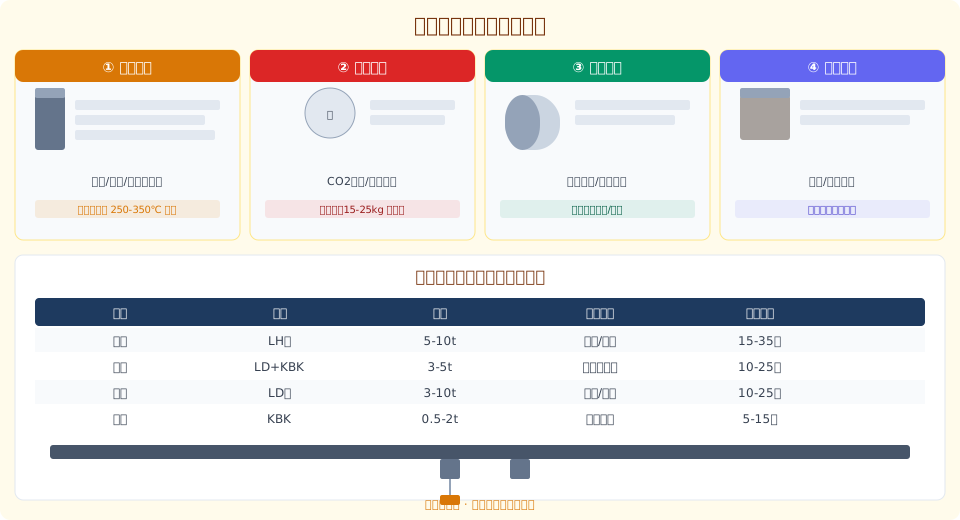
Electrode Workshop—Crane Configuration Between the Drying Oven and the Coating Machine
Welding rod production process: wire drawing → wire cutting → extrusion coating → drying (250–350°C) → packaging. Among these, the drying oven and the extrusion coater are the areas where cranes are used most frequently. Welding rod drying ovens weigh 3–8 metric tons, requiring cranes to assist with installation and maintenance. Coating machine molds weigh 200–800 kg and are replaced 2–6 times daily. We recommend LH-type 5–10 metric ton overhead cranes with a span of 10–18 meters. The welding rod workshop is characterized by high dust levels (from flux powder), so the crane’s electrical enclosure must be equipped with an air filtration system. The LH-type cranes designed by Krude Heavy Industry for welding rod workshops come standard with corrosion-resistant wire ropes (with thickened galvanized coating) and sealed electrical enclosures (IP5X dust protection rating). For the drying furnace area, a two-speed hoisting speed of 6/1.5 m/min is recommended, with the low speed used for precise positioning of material racks inside the furnace.
The welding rod packaging line is highly automated, and the packaging equipment (weighing → sealing → boxing) is mostly arranged in an assembly line configuration. The primary need for cranes in the packaging area is for replacing parts during equipment maintenance. Space can be reserved above the packaging line for an LD-type 3–5-metric-ton short-span crane or a monorail hoist system. Krud Heavy Industry recommends a dual-crane solution combining LH and LD types for the welding rod workshop: the LH type in the main workshop handles the coating and drying areas, while the LD type covers the packaging area for light-load applications. The total investment in cranes for the entire welding rod production line is approximately 150,000–350,000 yuan. For welding rod factories with expansion plans, the LH-type cranes can be equipped with track extension interfaces to facilitate track splicing when the workshop is extended in the future.
Welding Wire Workshop—Crane Plan for Coil Handling Workstations
The production line for CO₂ gas-shielded welding wire and submerged arc welding wire includes: wire rod drawing → electroplating/copper plating → layer winding → packaging. Welding wire spools typically weigh 15–25 kg (15 kg spools or 20 kg spools). The equipment in the welding wire workshop is relatively lightweight (wire drawing machine motors weigh 500–2,000 kg; layer winding machines weigh 300–800 kg), but the equipment is densely arranged, and maintenance space is limited. We recommend a combined solution featuring LD-type 3–5-metric-ton cranes and KBK workstation hoists: LD-type cranes cover heavy-load areas such as the wire drawing zone and annealing furnace zone, while KBK flexible hoists cover maintenance of workstation equipment in the layer winding and packaging zones. Krud Heavy Industry’s welding wire workshop solution emphasizes the coordinated design of overhead piping and equipment bases—planning crane tracks and related clearance spaces during the equipment layout phase.
Another critical aspect to consider in the welding wire workshop is the handling of the copper plating solution. The copper plating tank area is subject to acid and alkali corrosion (copper sulfate, sulfuric acid); therefore, it is recommended that cranes in this area use hot-dip galvanized rails and main beams with anti-corrosion coatings. For the chain hoists on KBK workstation cranes, we recommend using stainless steel housings or anti-corrosion coatings. The anti-corrosion solutions provided by Krude Heavy Industry for welding wire workshops have been implemented on multiple copper plating production lines, extending equipment service life by 2 to 3 times. The investment in cranes for the welding wire workshop is approximately 100,000–250,000 yuan (LD type + KBK). It is recommended to reserve lifting access points for tank inspection and maintenance within the coverage area of the cranes in the copper plating zone to facilitate the hoisting of heavy loads during future tank replacements.
Flux Workshop—Crane Design for Dust and Moisture Protection
In the production processes for sintered and smelted fluxes, dust issues arise during screening, drying, and packaging. The main components of flux (silicates, manganese ore, titanium ore, etc.) are highly hard and abrasive. The design of cranes in flux production workshops must prioritize dust and moisture protection. We recommend the LD model with a capacity of 3–10 metric tons, featuring an electrical enclosure with an IP54 or higher protection rating and a fully enclosed motor with cooling fins. Dust covers must be installed on the crane rails to prevent flux dust from accumulating on the rail surface and causing the wheels to slip. Krud Heavy Industry’s experience in flux workshops indicates that regular cleaning (once a week) is more effective than a one-time dust-proof retrofit; therefore, cleaning aisles have been incorporated into the track design.
The flux drying kiln and the melting furnace are the core thermal processing equipment in this workshop. The drying temperature ranges from 200 to 400°C, while the melting temperature exceeds 1,500°C. If the crane in the melting furnace area is required to operate over the furnace opening, it must be designed to withstand high temperatures (as in the heat treatment carburizing furnace design). If the smelting furnaces in the flux workshop are located separately from the drying area, it is recommended to designate a separate bay for the smelting furnaces and use independent high-temperature-resistant cranes. The crane solution for the Krude Heavy Industry flux workshop involves an investment of approximately 100,000–250,000 yuan, including track and electrical installation. For the flux packaging line, it is recommended to install a 0.5–1-metric-ton KBK workstation crane for lifting and filling ton bags. Once the flux packaging line is upgraded to automated filling, the KBK crane will primarily be used for equipment maintenance.
Brazing Workshop—Light-Load Precision and Precious Metals Management
Silver-based and copper-based brazing alloys are precious metal materials, with a cost per kilogram ranging from hundreds to thousands of yuan. In the brazing alloy workshop’s production process—which includes melting, rolling, wire drawing, cutting, and packaging—material management (theft prevention) is the top priority. For cranes, the KBK 0.5–2-metric-ton light-duty solution is recommended, with a low-speed hoisting rate of 1–4 meters per minute to prevent the brazing wire from falling or scattering during handling. Brazing workshops are typically small in size (200–500 m²), and the flexible KBK track system can be arranged to cover all equipment. The KBK system designed by Krud Heavy Industry for the brazing material workshop can be equipped with an electronic weighing hook (accuracy ±0.1 kg), which simultaneously records the material weight during lifting operations, enabling real-time inventory tracking and traceability of brazing materials.
Medium-frequency melting furnaces used in brazing alloy production typically have a capacity of 50–200 kg; a crane is required to hoist the furnace body and replace the crucible. It is recommended to install a separate 0.5–1-metric-ton column-mounted jib crane above the melting station to cover the crucible handling and medium-frequency furnace maintenance areas. KBK tracks should be installed above the rolling mill and wire drawing machine, with the loading and unloading of wire spools and sheet metal fully mechanized. The crane solution (KBK + jib crane) for the Krude Heavy Industry brazing materials workshop requires an investment of approximately 50,000–150,000 yuan; while the overall investment is modest, it significantly improves production efficiency. For workshops handling high-value precious metal brazing materials (silver content ≥ 501 TP3T), it is recommended to install cameras and limit sensors on the cranes, in conjunction with an access control system, to enable full-process monitoring of the handling of valuable materials.
|
Welding Rod Mold Hoist LH-Type 5–10-Ton Drying Oven Coating Machine Mold |
Welding Wire Station Hoist LD+KBK 3-5t Copper-Plating Area Corrosion Protection |
Flux Dust Control LD Series 3–10-metric-ton Dust Cover + Sealed Electrical Components |
|
Low-load brazing KBK 0.5–2 t Electronic Scale for Precious Metals |
Precious Metals Management Weighing hook ±0.1 g + access control interlock |
Total Plant Investment 150,000–800,000, including a primary and secondary server solution |
Comparison Table of Crane Configurations for Four Types of Welding Materials Manufacturing Workshops
| Workshop | Recommended Models | Tonnage | Special Needs | Environmental Considerations | Project Investment |
|---|---|---|---|---|---|
| Welding Rod Workshop | LH Type | 5–10 metric tons | Hoisting of Extrusion Dies | Pharmaceutical Coating Dust | 150,000–350,000 |
| Welding Wire Workshop | LD Type + KBK | 3–5 metric tons | Copper Plating Area for Corrosion Protection | Acid Mist Corrosion | 100,000–250,000 |
| Flux Workshop | LD Type | 3–10 metric tons | Dust-proof and moisture-proof | High-Hardness Dust | 100,000–250,000 |
| Brazing Shop | KBK+ Jib Crane | 0.5–2 metric tons | Precious Metals Management | Precision, Light Load | 50,000–150,000 |
| Turnkey Solutions | Configuration Options | 0.5–10 metric tons | Full Coverage | Custom Partitioning | 150,000–800,000 |
Krude Heavy Industries has extensive experience in providing crane solutions for the welding materials manufacturing industry. Whether it’s the flux dust environment in the electrode workshop, the electroplating and corrosion protection requirements in the welding wire workshop, the high-hardness abrasive dust in the welding flux workshop, or the management of precious metal materials in the brazing workshop, Krude Heavy Industries offers corresponding, proven products and design solutions for each.
|
Expertise in Corrosion and Dust Protection Hot-dip galvanized track + sealed electrical enclosure + stainless steel hook, suitable for environments with welding fumes and flux dust |
Precious Metals Management Solutions KBK+ electronic weighing hook with ±0.1 kg accuracy; simultaneous weighing during material handling to prevent theft |
Modular, Flexible Configuration LH/LD gantry cranes, KBK cranes, and jib cranes can be flexibly combined based on the production process, and investment can be phased. |
Frequently Asked Questions (FAQ)
Q: How is the lifting capacity of a crane in a welding rod workshop determined?
Answer: The heaviest items in a welding rod workshop are the drying oven body (3–8 metric tons) and major overhaul parts for the coating press (1–3 metric tons). A capacity of 5–10 metric tons is recommended to cover all needs. For a welding rod packaging line alone, 3–5 metric tons is sufficient. Be sure to consider the dimensions of the workshop’s lifting openings to ensure that the crane can replace components in the future.
Q: Does a welding wire production workshop require an explosion-proof design?
Answer: Explosion protection is not required for routine production in the welding wire workshop (CO₂ welding wire/submerged arc welding wire). However, if the welding wire undergoes chemical treatment processes such as boron or nickel plating, the explosion protection requirements for chemical vapors must be assessed. The copper-plating area for welding wire is primarily subject to acid mist corrosion; therefore, explosion protection is not required, but corrosion protection is necessary.
Q: Does dust in the flux workshop have a significant impact on the service life of cranes?
Answer: Welding flux dust (silicate/manganese ore powder) is highly abrasive and causes significant wear on crane rail wheels. Standard wheels need to be replaced every 2–3 years, but this interval is extended to 4–5 years when a track cleaning device is installed. We recommend regularly replacing the wheels and lubricating the rails. Cranes in the flux workshop at Krude Heavy Industry come standard with track cleaning brushes and wear-resistant wheels.
Q: Is the accuracy of the KBK weighing hook in the brazing workshop sufficient?
Answer: The standard electronic weighing hook has an accuracy of ±0.1 kg, which meets the daily inventory needs for silver-based brazing alloys (priced at 3,000–8,000 yuan per kilogram). For higher accuracy (such as laboratory-grade ±0.01 kg), a balance-type hook load cell can be selected. Krude Heavy Industries can integrate weighing data into the ERP system to enable automatic inventory counting of materials.
