Crane Selection for Bridge Construction: Pile, Pier, Girder & Deck

At a glance: Kelude Heavy Industry provides crane configuration solutions for bridge construction across all four work phases—pile foundations, piers, girders, and deck—with lifting capacities from 8 to 300 t (truck crane / crawler crane) and working radii from 10 to 50 m. Total investment in lifting equipment for a full bridge project typically ranges from approximately $74,000 to $1,190,000. The pile foundation phase uses 25–80 t truck cranes for rebar cage hoisting; the pier phase relies on 50–100 t crawler cranes or truck cranes; the girder phase employs 80–300 t bridge erecting machines or large truck cranes; and the deck phase uses 25–50 t truck cranes or truck-mounted cranes—covering the complete lifting needs from foundation work through deck installation.

Crane Configuration Solutions for Bridge Construction

Pile Foundation | Pier | Girder Precast/Erection | Deck & Ancillary

Lifting solutions for the four bridge construction phases—pile foundation, pier, girder, and deck. Truck cranes, crawler cranes, and bridge erecting machines from 12 t to 200 t.

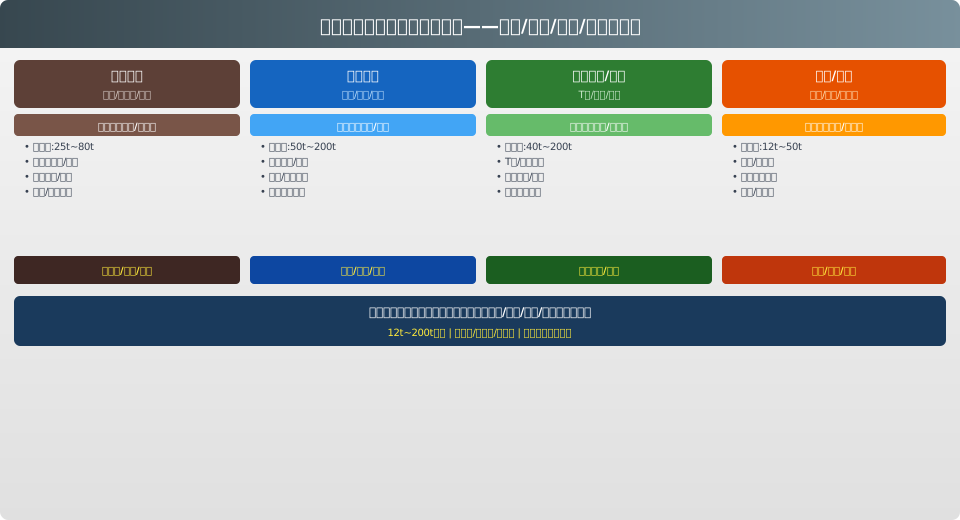
Bridge Construction Engineeringcraneconfiguration solution——Pile Foundation/Pier Column/Girder Body/Deck Four Work Sections

Scenario 1 — Pile Foundation

• Lifting capacity: 25 t–80 t, truck crane / crawler crane

• Rebar cage flipping / lowering into hole

• Drill rig relocation / assembly

• Tremie pipe / hopper lifting

Rebar cage | Drill rig / tracks

Scenario 2 — Pier Construction

• Lifting capacity: 50 t–200 t, truck crane / tower crane

• Pier rebar / formwork

• Cap beam / bearing pad installation

• Bridge-specific construction

Pier / cap beam | Formwork

Scenario 3 — Girder Precast / Erection

• Lifting capacity: 40 t–200 t, bridge erecting machine / gantry crane

• T-beam / box girder precasting

• Girder erection / alignment

• Specialized erection equipment

Girder precast | Erection

Scenario 4 — Deck & Ancillary

• Lifting capacity: 12 t–50 t, truck crane / truck-mounted crane

• Guardrail / expansion joint

• Deck paving materials

• Flexible / multi-position

Deck | Flexible

Selection Parameters by Work Zone

Kelude Heavy Industry: Overhead & Gantry Crane Solutions

Kelude Heavy Industry is a professional manufacturer of overhead cranes, gantry cranes, and electric hoists. We provide comprehensive material handling solutions for industrial applications, from standard equipment to custom-engineered systems.

Overhead Cranes Built for Industrial Demands

Our overhead crane lineup covers single-girder and double-girder designs, with capacities ranging from 1 ton to 100 tons. These cranes are widely used in workshops, warehouses, and production lines where reliable lifting and precise load positioning are critical. Each unit is engineered for high duty cycles and long service life.

Gantry Cranes for Outdoor and Heavy-Duty Use

For outdoor yards, storage areas, and heavy fabrication shops, we offer a range of gantry cranes, including full-gantry, semi-gantry, and portable models. With spans up to 40 meters and lifting heights tailored to your site, these cranes deliver stable performance under demanding conditions.

Electric Hoists and Trolleys for Versatile Lifting

Our electric wire rope hoists and chain hoists are available in various capacities and mounting options—fixed, lug-mounted, or motorized trolley. Designed for smooth operation and low maintenance, they are ideal for integration into new or existing crane systems.

Q: What is the typical lead time for a standard overhead crane?
A: For standard single-girder cranes, lead time is typically 30-45 days. Double-girder and custom-engineered models may require 60-90 days depending on specifications.

Q: Do you provide installation and commissioning services?
A: Yes, we offer on-site installation, commissioning, and operator training. Our service team can also provide maintenance support and spare parts supply.

Q: Can cranes be designed for explosion-proof environments?
A: Absolutely. We supply explosion-proof cranes with appropriate motor and electrical protection ratings, suitable for hazardous areas such as chemical plants and paint shops.

Q: What is the warranty period for Kelude cranes?
A: We provide a standard 12-month warranty covering workmanship and materials. Extended warranty options are available upon request.

Contact Kelude Heavy Industry

A: To discuss your lifting requirements or request a quotation, contact our sales team. We respond to all inquiries within 24 hours.

Parameter ItemPile FoundationPier ColumnGirder ErectionBridge Deck Accessories
recommended modeltruck crane/crawler cranetruck crane/Tower CraneBridge erecting machine/Gantry Cranetruck crane/Truck-mounted crane
Lifting Capacity25t~80t50t~200t40t~200t12t~50t
special requirementsReinforcement Cage/Drilling RigPier Column/Capping BeamTCapping Beam/Box Girder Erectionguardrail/Pavement
$0.7M–$1.2M
Total Bridge Investment
8–300 t
Lifting Capacity
10–50 m
Working Radius
A3–A5
Work Duty Classification
80–300 t
Bridge Erecting Machine
30–300 m
Bridge Span

Lifting Solutions for Every Bridge Construction Phase

Reinforcing cage turnover and lowering into the pile bore is the core lifting operation in the foundation phase. Pier cap installation in the substructure phase involves heavy lifts. Girder erection requires dedicated bridge erecting machines.

Why Choose Kelude for Bridge Lifting

Kelude Heavy Industry has spent years specializing in lifting equipment for bridge construction, delivering end-to-end hoisting solutions for highway bridges, railway bridges, and municipal bridges—from pile foundations to the bridge deck. Our equipment fleet includes truck cranes and crawler cranes with lifting capacities from 8 to 300 tonnes, and we have provided crane rental and hoisting services for over 100 bridge projects across China.

Dedicated Lifting Spreader for Pile Cages
Pile reinforcing cages for bridge foundations range from 12 to 30 m in length and weigh 5 to 20 t per section. Kelude supplies a purpose-built turnover lifting beam with a hydraulic auto-rotation mechanism, paired with a tandem lifting setup using two truck cranes to safely rotate the cage from horizontal to vertical. Load cells on each lifting point provide real-time monitoring throughout the turnover; an alarm triggers and adjustments are made automatically if deviation exceeds 10%.
Girder Erection Lifting Systems
Erecting precast box girders and T-beams (80–200 t, 20–40 m long) is the highest-risk and most technically demanding lifting task in bridge construction. Kelude offers 80–300 t bridge erecting machines or tandem lifting configurations, complete with a dedicated balancing lifting beam and multi-point suspension system. Positioning accuracy for girder placement is held to ±20 mm, and each girder can be erected in 2 hours or less.
Light Lifting for Deck-Level Work
Deck-level operations—crash barriers, deck paving, expansion joints, and similar tasks—call for light lifting equipment. Kelude provides 25–50 t truck cranes or deck-mounted jib cranes. The deck jib crane mounts directly onto the crash barrier and travels along the deck, covering the full deck width without occupying space below the bridge. A small electric hoist handles vertical transport of deck materials.

Frequently Asked Questions

Q: What lifting capacity is required for hoisting steel reinforcement cages in bridge construction?
A: Steel reinforcement cages typically range from 1 to 2.5 m in diameter, 12 to 30 m in length, and weigh 5 to 20 t per section. The lifting capacity is determined by multiplying the heaviest cage section by a safety factor of 1.25—a 30 m long, 2.5 m diameter cage weighing approximately 20 t requires a 25 t truck crane. Cage hoisting demands a dedicated turnover lifting frame paired with tandem lifting by two cranes, and the load distribution between the primary and auxiliary cranes must be monitored in real time during the turnover process. Kelude offers specialized hoisting scheme development and load verification services for steel reinforcement cage installation.
Q: Bridge erecting machine or truck crane for precast box girder erection?
A: For short-span bridges (≤30 m) with low piers (≤15 m), a truck crane is the preferred choice—single or tandem lifting offers flexibility and eliminates the need for dedicated crane rails. For medium-to-long spans (30–50 m) and tall piers (>15 m), a bridge erecting machine is recommended. It features self-launching capability, allowing girder transport vehicles to feed beams directly beneath the machine, achieving erection rates of up to 2 hours per girder. Kelude Heavy Industry offers both truck crane rental and bridge erecting machine services.
Q: What else should be considered in crane selection for bridge construction?
A: Beyond lifting capacity and working radius, the following factors also matter: ① Site conditions at the bridge location—narrow valleys or river-crossing spans may require superlift counterweight configurations; ② Clearance and turning radius along the girder transport access system; ③ Bearing capacity of foundation at crane setup positions—soft ground may need reinforcement; ④ Wind speed during construction—hoisting must stop when wind exceeds Level 6; ⑤ Nighttime lighting and road traffic management. Kelude provides full-process technical support for bridge construction lifting plans.
Q: What crane is recommended for bridge deck construction?
A: For bridge deck paving and guardrail installation, a 25–50 t truck crane or a deck-mounted jib crane is recommended. Truck cranes offer flexibility and can work from below or alongside the bridge, while jib cranes are fixed to the guardrail and travel along the deck. Bridge deck work is characterized by numerous scattered work points, linear distribution, and light single-point hoisting loads. Kelude recommends deploying one truck crane per 200–300 m of bridge length, paired with a small electric hoist for vertical transport.

Related News

contact

contact us

phone:
+86 13903802779

mail:3915269@qq.com

Working hours: Monday to Friday

Wechat
Wechat
SHARE
TOP