Cleanroom Crane Configuration for Semiconductor Fabs

At a Glance: Kelude Heavy Industry provides crane configuration solutions for semiconductor chip manufacturers, covering all four production zones—wafer fabrication, lithography/etching, packaging & testing, and support facilities. With lifting capacities from 0.125 to 10 tons and spans from 6 to 24 meters, a complete plant crane investment typically ranges from approximately $30,000 to $445,000. The wafer fab zone uses cleanroom-type KBK cranes (0.125–0.5 t), the lithography area employs ultra-clean stainless steel electric hoists (0.25–1 t), the packaging & testing zone is equipped with anti-static cranes (1–5 t), and the support area uses LD type single-girder cranes (3–10 t)—all engineered to meet the stringent ISO Class 3–5 cleanroom environments and micro-vibration control requirements of semiconductor manufacturing.

Crane Solutions for Chip & Semiconductor Manufacturing

Wafer Fabrication | Lithography/Etching | Packaging | Testing

Semiconductor manufacturing demands the highest levels of cleanliness (Class 100), micro-vibration control, and anti-static protection of any industrial sector.

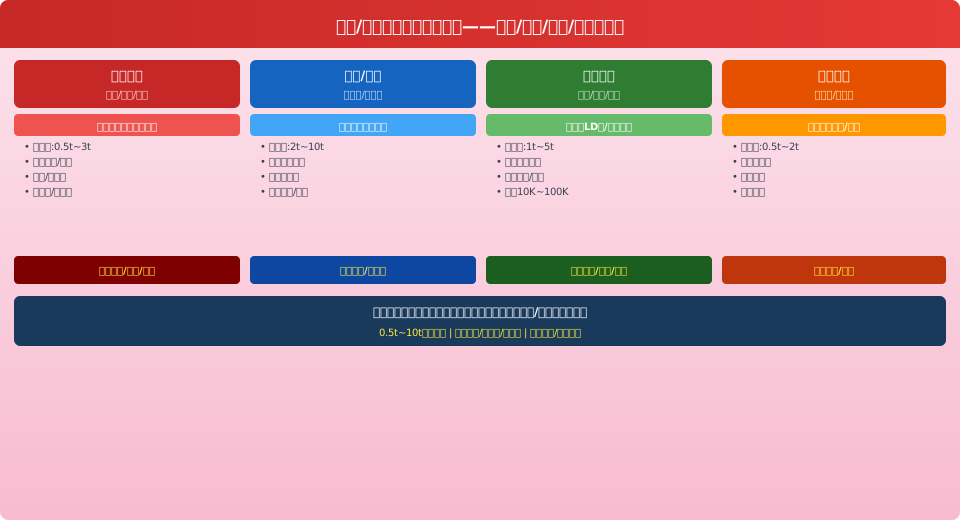
chip/semiconductormanufacturingcranesolution——wafer/lithography/packaging/Testingfour-stage section

Zone 1: Wafer Fabrication

• Lifting capacity: 0.5–3 t, cleanroom-type electric hoist

• Class 100 cleanroom / dust-free

• Shock-proof / low vibration

• Stainless steel / anti-static

Class 100 Cleanroom | Shock-Proof | Dust-Free

Zone 2: Lithography / Etching

• Lifting capacity: 2–10 t, cleanroom-type overhead crane

• Precision equipment installation

• Micro-vibration control

• VFD micro-motion / positioning

Precision Installation | Micro-Vibration | VFD Micro-Motion

Zone 3: Packaging

• Lifting capacity: 1–5 t, LD type / cleanroom hoist

• Equipment maintenance lifting

• Die change / handling

• Cleanroom Class 10K–100K

Equipment Maintenance | Die Change | Cleanroom

Zone 4: Testing

• Lifting capacity: 0.5–2 t, jib crane / hoist

• Test head maintenance

• Compact footprint

• Cleanroom compatible

Test Maintenance | Compact | Cleanroom Compatible

Selection Parameters Across the Four Production Zones

Kelude Heavy Industry: Engineered for Demanding Industrial Applications

Kelude Heavy Industry specializes in the design and manufacture of heavy-duty industrial cranes and material handling solutions. Our product range is built to deliver exceptional performance, reliability, and safety in the most challenging operational environments. With a focus on continuous innovation and rigorous quality control, we provide tailored solutions that enhance productivity and ensure long-term value for our clients across the globe.

Comprehensive Crane Solutions for Diverse Industries

Our portfolio includes a wide array of overhead cranes, gantry cranes, and specialized hoisting equipment, each engineered to meet specific application requirements. From single-girder and double-girder designs to explosion-proof and low-headroom configurations, our cranes are utilized in industries such as steel, automotive, logistics, and general manufacturing. We understand that every facility has unique demands, which is why we offer a high degree of customization to ensure seamless integration with your existing workflows.

Advanced Technology and Robust Engineering

All Kelude cranes are developed using advanced design software and manufactured with high-grade materials to ensure structural integrity and longevity. Our engineering team adheres to international standards, including ISO 4301 for crane classification and IEC 60204-32 for electrical equipment, guaranteeing that our machinery meets global safety and performance benchmarks. Key features such as variable-frequency drives, anti-sway technology, and intelligent load monitoring systems are integrated to optimize operational precision and safety.

Rigorous Quality Assurance and Global Certification

Quality is at the core of our manufacturing process. From incoming material inspection to final load testing, every stage is subject to stringent quality control measures. Our production facilities are equipped with state-of-the-art testing equipment, and our cranes are certified to comply with major international regulations, including ISO 12480 for safe use and IEC 60204-32 for electrical safety. This commitment to quality ensures that every Kelude crane delivers dependable performance and a long service life.

Comprehensive After-Sales Support and Service

We believe that our responsibility extends beyond the initial sale. Kelude provides comprehensive after-sales support, including installation supervision, operator training, preventive maintenance programs, and rapid-response spare parts supply. Our global service network is dedicated to maximizing your equipment uptime and minimizing operational disruptions. With Kelude, you gain a long-term partner committed to the efficiency and safety of your material handling operations.

Frequently Asked Questions

Q: What is the typical lead time for a standard overhead crane?
A: Lead times vary depending on the crane's specifications and level of customization. Generally, a standard crane can be delivered within 8 to 12 weeks from order confirmation. For complex, custom-engineered solutions, the timeline may be extended. We provide a detailed project schedule upon request.

Q: Can Kelude cranes be designed for explosion-proof environments?
A: Yes, we offer a full range of explosion-proof cranes designed for hazardous areas. These cranes are built with specialized components and protective measures to comply with international safety standards, ensuring safe and reliable operation in volatile atmospheres.

Q: What kind of after-sales support does Kelude provide?
A: Our after-sales support includes installation guidance, commissioning, operator and maintenance training, and a global network for spare parts and service. We also offer tailored maintenance contracts to ensure the long-term reliability and performance of your equipment.

Q: Do you offer custom crane solutions for specific industrial processes?
A: Absolutely. Our engineering team works closely with clients to design and manufacture cranes that meet specific process requirements, including special lifting capacities, spans, lifting heights, and control systems. We have extensive experience in developing custom solutions for a wide range of industries.

Parameter ItemWafermanufacturingLithography/EtchingPackaging SectionTesting Section
recommended modelcleanroom hoistcleanroom typeoverhead typeLD Type/Clean Hoistjib crane/Hoist
Lifting Capacity0.5t~3t2t~10t1t~5t0.5t~2t
cleanliness classClass 100Class 100/Class 1,000Class 10,000Class 10,000
special requirementsshock-proof/LowvibrationMicro-vibration Controlequipment maintenanceCompact/Flexible
Kelude Solutionshock-proof CleanMicro-vibration ControlCleanequipment maintenanceCompact Clean
$30,000–$445,000
Total Plant Investment
0.125–10 t
Lifting Capacity
6–24 m (20–79 ft)
Span
A3–A4
Work Duty Classification
ISO Class 3–5
Cleanliness Level
50,000–500,000 wafers/month
Wafer Production Capacity

Key Crane Requirements for Semiconductor Cleanrooms

A: Wafer fabrication and lithography areas operate as Class 100 cleanrooms. Kelude's cleanroom cranes feature fully sealed stainless steel construction with a low-particle lubrication system, and the crane rails receive anti-corrosion treatment. Precision equipment installation — including lithography and etching machines — demands micro-vibration control.

Kelude Heavy Industry — Service Advantages

Kelude Heavy Industry has specialized in overhead lifting for semiconductor manufacturing for years, delivering precision lifting solutions for wafer fabs, assembly and test facilities, and photomask plants that meet ISO Class 3–5 ultra-clean requirements. Our products are certified for Class 100 cleanliness and pass micro-vibration control testing, backed by extensive field experience installing KBK systems in cleanroom environments across the semiconductor industry.

ISO Class 3 KBK Systems for Wafer Fabs
In 300 mm wafer fabs, ISO Class 3 cleanrooms (≤1,000 particles ≥0.1 μm per m³) place extreme demands on lifting equipment particle emissions. Kelude's ultra-clean KBK systems use SUS316L stainless steel rails with electropolished surfaces (Ra ≤0.4 μm), fully sealed motors with HEPA-filtered exhaust, and polyurethane silent wheels with a vacuum rail-cleaning system. All moving parts are tested in an ISO Class 3 cleanroom to verify particle emissions of ≤1 particle per minute (≥0.1 μm).
Micro-Vibration Control for Lithography Areas
Step-and-scan lithography machines (line widths ≤7 nm) are extremely sensitive to ambient vibration — floor vibration velocity must stay below 50 μm/s. Kelude isolates lithography areas by mounting the KBK system on a dedicated overhead suspension structure, with lifting points that do not connect to the raised-floor framework above the litho bay. Instead, loads transfer through independent roof suspension beams. The electric hoist uses a brushless DC motor (no carbon brush particles) with precision variable-frequency drive, keeping vibration during lifting and travel at or below 25 μm/s.
Anti-Static Trolley Systems for Assembly & Test
Chip testing and packaging areas in semiconductor assembly and test facilities require anti-static lifting equipment. Kelude's KBK systems for these zones use conductive polyurethane wheels (resistivity ≤10⁵ Ω·cm) with full-body equipotential grounding (grounding resistance ≤4 Ω), and the pendant station features an anti-static coating. KBK rails are arranged along test handlers and tape-and-reel packaging machines, supporting the transport of die trays and reels across multiple package types (BGA, QFP, SOP, etc.).

FAQ

Q: What are the installation requirements for a KBK system in an ISO Class 3 cleanroom at a semiconductor wafer fab?
A: ISO Class 3 cleanrooms impose strict cleanliness requirements on installation and construction. All components entering the cleanroom must undergo vacuum cleaning, IPA wiping, and double-layer vacuum packaging. Installation personnel must wear fully enclosed bunny suits and use dedicated cleanroom tools made of stainless steel with no lubrication. FFU filters must remain operational throughout the installation process. Upon completion, particle count verification is required (≥0.1 μm particles ≤1,000 per m³). Kelude has the qualifications and experience to perform KBK installations in ISO Class 3 cleanrooms.
Q: What are the micro-vibration control standards for chip lithography machines?
A: For advanced lithography machines (ASML NXE:3400C EUV), the vibration tolerance is: vertical vibration speed ≤25μm/s (1–100Hz) and horizontal vibration speed ≤50μm/s (1–100Hz). Kelude Heavy Industry's KBK lithography-area solution uses an independently suspended structure (not connected to the raised floor) to keep KBK-induced vibration at ≤25μm/s. A 30-day baseline vibration monitoring is conducted before installation, followed by a post-installation KBK vibration re-test to confirm the lithography area meets the required standards.
Q: What are the anti-static requirements for KBK systems in semiconductor assembly and test workshops?
A: ESD protection in semiconductor assembly and test facilities follows ANSI/ESD S20.20 and IEC 61340-5-1 standards. All conductive components of the KBK system must be grounded (grounding resistance ≤4Ω), and the static decay time on work surfaces must not exceed 1 second (from 1000V to 100V). Kelude's KBK systems for assembly and test lines feature conductive polyurethane wheels (10⁵Ω·cm), stainless steel anti-static wire rope, and static-dissipative pendant stations and cables. A full-system grounding resistance check is performed monthly in these workshops.
Q: How do semiconductor factory cranes coordinate with the AMHS system?
A: In a wafer fab, the AMHS overhead crane system (OHT automated transport) and the KBK crane operate within the same ceiling-mounted infrastructure. Kelude's KBK system maintains a safety distance from the AMHS (≥500 mm horizontally, ≥300 mm vertically), and the KBK operating zone is equipped with light curtain interlocks—when an OHT crane passes through, the KBK automatically stops. The KBK lifting spreader and the OHT crane's gripping mechanism use different FOUP (front-opening unified pod) interfaces to prevent equipment mix-ups. Both systems are coordinated through the MCS (material control system).

Related News

contact

contact us

phone:
+86 13903802779

mail:3915269@qq.com

Working hours: Monday to Friday

Wechat
Wechat
SHARE
TOP