

GB/T 17909.1-1999 Standard for the Content and Use of Crane Operation Manuals
📌GB/T 17909.1-1999, “Cranes—Operating Manuals—Part 1: General Requirements,” is the general standard for the preparation of crane operating manuals.This standard specifies the content, format, and preparation requirements for operating manuals and serves as a common basis for manufacturers to prepare operating instructions and for users to follow standard operating procedures.
GB/T 17909.1-1999, which is equivalent to ISO 9928-1:1990, is a specific standard for the preparation of crane operation manuals. The operator’s manual is one of the most important documents included with a crane upon delivery; it serves as a fundamental guide for operators to correctly operate the equipment, prevent operational errors, and respond to emergencies. The standard applies to the preparation of operator’s manuals for all types of cranes, including overhead, gantry, tower, and mobile cranes, and specifies the content framework and writing guidelines that the manuals must follow.
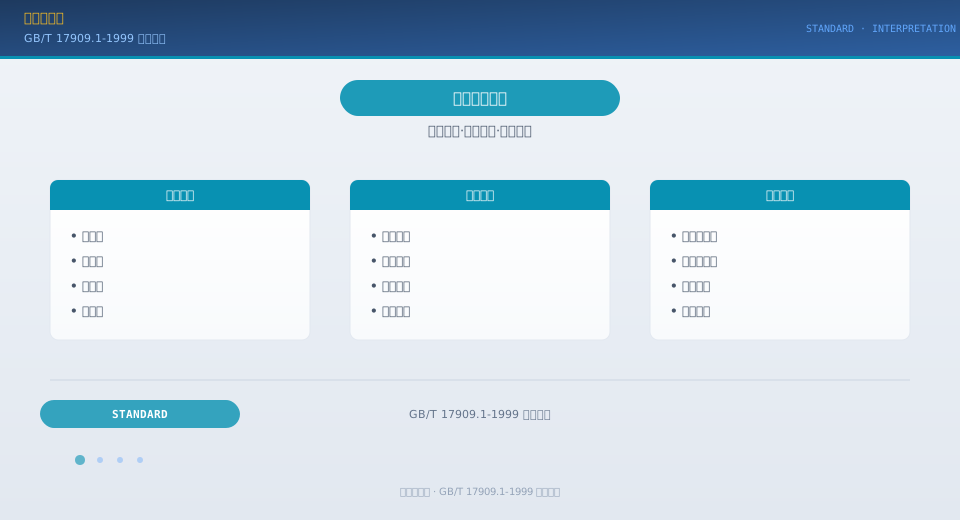
Basic Contents of the Operating Manual
The standard stipulates that the operating manual shall include the following basic content: Overview—crane model and specifications, manufacturer’s name and address, serial number and date of manufacture, applicable standard number, and a summary table of technical parameters (rated lifting capacity, span, lifting height, duty class, power supply parameters, etc.). Safety Section—Safety precautions and explanations of safety signs, including prohibited operations (strictly prohibited: overloading, oblique pulling or tilted lifting, lifting unidentified objects, etc.), descriptions of safety devices and their set values (overload limiter activation values, limit switch positions, wind speed alarm thresholds, etc.), requirements for personal protective equipment (safety helmets, non-slip shoes, protective gloves, etc.) and emergency operating procedures (power disconnection, manual brake release, emergency lowering, etc.). The Safety Section should be placed at the very beginning of the manual and highlighted using bold typeface and warning symbols.
Operations Section—Detailed instructions on how to operate each mechanism, including the layout and functions of the controller or control lever; operating procedures for each mechanism (the complete process for starting, running, and stopping); restrictions on simultaneous operation of two mechanisms (hoisting and travel must not be operated simultaneously); instructions for using the speed control device; and techniques for fine-tuning operations. The “Operation” section should use a step-by-step numbered format, with each step beginning with a verb and presented concisely. Maintenance Section—Daily inspection items and intervals; lubrication charts (indicating the locations of each lubrication point, lubricant grade, and refill intervals); adjustment methods and parameters for each mechanism (brake clearance, coupling alignment, wire rope deflection angle, etc.); and a list of wear-prone parts and their replacement intervals. Appendices—Electrical schematics and wiring diagrams; hydraulic and pneumatic system schematics; a troubleshooting reference table; and after-sales contact information.
Formatting and Language Requirements
The standard sets forth normative requirements for the format and language of the operating manual. The manual shall be printed on A4-size paper (210 mm × 297 mm), and the binding method shall be selected to ensure ease of use (spiral binding or ring binder binding is recommended to allow the manual to lie flat and facilitate the replacement of individual pages). Pages shall be numbered consecutively, and the total number of pages shall be indicated. The cover of the manual shall include the equipment name and model, the manufacturer’s name, and the document number. The manual shall be written in Chinese (for exported equipment, a foreign-language version may also be provided, but the Chinese version shall have equal legal force). The content shall be expressed accurately and concisely, avoiding the use of dialects, slang, or ambiguous expressions. Content involving safety warnings must use standardized safety warning symbols: Danger (red background + white symbol)—failure to avoid will result in death or serious injury; Warning (orange background)—failure to avoid may result in death or serious injury; Caution (yellow background)—failure to avoid may result in minor injury or equipment damage.
Illustrations and tables are an important part of operating manuals. The standard requires that all illustrations and tables be numbered and include captions; illustrations should be numbered sequentially by chapter (e.g., ”Fig. 3-1 Controller Layout”), and tables should be numbered sequentially by chapter (e.g., ”Table 5-1 Lubrication Schedule”). Illustrations of operating procedures should use 3D diagrams or photographs, with the locations and numbers of key operating components clearly labeled. Electrical schematics should use national standard graphic symbols (GB/T 4728 series), with component numbers and wire numbers clearly marked on the diagrams. Lubrication charts should indicate the numbers of each lubrication point, the lubricant grade, and the refill intervals on a schematic diagram of the entire machine’s exterior. All illustrations must be clear and legible, with photographs having a resolution of at least 300 dpi. Drawings and tables should be neatly folded and attached to the back of the manual for easy removal, enlargement, and reference.
Operating Manual Management Requirements
The standard also sets forth requirements for the management of operating manuals. Each crane must be equipped with at least two copies of the operating manual upon leaving the factory—one to be delivered to the user with the equipment, and one to be retained by the manufacturer for reference. The manuals should be stored in a designated document box located in the operator’s cab or near the equipment; they must not be left in random locations or removed from the equipment site. A version control system should be established for revisions and updates to the manuals—a revision record form must be completed for each revision, specifying the details of the revision, the reason for the revision, the person responsible, and the date of the revision; the revised version must be marked with a new version number and date. Outdated manuals must be collected and destroyed or stamped as “void.” After the equipment undergoes technical upgrades or major repairs, the operating entity must obtain updated operating manuals from the manufacturer.
The standard encourages manufacturers to also provide electronic versions of the operating manuals, stored on CDs or USB drives and delivered alongside the printed manuals. The electronic manuals should be in PDF format and support full-text search and bookmark navigation. Technical specification tables may also be provided in Excel spreadsheet format to facilitate user import into equipment management systems. For exported equipment, the electronic manual should be provided in multiple languages, including both Chinese and English. The electronic manual should be password-protected to prevent unauthorized modifications, and the modification password should be retained by the manufacturer. Krud Heavy Industry provides both printed and electronic versions of the operating manual upon equipment delivery, prepared in accordance with the standard format.
Comparison Table of the Operational Manual's Content Outline
The following comparison table summarizes the framework of content that the standard requires an operating manual to include, as well as the core requirements for each chapter. Manufacturers may use this framework to prepare the manual item by item, and users may refer to it for acceptance inspection.
| Chapters | Main Content | Formatting Requirements |
|---|---|---|
| Overview | Equipment Information / Technical Specifications / Compliance Standards | The table lists all parameters |
| Safety | Prohibited Actions / Safety Devices / Emergency Procedures | Warning Symbol/Bold Text |
| Operation | Operating Instructions / Speed Control / Micro-switch | Step-by-Step Numbering / 3D Illustrations |
| Maintenance | Inspection/Lubrication/Adjustment/Wear Parts | Lubrication Chart/Adjustment Parameter Table |
| Appendix | Electrical Diagrams / Troubleshooting Guide / Contact Information | Schematic Diagrams / Wiring Diagrams / Photos |
Requirements for Operating Manuals of Special-Purpose Cranes
The standard sets forth specific supplementary requirements for the preparation of operating manuals for different types of cranes. The operating manual for tower cranes shall include: operating procedures and precautions for raising and lowering the tower; installation and inspection requirements for each attachment device; safety operating procedures for the tower under wind power conditions (stop work and release the slewing brake when wind speeds exceed Force 6); and operating instructions and test methods for the lifting moment limiter. The operating manual for mobile cranes should include: procedures for extending and retracting outriggers and ground bearing capacity requirements; rated lifting capacity tables (load tables) for different boom length combinations; and procedures for switching between travel and working modes. The operating manuals for bridge and gantry cranes should include: safety precautions for the travel of the main and hoist trolleys; coordination procedures for multiple cranes operating on the same track; and operating methods for wind-resistant rail clamps and anchoring devices.
Frequently Asked Questions
Q: What should I do if I lose the user manual?
Answer: You may contact the original manufacturer to have a replacement issued. If the manufacturer no longer exists, you may commission a qualified testing organization to rewrite the operating manual based on the actual condition of the equipment. When drafting the manual, you should refer to the content framework and formatting requirements specified in GB/T 17909.1.
Q: Does the operating manual need to be updated in tandem with equipment modifications?
Answer: Yes. After technical upgrades or major repairs to equipment, the relevant operating procedures, safety device parameters, and circuit diagrams may change; the operating manual should be updated accordingly to ensure that operators follow the latest version when performing their duties.
Q: Do the operating manuals for imported equipment need to be translated?
Answer: The operating manual for cranes used on-site must be in Chinese. For imported equipment, the manufacturer or importer must provide a Chinese translation of the foreign-language operating manual, and the Chinese translation must be reviewed and approved by the technical supervisor before use.
Q: Are the operation manual and the maintenance manual the same book?
Answer: They are different. The operating manual is intended for operators and focuses on daily operations and safety precautions. The maintenance manual is intended for maintenance personnel and focuses on disassembly and assembly, troubleshooting, and parameter adjustment. The two manuals may be combined, but the intended audience and the division of chapters should be clearly indicated.
