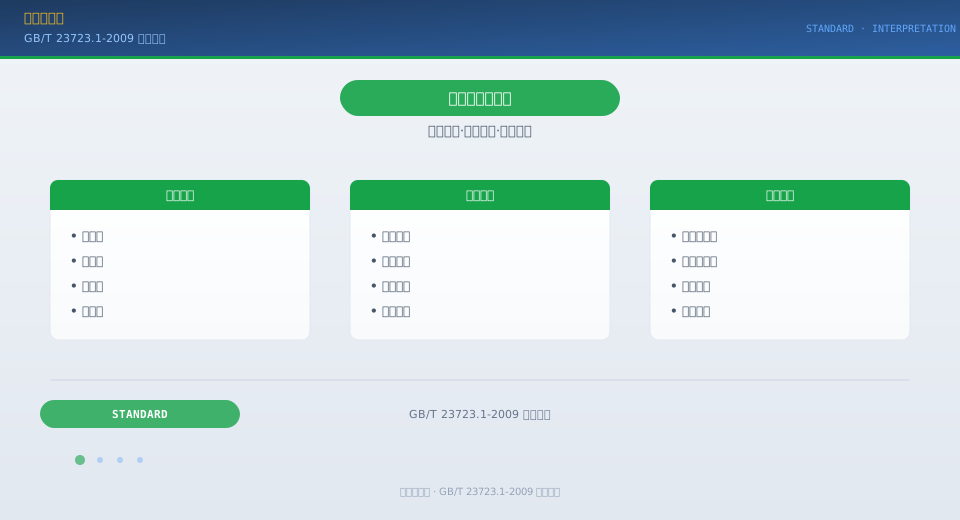

Safe Crane Operation and Operator Management per GB/T 23723.1-2009
GB/T 23723.1-2009 "Cranes — Safe Use — Part 1: General Principles" is the overarching standard for the safe use of cranes. The standard specifies management requirements, operating rules, and personnel responsibilities for the safe use of cranes, serving as a general specification for user units to establish a safety management system.
GB/T 23723.1-2009, identical to ISO 12480-1:1997, is the umbrella standard for crane safe use. It specifies the safety management system that user units must establish and the safe operating procedures that operators must follow, providing the basis for safety management throughout the entire crane lifecycle—from installation acceptance to daily operation. Compared with GB/T 25849, this standard places greater emphasis on the structure of the management system and organizational responsibilities. Kelude Heavy Industry uses this standard to prepare safe use manuals for clients and deliver operator safety training, helping clients build a compliant safety management system.
Safety Management System and Organizational Responsibilities
The standard requires user units to establish a comprehensive safety management system with clearly defined safety responsibilities at all levels. Management responsibilities include developing and approving the safety management system, providing the resources and training necessary for safe use, and periodically reviewing how the system is implemented. Safety management personnel are responsible for drafting operating procedures and safety rules, organizing safety training and assessment, supervising daily operator practices, conducting periodic equipment safety inspections, and coordinating emergency plan drills and accident investigations. Operators are responsible for operating equipment strictly in accordance with procedures, performing daily inspections and maintenance, promptly reporting any safety hazards, and refusing to follow illegal commands or unclear hand signals. The standard emphasizes that safety responsibilities must be cascaded from the company leadership down to frontline operators, with each position's duties documented in writing and incorporated into the job performance assessment system.
The standard also sets requirements for safety training within user units. New operators must complete no less than 40 hours of professional training and pass an assessment to obtain a special equipment operator certificate before working independently. In-service operators must complete at least 24 hours of continuing safety education each year. Training content should cover crane structure principles and safety technology, operational skills and emergency handling methods, safety regulations and standards, and accident case analysis with lessons learned. Training records must be maintained, documenting the time, content, and assessment results. Signal persons are also required to undergo regular training to master standard hand signals and flag signals, and to understand crane performance characteristics and safety precautions.
General Rules for Safe Operation
The standard specifies general rules for safe crane operation applicable to all crane types. Pre-operation inspection—operators must perform a daily inspection at the start of each shift, verifying that the brake, limit switch, wire rope, lifting spreader, and all safety devices are in proper working condition. Any issues must be reported immediately; equipment must not be operated with known defects. Trial lift—before lifting, a trial lift must be performed by raising the load approximately 200 mm off the ground to check brake reliability, load stability, and even tension in the slings. Prohibited actions during operation—overloading, angled pulling, lifting loads of unknown weight (such as buried or frozen objects), using limit switches as a normal stopping method, passing loads over personnel, leaving the controls unattended during a lift, and allowing people to stand beneath a suspended load.
Environmental safety management is also a key part of the standard. For nighttime operations, the work area must be adequately illuminated with illuminance of no less than 50 lx. In high winds—operations shall be stopped for tower cranes when wind speed exceeds Force 6 (approximately 13 m/s), and for overhead and gantry cranes when wind speed exceeds Force 12. Outdoor crane hooks must be raised to the upper limit position and secured against wind. When multiple cranes operate in the same area, a coordinated work plan must be developed, defining the operating range and right-of-way rules for each crane. The standard also requires that crane electrical equipment be protected by earthing in accordance with procedures, with grounding resistance no greater than 4 Ω. When leaving the operator's position, the operator must raise the lifting spreader to the upper limit and disconnect the main power supply. At the end of each shift, an operation log must be completed, recording equipment status, work performed, and any issues identified.
Shift Handover and Multi-Crane Coordination
The standard sets out detailed requirements for shift handover procedures. Before handing over, the outgoing operator must raise the hook to its upper limit position, cut off the main power supply, and clear the operating area. The handover report must cover: equipment operating conditions and any abnormalities observed during the shift, corrective actions already taken, unresolved issues, and safety precautions for the incoming shift. The incoming operator should arrive early to review the operation log, perform a pre-shift inspection, and confirm the equipment is in normal condition before taking over. Both parties must sign the operation log to acknowledge the handover; no work may proceed on the next shift unless the handover is fully completed. When multiple cranes operate on the same rail or within the same area, a designated person must be assigned for unified command and coordination. A minimum clearance of 1 m must be maintained between adjacent cranes, and when traveling in the same direction, the trailing crane must keep a following distance of at least 2 m. For tower cranes engaged in cross operation, the jib length and scope of coverage must be calculated to prevent collision between cranes.
Safety Management Requirements Comparison Table
The comparison table below summarizes the safe use management requirements set out in the standard. User units can use this framework to establish and improve their own safety management systems.
| Management Segment | requirements Content | Responsible Department |
|---|---|---|
| System Establishment | operating procedures/inspection System/Maintenance System/emergency plan | safety management Responsible Department |
| Personnel Management | Certified Operation/training assessment/Healthinspection | HR Department |
| Equipment Management | technical documentation/periodic inspection/Maintenance Plan | Equipment Management Department |
| Operation Management | Pre-Shift Inspection/operation log/shift handover | Operating Crew |
| Emergency Management | emergency plan/Drill/Incident Report | safety management Responsible Department |
Accident Reporting and Investigation Requirements
The standard requires user units to establish procedures for accident reporting and investigation. In the event of a crane safety accident, the emergency plan must be activated immediately to rescue injured personnel and preserve the accident scene, with a report submitted to the local special equipment safety supervision authority within the required timeframe. The accident report must include: the date, time, location, and equipment involved; a description of the incident and casualties; a preliminary assessment of the cause; and the emergency measures already taken. The investigation should be organized by the user unit's safety management department or conducted in conjunction with the special equipment regulatory authority. The investigation covers: inspection of the equipment's technical condition (verifying that safety devices function properly and assessing the state of the wire rope and brake), review of operating records and operation logs, and verification of operator qualifications and training history.
Upon completion of the investigation, a formal accident investigation report must be issued, including a root cause analysis (direct and indirect causes), determination of responsibility, recommended rectification measures, and technical or managerial strategies to prevent recurrence. Rectification actions must be assigned to specific responsible departments with clear deadlines, and the safety management department is responsible for tracking implementation and verifying effectiveness. Accident reports and related records must be retained for at least 5 years. The standard emphasizes that accident analysis should go beyond assigning individual blame and instead examine systemic issues within the safety management system—are safety procedures inadequate? Is training insufficient? Is equipment maintenance being neglected? Eliminating safety hazards at their source is the ultimate goal of accident management.
FAQ: Common Questions on Crane Safety Standards
Q: What is the difference between ISO 4301 and ISO 12480?
A: ISO 4301 focuses on the structure of the safety management system and organizational responsibilities, while ISO 12480 addresses operator requirements and operating procedures at the operational level. The two standards complement each other and, when used in conjunction, provide full coverage of all aspects of safe use.
Q: What are the training requirements for newly hired operators?
A: A minimum of 40 hours of professional training covering structural principles, operational skills, safety regulations, and emergency handling. Operators must pass the training assessment and obtain a special equipment operator certificate before working independently.
Q: How often should emergency plan drills be conducted?
A: The standard requires at least one full-scale emergency response drill per year. Drills should cover emergency response and rescue procedures for common accident types, including crane-related injuries, falls from height, and electric shock.
Q: What information must be recorded in the operation log?
A: The operation log should record crane operating hours for each shift, work performed, equipment condition, any abnormalities detected, and corrective actions taken. Both the outgoing and incoming operators must sign the log together at shift handover to confirm its accuracy.