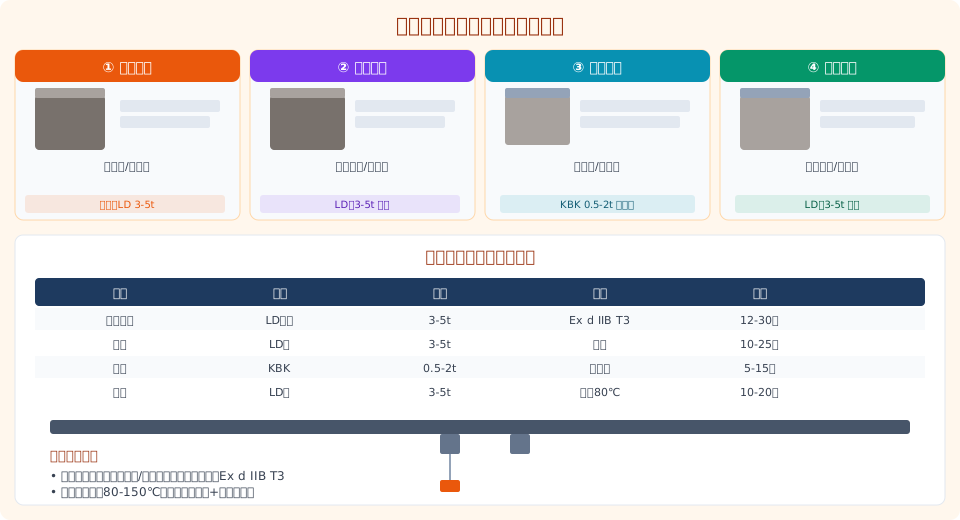

Crane Configuration for Adhesive and Sealant Production Lines
Crane systems for adhesive and sealant plants are configured around four process stages: resin synthesis, mixing & dispersing, filling & sealing, and curing. Resin synthesis uses explosion-proof LD Type cranes (3–5 t, Ex d IIB T3); mixing & dispersing uses corrosion-resistant LD Type cranes (3–5 t); filling lines use KBK workstation cranes (0.5–2 t); and curing areas use LD Type cranes rated for 80 °C (3–5 t). Total plant investment ranges from $15,000 to $60,000. Solvent-based adhesive production areas must be fully explosion-proof with static grounding.
Explosion-Proof Cranes for Resin Synthesis Areas
Resin synthesis for adhesives (acrylic, polyurethane, epoxy, silicone, etc.) relies heavily on organic solvents such as toluene, xylene, ethyl acetate, and acetone. These solvents volatilize during reactions and mix with air to form explosive gas atmospheres. Synthesis workshops are classified as Zone 1 or Zone 2 explosive hazardous areas per GB 50058. We recommend LD Type explosion-proof cranes (3–5 t) rated Ex d IIB T3, suitable for T3 gas groups like toluene and xylene. Reactor vessels weigh 2–5 t and stand 4–8 m tall. Kelude's explosion-proof cranes for resin synthesis areas feature a fully explosion-proof electrical system, including an explosion-proof motor, explosion-proof control box, explosion-proof limit switches, and explosion-proof remote control. Static grounding in the synthesis area is critical — the crane rail, hoist, and lifting spreader must all be reliably grounded (grounding resistance ≤ 4 Ω).
Resin synthesis involves raw material feeding — monomers, initiators, and solvents are metered into the reactor. Solid materials (e.g., fillers, pigments) require crane assistance to lift bulk bags or drums. We recommend installing a KBK workstation crane (0.5–1 t) at the feeding platform to work with the bulk bag unloading station. Kelude's synthesis area solution combines an LD Type explosion-proof crane with a KBK explosion-proof workstation crane. Reactor cleaning typically occurs every batch (8–24 hours), requiring the reactor lid — weighing 100–500 kg depending on vessel diameter — to be opened with crane assistance. Crane investment for the synthesis area ranges from $18,000 to $45,000. The explosion-proof zone is defined as a 3–5 m radius around the reactor vent; all crane coverage within this zone must use explosion-proof equipment.
Cranes for High-Viscosity Mixing & Dispersing
The mixing and dispersing stage uniformly blends resin with fillers, plasticizers, stabilizers, and other additives using high-speed dispersers or three-roll mills. Mixing vessels and dispersers weigh 1–5 t. While solvents are not directly added in this area (they are introduced during resin synthesis), processes involving solvent-containing adhesives still require explosion protection. We recommend LD Type cranes (3–5 t), either standard or explosion-proof. Dispersing equipment requires frequent maintenance — dispersing shafts and discs need periodic replacement every 3–6 months depending on wear, with weights ranging from 200–800 kg. Kelude's dispersing area cranes come standard with remote control operation, allowing operators to handle dispersing disc removal and replacement directly from the workstation. Three-roll mill rollers weigh 500–2,000 kg each; replacing them requires pulling the roller from the frame — precise positioning and creep-speed lowering are essential.
Adhesive compounds in the mixing and dispersing area can reach viscosities up to 100,000 mPa·s, making equipment cleaning challenging. We recommend dedicated cleaning drums and tools — a KBK workstation crane can cover both the cleaning and dispersing stations. Kelude recommends equipping the dispersing area electric hoist with variable frequency micro-speed control (0.5–3 m/min) to prevent drum sway when lifting high-viscosity materials. Crane investment for the dispersing area ranges from $15,000 to $37,000. For water-based (solvent-free) adhesive dispersing areas, a standard LD Type crane can be used, reducing investment by approximately 30%.
KBK Flexible Cranes for Filling & Sealing Lines
The filling method for adhesives depends on viscosity and package size. Low-viscosity adhesives are filled using automatic filling machines (drums or bottles), while high-viscosity sealants use ram-type fillers or soft packaging. Filling equipment weighs 500–2,000 kg. We recommend a KBK workstation crane system (0.5–2 t). The KBK rail in the filling area covers the filling machine, sealing machine, and checkweigher, enabling quick equipment maintenance and replacement. Kelude's KBK system for filling areas can be combined with a pneumatic balancer — the balancer (125–300 kg) handles palletizing of finished drums (20–200 L). Explosion protection classification for the filling area: the area near the filling head for solvent-based adhesives is Zone 1 and requires an explosion-proof KBK hoist. Water-based adhesive filling areas can use standard non-explosion-proof equipment.
Finished adhesive packaging — drum lid pressing, label application, and palletizing — requires auxiliary lifting tools. We recommend installing a column-mounted jib crane (250–500 kg) at the end of the packaging line for palletizing finished drums. Kelude's filling area solution typically requires an investment of $7,500 to $22,000. Adhesive filling lines require frequent changeovers (due to color/formula variations), so the KBK system must support rapid line reconfiguration. Kelude's modular KBK design allows rail extension and hoist repositioning to accommodate changes in filling line layout.
Crane Solutions for Curing Ovens & Constant-Temperature Tunnels
Certain adhesives (e.g., epoxy and silicone) require curing. Curing methods include room-temperature curing and heat curing (ovens/tunnels). Oven temperatures range from 80–150 °C, with tunnel lengths of 10–30 m. We recommend an LD Type crane (3–5 t) covering the oven area for maintenance of the internal conveyor chain and assembly of oven modules. Crane usage in the curing area is infrequent (1–2 times per month), but reliability requirements remain high — due to elevated temperatures and poor air circulation inside the oven, the crane's electrical cabinet must be mounted outside the oven. Kelude's curing area cranes use temperature-resistant cables (silicone rubber insulation) and remote electrical cabinets installed in the ambient-temperature zone outside the oven.
Resin Synthesis LDExplosion-proof3-5t Ex d IIB T3 | Mixing & Dispersing LD Type3-5t variable frequency micro-speed | Filling & Sealing KBK 0.5-2t Gasdynamic balancing |
Curing & Conditioning LD Type3-5t Temperature Resistance80℃ | Static Electricity Grounding Full Line Grounding≤4Ω Explosion-proof Essential | total plant investment 10-40All-Inclusive Process |
Adhesive & Sealant Manufacturing Crane Configuration Comparison
| All-Inclusive Process | Machine Model | tonnage | explosion-proof requirements | Specialconfiguration | investment |
|---|---|---|---|---|---|
| Resin Synthesis | LDExplosion-proof | 3-5t | Ex d IIB T3 | fully explosion-proof+Static Electricity Grounding | 12-30Universal |
| Mixing & Dispersing | LD Type | 3-5t | On-Demand Explosion-proof | variable frequency micro-speed+remote control | 10-25Universal |
| Filling & Sealing | KBK | 0.5-2t | On-Demand Explosion-proof | pneumatic balancer+Slewing Jib | 5-15Universal |
| Curing & Conditioning | LD Type | 3-5t | Standard | Temperature Resistance Cable+Remote Electric Control | 10-20Universal |
| complete plant | Combination | 0.5-5t | Zone | Fullcoverage | 10-40Universal |
Kelude Heavy Industry provides crane solutions for the adhesive and sealant industry, covering the full process from resin synthesis, mixing and dispersion, to filling and sealing, and curing. Explosion-proof design and static grounding in solvent-laden environments are the most critical crane safety requirements for this sector — Kelude has delivered multiple explosion-proof cranes across adhesive manufacturing hubs in the Pearl River Delta and Yangtze River Delta regions.
Explosion-proof Specialty fully explosion-proof Ex d IIB T3(T4)+Static Electricityearthing system, Safety Cornerstone for Solvent-Based Adhesive Production Areas | Mixing & Dispersing Creep speed Control variable frequency micro-speed0.5-3m/min+Remote control operation, Precise High-Viscosity Adhesive Drum Positioning | Flexible Filling Solution KBKmodulardesign+pneumatic balancer, filling line Rapid Color & Formula Changeoveradjustment |
FAQ: Explosion-Proof & Lifting Solutions for Adhesive Plants
Q: How do I select the right explosion protection class for an adhesive workshop?
A: For toluene (flash point 4°C), Ex d IIB T3 is required. For ethyl acetate (flash point -4°C), Ex d IIB T4 is required. The key is identifying the specific solvents used and their flash points. Kelude offers explosion-proof selection consulting and hazardous area classification guidance.
Q: Is explosion-proof equipment mandatory in the mixing and dispersion area?
A: If mixing is carried out in sealed equipment with no solvent vapor release, explosion-proof protection may not be required. However, if the mixture contains solvents and explosive vapors could be released during dispersion, explosion-proof equipment is essential. We recommend basing the decision on actual gas detection alarm readings.
Q: Should I choose a KBK system or a fixed base crane for the adhesive filling line?
A: For light filling line equipment (500–2000 kg) with frequent line changes and equipment adjustments, a KBK system is clearly the better choice. KBK rails can cover the entire line, allowing the hoist to travel along the rail to any equipment position. A fixed base bridge crane has limited scope of coverage.
Q: Do I need a crane inside the curing oven?
A: Installing a fixed crane inside the oven is not recommended — high-temperature environments (80–150°C) significantly shorten crane service life. Instead, we recommend a removable maintenance lifting point (lifting eye + manual hoist) on the oven roof. When oven maintenance is required, the oven module is moved out and hoisted in a normal-temperature area. Kelude provides oven maintenance hoisting plans.