Wire Rope Electric Hoist Specs: JB/T 9008.2-2014 Guide

JB/T 9008.2-2014 "Wire Rope Electric Hoists — Part 2: Technical Specifications" is the governing standard for wire rope electric hoist technical specifications. It defines the technical requirements, test methods, inspection rules, and marking, packaging and transportation requirements for wire rope electric hoists.


Technical Requirements for Wire Rope Electric Hoists

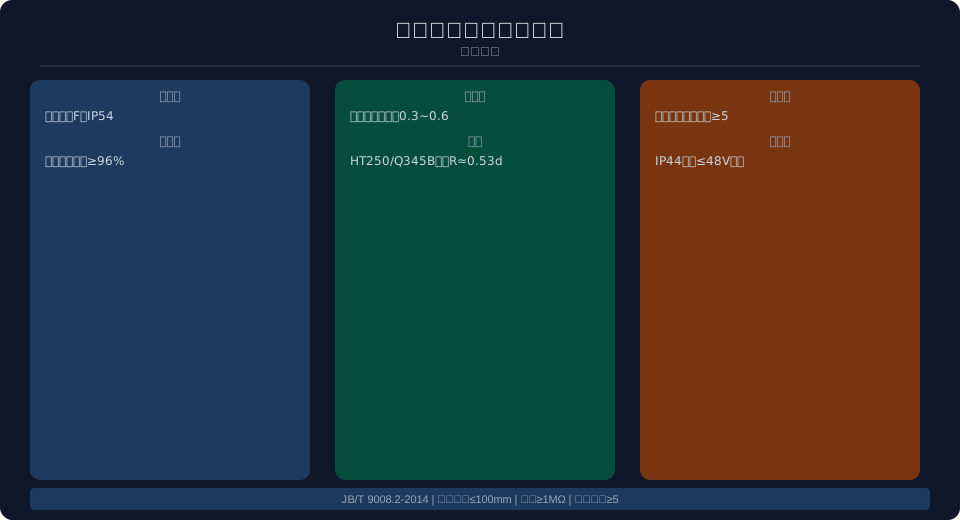
Kelude Heavy Industry manufactures wire rope electric hoists in various models, strictly following national standards in production. The standard systematically specifies materials and manufacturing requirements for electric hoists — the motor is a cone rotor motor (Class F insulation, IP54 Protection Rating), with the brake integrated into the motor design. Brake Clearance is 0.3–0.6 mm. The Reducer / Gearbox uses planetary gear transmission with gears made of 20CrMnTi steel, Carburizing and Quenching to HRC 58–62, with accuracy grade not lower than Grade 8. Single-stage Reducer efficiency is ≥96%. The Drum is made of HT250 grey cast iron or a Q345B (≈S355J2) welded structure, with rope groove radius R ≈ 0.53–0.55d. The Wire Rope is a non-spinning, galvanized wire rope with a Safety factor ≥5.

The standard also specifies Assembly requirements — all components must rotate freely without jamming after assembly. The Brake must operate reliably with Braking torque ≥1.5 times the rated load torque. The Reducer must run smoothly with noise ≤75 dB(A). The Wire Rope must be evenly and tightly wound on the Drum without overlapping or pinching, with the fleet angle not exceeding 3°. The electrical system Insulation Resistance must be ≥1 MΩ (cold state), and Grounding Resistance ≤4 Ω. The complete hoist must pass a no-load test run of at least 5 consecutive cycles without any abnormality.


Electric hoist technical specifications


The standard further specifies complete hoist Assembly requirements — all components must rotate freely without jamming after assembly, and the Brake must respond reliably. The Reducer must run smoothly with noise ≤75 dB(A). The Wire Rope must be evenly and tightly wound on the Drum without overlapping or pinching, with the fleet angle not exceeding 3°. The electrical system Insulation Resistance must be ≥1 MΩ (cold state), and Grounding Resistance ≤4 Ω. The complete hoist must pass a no-load test run of at least 5 consecutive cycles without any abnormality. The standard also mandates Type Test for electric hoists — conducted every 2 years, covering all routine test items plus a damp-heat test (48 hours at 40°C, 93% humidity), a vibration test (10–55 Hz frequency sweep), and a Durability test (service life ≥5,000 hours).

The standard defines the operating environment for electric hoists — normal Operating ambient temperature ranges from −20°C to +40°C, with Relative Humidity ≤85% (at 25°C). For High-Temperature Environment (e.g., smelting and foundry workshops), motors with Class H insulation (180°C) must be selected. For Dusty Environment Service or wet conditions (e.g., mines, coal washing plants), the Protection Rating must be raised to IP55 or higher. The standard also requires a Visual inspection of the hoist before installation to confirm no transit damage, followed by a no-load test run of at least 5 cycles after installation to verify all mechanisms function properly.

Testing and Inspection Procedures

Routine tests are performed unit by unit — a No-Load Test (at least 5 full cycles), a Rated Load Test (100% SWL) with 3 lift/lower cycles measuring load drop ≤100 mm, a Static load test at 1.25 times the rated load (10 minutes with no permanent deformation), and an insulation test (≥1 MΩ). Type Test is conducted every 2 years and covers all routine test items plus damp-heat, vibration, and Durability tests (service life ≥5,000 hours). Each Brake must undergo individual Braking torque testing to ensure it reaches ≥1.5 times the rated capacity.

Motor
Conical rotor
Class F / IP54
Brake
Clearance 0.3–0.6 mm
Torque ≥1.5×
Reducer
Planetary gear
Single-stage ≥96%
Wire Rope
Galvanized, non-spinning
Safety factor ≥5
Noise
≤75 dB(A)
Smooth operation
Insulation
≥1 MΩ
IP54 control box
inspection items technical requirements Method Determination
No-load Full Travel≥5Cycles Visual Inspection+Auditory Inspection Smooth Operation, No Abnormalities
rated load Lifting and Lowering3Cycles Measurementload drop ≤100mm
static load 1.25Times×10min Visual Inspection+Measuring Instrument Nonepermanent deformation
insulation ≥1MΩ 500VMegohmmeter (Insulation Tester) Conforming
Braking rated load Braking Measuring Drift ≤100mm

Operation & Maintenance Guide

Inspect brake clearance and brake ring wear every 100 working hours. Check wire rope for wire breaks and lubrication condition every 500 working hours. Replace gearbox lubricating oil every 1,000 working hours (initial oil change after 100 hours). Inspect hook for wear and deformation every 2,000 working hours. Conduct a comprehensive annual safety inspection. Scrap the wire rope if wire breaks exceed the standard limit or diameter reduction surpasses 7%. Scrap the hook if wear exceeds 10% of original dimensions or throat opening increases by more than 15%.

Component maintenance item Period discard criteria
Brake Clearance Check 100h Wear>50%
Wire Rope wire break Inspection 500h Diameter Reduction>7%
Reducer / Gearbox Oil Change 1000h noise Increase
Hook Wear Inspection 2000h Wear>10%

The standard specifies installation requirements for electric hoists. For stationary installations, the drum shaft levelness deviation must not exceed 1/1000. For trolley-mounted installations, the crane rail must be straight with a track gauge deviation of no more than ±2 mm. The wire rope must be wound evenly on the drum without pinching or overlapping. When the rope end is secured with clamp plates, at least two clamps are required per end, with a tightening torque of approximately 150 N·m for M16 bolts. The standard also requires that the hoisting height limit switch be periodically inspected to ensure reliable operation.


Frequently Asked Questions

Q: How do JB/T 9008.2 and 9008.1 relate to each other?

A: JB/T 9008.1 defines the types and basic parameters of electric hoists (model, specification, dimensions), while JB/T 9008.2 specifies the technical requirements (material requirements, manufacturing precision, assembly requirements, test methods, and inspection rules). The two standards are used together, forming a complete standard system for wire rope electric hoists.

Q: What are the electrical system requirements for electric hoists?

A: The motor must be a cone rotor motor with Class F insulation and IP54 protection. The electrical control cabinet must have a protection rating of at least IP44. The control voltage must be safety extra-low voltage of 36V or 48V. An emergency stop switch is required in the control circuit. Power is supplied via C-type or H-type conductor rails. Grounding resistance must not exceed 4Ω.

Q: What safety requirements apply to the wire rope?

A: The wire rope must be galvanized, cross-laid, and non-spinning, with a nominal tensile strength of at least 1570 MPa. The safety factor must be no less than 5. At least two safety wraps must remain on the drum. The rope end must be secured using clamp plates or a wedge socket. Wire rope scrapping criteria are governed by GB/T 5972.

Q: What does the factory acceptance test cover?

A: The factory acceptance test includes a visual inspection (coating, nameplate, weld quality), a no-load test (at least 5 full cycles), a rated load test (3 lifting/lowering cycles with a load drop of no more than 100 mm), a 1.25× static load test (10 minutes), and an electrical insulation test (≥1 MΩ).

Related News

contact

contact us

phone:
+86 13903802779

mail:3915269@qq.com

Working hours: Monday to Friday

Wechat
Wechat
SHARE
TOP