

Interpretation of the JB/T 7334 Standard on "Hand-Operated Chain Hoists"
📋 JB/T 7334-2016 "Hand-Operated Chain Hoists" is a technical document within the mechanical industry standards that specifies the types and basic parameters, technical requirements, test methods, inspection rules, as well as marking, packaging, transportation, and storage requirements for hand-operated chain hoists. The standard applies to hand chain hoists with rated lifting capacities ranging from 0.5 t to 40 t and serves as the core basis for product design and manufacturing, factory acceptance testing, and user selection.
Hand chain hoists, also known as ”inverted chain hoists” or ”magic hoists,” are the most common type of lightweight, small-scale manual lifting equipment. The operator pulls the chain to rotate the hand sprocket, which, after being reduced in speed by a gear mechanism, drives the load sprocket to lift the load. JB/T 7334-2016 is the current industry standard for this product, providing comprehensive specifications for its mechanical performance, safety requirements, and inspection procedures. Due to their simple structure, lack of power requirements, and ease of maintenance, hand chain hoists are widely used in factory workshops, warehousing and logistics, construction sites, and equipment installation.
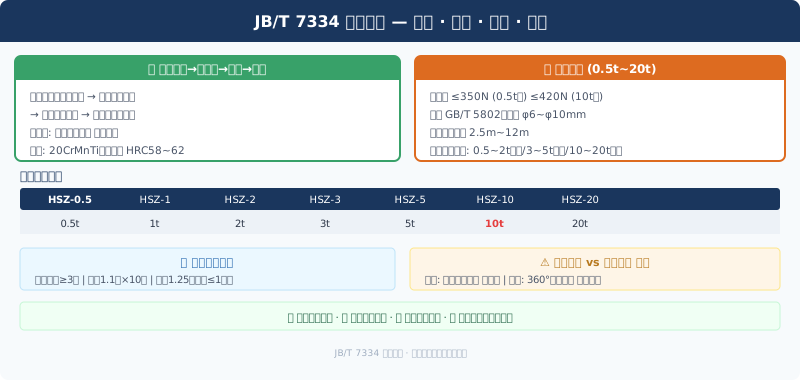
Compared to electric hoists, hand-operated hoists are not limited by power supply conditions and can be used for lifting operations in locations without electricity and in explosion-proof environments. Although their lifting speed is slow (typically 0.02–0.05 m/s), they offer precise positioning and smooth operation. Krude Heavy Industry manufactures a full range of hand chain hoists with capacities from 0.5 metric tons to 20 metric tons. The core components are forged from alloy steel and heat-treated, and each unit undergoes a 1.25-times dynamic load test before leaving the factory.
Principles of Power Transmission and the Structure of Core Components
The drive system of a hand-operated chain hoist consists of five components: the hand chain, the hand sprocket, the gear reduction mechanism, the load sprocket, and the load chain. When the operator pulls the hand chain, it drives the hand sprocket to rotate. The torque is amplified through a multi-stage gear reduction mechanism and transmitted to the load sprocket, thereby driving the load chain and hook to lift and lower the load. Standards require that the gear reduction ratio be reasonably designed based on the rated lifting capacity to ensure that the operating force does not exceed 360 N (approximately 36 kgf), guaranteeing that a single person can operate even the heaviest-capacity models.
The load chain is one of the most critical load-bearing components of a hand chain hoist. Standards require the use of high-strength calibrated chains that comply with GB/T 5802; common specifications range from φ6 mm to φ10 mm. The chain material should be 20Mn2 or an alloy steel of equivalent or higher grade, and the surface hardness after quenching and tempering should reach HRC 42–50. The standard explicitly requires that the minimum breaking strength of the chain shall not be less than four times the rated lifting capacity, and the chain shall not undergo permanent deformation when subjected to 1.5 times the rated load.
The braking system uses a ratchet-friction pad brake, consisting of a ratchet wheel, a pawl, and a brake housing. Its operating principle is as follows: During hoisting, the pawl engages with the ratchet wheel under spring pressure, preventing the load from falling freely; during lowering, pulling the hand chain in the opposite direction disengages the pawl, allowing the load to descend under its own weight. The standard specifies that the braking slip rate under 1.25 times the rated load shall not exceed 1 link per minute.
| Number of Gears | Speed Reduction Ratio Range | Applicable Tonnage | Hand-held Tensile Force (N) | Features |
|---|---|---|---|---|
| Single-stage gear | 1:5~1:8 | 0.5 metric tons to 2 metric tons | ≤280 | Simple structure, compact size |
| Two-stage gear | 1:20~1:40 | 1 metric ton to 5 metric tons | ≤320 | Sufficient torque amplification and excellent overall performance |
| Three-stage gear | 1:60~1:100 | 5 metric tons to 20 metric tons | ≤360 | High reduction ratio, easy handling of heavy loads |
| Planetary Gear | 1:30~1:80 | 10 metric tons to 40 metric tons | ≤360 | Compact design, high load-bearing capacity |
Tonnage Specifications and Model Selection
JB/T 7334-2016 specifies the following rated load capacity series for hand chain hoists: 0.5 t, 1 t, 1.6 t, 2 t, 2.5 t, 3.2 t, 5 t, 8 t, 10 t, 16 t, 20 t, 32 t, and 40 t—for a total of thirteen specifications. Among these, the 0.5 t to 5 t range is classified as light-duty, primarily used for routine maintenance and general lifting operations; the 10 t to 20 t range is medium-duty, used for equipment installation and production line assembly; and the 32 t to 40 t range is heavy-duty, suitable for the lifting and handling of large equipment. It is worth noting that high-capacity hand chain hoists rated at 10 metric tons or more often employ a double-chain or four-chain configuration, which increases the number of load-bearing chains to ensure safety and reliability.
Standard lifting heights are categorized by tonnage: 0.5 t to 2 t is 2.5 m or 3 m; 3.2 t to 5 t is 3 m; 8 t to 20 t is 3 m; and 32 t to 40 t is 3 m. In actual use, non-standard stroke lengths can be customized as needed; however, when extending the chain, care must be taken to account for the impact of the chain’s own weight on the operator’s pulling force. When selecting a model, it is recommended to use 1.25 to 1.5 times the actual lifting weight as the rated lifting capacity to ensure a sufficient load margin.
For applications involving frequent use, select products with a duty class of at least M4. The duty class of a hand chain hoist is determined comprehensively based on the average daily operating time and the load spectrum factor, in accordance with the classification method outlined in the appendix of JB/T 7334. Products with a high duty class have stricter requirements regarding gear material, bearing selection, and heat treatment processes, resulting in a longer service life.
Material and Heat Treatment Requirements for Key Components
The hook is the most direct load-bearing component of a hand chain hoist. Standards require that it be forged from No. 20 steel or 20Cr steel, normalized after forging, and surface-hardened (HRC 38–45) at the hook opening. Finished hooks must undergo magnetic particle or ultrasonic testing; defects such as cracks, folds, or scale are not permitted. If the hook opening deforms during use to exceed 10% of its original dimension, the hook must be immediately scrapped and replaced.
Gear materials must be alloy structural steels such as 40Cr or 20CrMnTi. After carburizing and quenching, the tooth surface hardness should reach HRC 55–62, and the core hardness should be HRC 30–45. The carburization depth is determined by the module (typically 0.8–1.2 mm). Gear accuracy shall not be lower than Grade 8 as specified in GB/T 10095. All gears shall undergo a meshing inspection prior to assembly; the number of contact spots shall be no less than 40% along the tooth height and no less than 50% along the tooth length.
| Test Items | Standard Metrics | Test Conditions |
|---|---|---|
| No-Load Test | Operates smoothly, with no jamming or unusual noises | A total of ≥3 round trips |
| Dynamic Load Test | 1.1 times the rated load, ≥10 takeoffs and landings throughout the entire flight | All agencies are operating normally. |
| Brake slip | ≤1 link/min | 1.25 times the rated load, stationary after lifting 300 mm |
| Static Load Test | 1.5 times the rated load, for 10 minutes | No permanent deformation, no cracks |
| Total Chain Elongation | ≤ Original length 3% | 1.25 times the rated load, measured after 500 cycles |
| Gear Meshing | Contact spots ≥ 40% (High)/50% (Long) | Staining Method Examination |
Frequently Asked Questions
Q: What basic parameters and scope of application does the JB/T 7334-2016 standard specify for hand chain hoists?
Answer: JB/T 7334-2016 specifies thirteen models of hand-chain hoists with rated lifting capacities ranging from 0.5 t to 40 t, with standard lifting heights of 2.5 m or 3 m. The standard applies to hand chain hoists that use a hand-operated chain as the drive mechanism and lift loads via a sprocket driven by a gear reducer, covering the full range of technical requirements from design and manufacturing to factory inspection.
Q: How do you select the appropriate hand chain hoist model based on actual operating conditions?
Answer: The key parameter for selection is the actual weight of the load being lifted. It is recommended to set the rated lifting capacity at 1.25 to 1.5 times the calculated load. For production environments involving frequent use, select products with a duty class of M4 or higher, paying close attention to the gear material (40Cr/20CrMnTi) and heat treatment process (carburizing and quenching to HRC 55–62). For high-capacity products rated at 10 metric tons or more, it is recommended to prioritize double-chain or four-chain configurations to increase safety redundancy; at the same time, ensure that the lifting height is compatible with the available workspace.
Q: What are the periodic inspection intervals and main inspection items for hand chain hoists?
Answer: JB/T 7334 stipulates that hand chain hoists should undergo a comprehensive periodic inspection once a year and a visual inspection before each use. Key items for periodic inspection include: measurement of hook opening deformation (≤10%), measurement of total elongation of the load chain (≤3%), testing of brake slip (≤1 link/min), and inspection of gear meshing contact spots. Hand chain hoists that are being put back into service after a prolonged period of inactivity must pass a comprehensive inspection and undergo a 1.25-times dynamic load test.
Q: How can safe operation of hand chain hoists be ensured on construction sites and during equipment installation?
Answer: The key to safe operation is as follows: Before lifting, check that the hook’s anti-disengagement device is in good condition, that the chain is free of knots or twists, and that the upper and lower hooks are bearing the load vertically; do not pull at an angle, lift at an oblique angle, or overload the equipment; when multiple people are pulling the hand chain simultaneously, they should maintain a consistent rhythm; No personnel are allowed to stand beneath the load during the lifting process; after use, the hand chain hoist should be unhooked and properly stored to prevent the chain from being under tension for extended periods. Krude Heavy Industry products come standard with overload protection devices and 360° rotating hooks, enhancing operational safety.
Standard Reference: JB/T 7334-2016 "Hand-Operated Chain Hoists" | Technical Department
