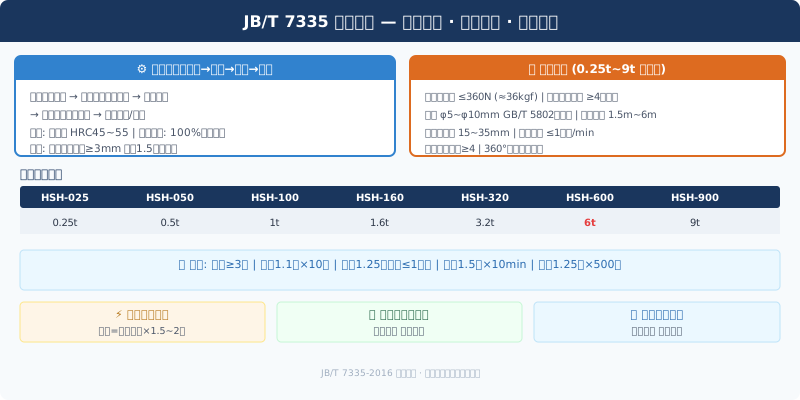

JB/T 7335 Lever Hoist Standard Explained

JB/T 7335-2016, the industry standard for lever hoists, defines the core technical specification for this product category. It covers type designations, basic parameters, technical requirements, test methods, inspection rules, marking, packaging, transport, and storage — applicable to lever hoists with a rated lifting capacity of 0.25t to 9t.

A lever hoist is a type of light and small lifting equipment that lifts and pulls loads through manual handle operation, leveraging the lever principle and a ratchet and pawl mechanism. JB/T 7335-2016 serves as the foundational industry standard for lever hoists and has become the essential technical document guiding Design & Manufacturing, Factory Acceptance Test, and product selection since its release. Unlike hand chain hoists, which are driven by a hand chain, the lever hoist operates through a reciprocating handle motion — a design that gives it a distinct advantage in confined spaces and applications requiring precise micro-adjustment.

JB/T 7335 Lever Hoist Structural Parameters Overview

Lever hoists are widely used in power line construction, equipment installation and positioning, steel structure assembly, mine roadway support, and various temporary operations requiring horizontal pulling or vertical lifting. Their compact structure and portability make them a common choice for field work and emergency repairs. Kelude Heavy Industry manufactures lever hoists in full compliance with the JB/T 7335 standard, covering the complete range from 0.25t to 6t, with high-strength Alloy Steel hooks and forged ratchets as standard equipment.


Working Principle and Mechanical Structure of Lever Hoists

The core drive mechanism of a lever hoist consists of the handle, ratchet, pawl, gear reduction system, and load chain. As the operator reciprocates the handle, the one-way engagement of the ratchet and pawl converts the handle's back-and-forth motion into intermittent rotation of the load sprocket, raising or lowering the load. Compared to hand chain hoists, which use a hand chain and hand chain wheel, the lever hoist offers a greater lever ratio for reduced operating effort and the ability to work at any angle.

The standard requires gear materials to be high-quality Alloy Steel with Heat treatment, achieving a Tooth surface hardness of HRC45–55 to ensure Wear Resistance and fatigue performance under frequent use. As critical safety components, the ratchet and pawl must undergo 100% Magnetic Particle Inspection (MPI), with no cracks, folds, or other Defects permitted. The load chain must conform to the calibrated chain specified in GB/T 5802, with common diameters of φ5mm to φ10mm and a Safety factor of no less than 4 times the rated load.

The handle, being the direct force-bearing component, must withstand 1.5 times the rated load in bending strength without permanent Deformation. Handle lengths range from 290mm to 600mm depending on capacity, balancing leverage with operational space requirements. The standard also specifies the handle sleeve material and wall thickness, requiring seamless steel tubing with a minimum wall thickness of 3mm.


Model Range, Specifications, and Performance Parameters

JB/T 7335-2016 defines ten rated Lifting Capacity ratings for lever hoists: 0.25t, 0.5t, 0.8t, 1t, 1.6t, 2t, 3.2t, 5t, 6t, and 9t. The 0.25t–2t units are classified as light-duty, primarily used for equipment fine-adjustment and pipeline installation; the 3.2t–9t units are medium-duty, intended for equipment installation and structural Hoisting. The minimum breaking load for all capacities must not be less than 4 times the rated load, and the handle operating force must not exceed 360N (approximately 36 kgf).

The standard also specifies graded lifting heights by capacity: 0.25t–1t units typically offer a lifting height of 1.5m–3m, 1.6t–3.2t units 1.5m–6m, and 5t–9t units 1.5m–3m. Standard lifting heights can be extended in 1.5m increments. Under full load, the chain travel per handle stroke — the distance the load moves with each pull — ranges from 15mm to 35mm depending on capacity, a parameter that directly affects operational efficiency.


Typical Applications and Selection Guide for Lever Hoists

Lever hoists are especially prevalent in the power industry — tensioning overhead transmission conductors, lifting components during tower assembly, and positioning substation equipment all rely on the Precise Positioning capability of the lever hoist. In steel structure erection, lever hoists are commonly used for temporary Fixing and fine alignment of beam-column connections. In underground mining, their Explosion-proof characteristics make them suitable for bracket installation and equipment pulling and transport.

Three key factors should guide product selection: first, the rated Lifting Capacity should include a safety margin of 1.5 to 2 times the actual load; second, the lifting height must match the working space — extended chain configurations are available when standard lifting heights are insufficient; third, handle operating force affects operator fatigue during frequent use, so high-cycle applications should prioritize lower-capacity models with higher Reduction Ratios. For horizontal pulling applications, confirm the hoist supports this function — certain high-end models allow operation in any direction across 360°.


Rated Lifting Capacity Range
0.25t ~ 9t
Handle Operating Force
≤360N (≈36kgf)
Minimum Breaking Load
≥4× rated load
Chain Diameter
φ5 ~ φ10mm
Standard Lifting Height
1.5m ~ 6m
Brake Slip Distance
≤1 chain link/min

Inspection Requirements and Quality Control

Per the Standard, every lever hoist must pass a No-Load Test, Dynamic Load Test, and brake test before leaving the factory. In the No-Load Test, the handle is fully cycled at least three times in both directions to confirm smooth, jam-free operation of all mechanisms. The Dynamic Load Test is conducted at 1.1 times the rated load for no fewer than ten full Hoisting and Lowering cycles, verifying proper gear meshing and chain travel. In the brake test, a load of 1.25 times the rated load is lifted 300 mm and held stationary; the load drop within one minute must not exceed the distance of one chain link.

The Type Test imposes stricter criteria: a Static load test at 1.5 times the rated load is applied for 10 minutes, during which no load-bearing Component may show permanent Deformation or Crack. A Fatigue test is then performed at 1.25 times the rated load for at least 500 cycles, after which all components must remain fully functional. Additionally, the increase in hook opening must not exceed 10% of the original dimension, and the total elongation of the chain must not exceed 3% of its original length.


Inspection Item Standard Requirement Inspection Method
No-Load Test Full-stroke Reciprocation≥3Cycles, Smooth Operation Manual operation, visual inspection
Dynamic Load Test 1.1Times Load, Full-stroke Lifting and Lowering≥10Cycles Loading Test Weightor Dynamometer
brake test 1.25Times Load, Droop≤1Chain Link/min Hoisting / Lifting300mm Dwell Timing After Stop
Static load test 1.5Times Load, Sustained10min None Deformation Type Test, Loading Platform
chain Elongation Detection ≤Original Length3% Standard Length Measurement Comparison
hook opening Deformation Amount≤10% vernier caliper Measurement

Model Rated Lifting Capacity Standardlifting height Handle Operating Force chain Diameter Dead Weight(Approx.)
HSH-025 0.25t 1.5m ≤200N φ5mm 7kg
HSH-050 0.5t 1.5m ≤240N φ5mm 9kg
HSH-100 1t 1.5m ≤280N φ6mm 12kg
HSH-160 1.6t 1.5m ≤300N φ8mm 16kg
HSH-320 3.2t 3.0m ≤340N φ10mm 24kg
HSH-600 6t 1.5m ≤360N φ10mm 35kg

Frequently Asked Questions

Q: Which types of lever hoists does the JB/T 7335 standard cover?

A: JB/T 7335-2016 applies to lever hoists with a rated lifting capacity of 0.25t to 9t, operated by manual handle force, using a ratchet and pawl mechanism to drive the load sprocket for hoisting or pulling loads. The standard does not cover hoists powered by electric motors or other power sources, nor does it apply to hand chain hoists or chain electric hoists. When selecting a hoist, users should verify the standard number indicated on the product nameplate.

Q: What are the key technical differences between a lever hoist and a hand chain hoist?

A: The primary differences lie in the drive mechanism and intended operating conditions. A lever hoist is driven by a handle and ratchet mechanism, offering a higher lever ratio for reduced manual effort. It supports operation at any angle through 360°, making it ideal for horizontal pulling and precise positioning. A hand chain hoist, by contrast, is driven by pulling the hand chain to rotate the hand chain wheel, delivering faster lifting speeds but limited horizontal pulling capability—it is better suited for vertical hoisting applications. Additionally, at the same tonnage, a lever hoist typically weighs 15%–25% less than a hand chain hoist.

Q: What are the required daily inspection and periodic inspection intervals for lever hoists?

A: JB/T 7335 requires a visual inspection before each use: check the hook for cracks or deformation, inspect the chain for wear or elongated links, verify reliable ratchet and pawl engagement, and confirm the handle is not bent. Routine maintenance—lubrication and cleaning—should be performed every 3 months. A full periodic inspection must be carried out at least once a year, including a load test at 1.25 times the rated load and flaw detection on critical components. After prolonged storage, the hoist must pass a complete inspection before being returned to service.

Q: How should a lever hoist be used correctly for overhead power line tensioning?

A: Overhead line tensioning is a typical application for lever hoists. Secure the upper hook to the pole or anchor point, and connect the lower hook to the conductor using a wire rope sling or wire tensioner. During tensioning, operate the handle slowly and steadily, monitoring sag changes to avoid over-tensioning in a single pass. Select the hoist capacity based on line tension—a common practice is to choose a unit rated at 1.5 to 2 times the calculated tension. Kelude offers dedicated lever hoist models for the power industry, featuring insulated handles and anti-corrosion surface treatment as standard.

Standard basis: JB/T 7335-2016 "Lever Hoists" | Technical Department

Related News

contact

contact us

phone:
+86 13903802779

mail:3915269@qq.com

Working hours: Monday to Friday

Wechat
Wechat
SHARE
TOP