
Cement Plant Crane Selection: Raw Material, Kiln & Packing Guide
At a glance: Kelude Heavy Industry provides crane selection schemes for cement producers across all four production stages—raw material crushing, raw meal grinding, clinker burning, and cement packaging—with lifting capacities from 5 to 50 t and spans from 12 to 36 m. Complete plant lifting equipment investment typically ranges from approximately $44,500 to $593,000. The raw material area is equipped with heavy-duty gantry cranes (16–32 t), the grinding area uses overhead cranes (16–50 t), the burning area is fitted with heat-resistant double-girder bridge cranes (20–50 t), and the packaging area employs grab or gantry cranes (10–20 t)—covering the full-process lifting needs of a cement production line from quarry crushing to finished product dispatch.
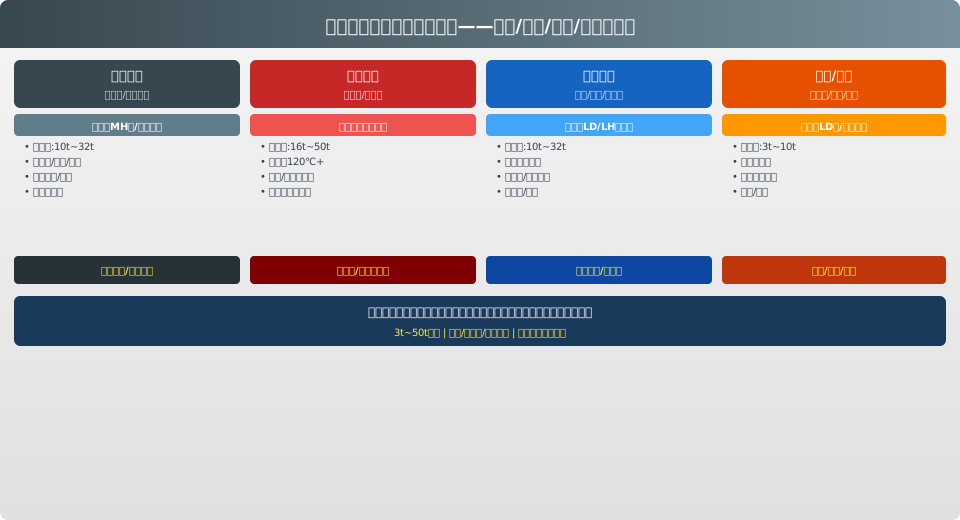
Crane Selection for Cement Production Lines
Raw Material | Burning | Grinding | Packaging & Dispatch
Crane selection for the four key sections of a cement production line: raw material, burning, grinding, and packaging.
Scenario 1: Raw Material Section
• Lifting capacity: 10–32 t, MH type / grab bridge crane
• Limestone / clay / iron powder
• Heavy-duty grab / dustproof design
• Dust seal
Heavy-Duty Grab | Dust Seal
Scenario 2: Burning Section
• Lifting capacity: 16–50 t, heat-resistant overhead crane
• Heat-resistant up to 120°C+
• Kiln / cooler maintenance
• Refractory brick replacement hoisting
Heat-Resistant | Refractory Brick Replacement
Scenario 3: Grinding Section
• Lifting capacity: 10–32 t, LD/LH type overhead crane
• Mill liner plate replacement
• Gearbox / motor maintenance
• High dust / sealed design
Mill Liner | High Dust
Scenario 4: Packaging & Dispatch
• Lifting capacity: 3–10 t, LD type / electric hoist
• Packaging machine maintenance
• Bulk loading system
• Dustproof / sealed design
Packaging / Bulk | Dustproof
Selection Parameters by Production Area
Kelude Heavy Industry is a professional manufacturer of industrial overhead cranes and electric hoists, integrating design, production, sales, and service. We provide a wide range of material handling solutions, including single-girder cranes, double-girder cranes, bridge cranes, gantry cranes, and explosion-proof hoists, tailored to meet the specific needs of various industries.
What Is an Industrial Overhead Crane?
An industrial overhead crane—often referred to as a bridge crane—is a machine designed to lift, lower, and horizontally move heavy loads within a defined area. It consists of a bridge that spans the workspace, supported by end trucks that travel along elevated runways. The hoist, which handles the actual lifting, moves along the bridge. These cranes are essential for improving efficiency and safety in manufacturing plants, warehouses, and other industrial facilities.
Key Components of an Overhead Crane System
Understanding the main parts of an overhead crane helps in selecting the right equipment and maintaining it properly. The core components include:
- The Bridge: The main horizontal beam that supports the hoist and trolley. It can be of single-girder or double-girder construction.
- The Hoist: The mechanism responsible for lifting and lowering the load. It can be wire rope or chain type, and may be manually or electrically operated.
- The Trolley: The unit that carries the hoist and moves it across the bridge.
- The End Trucks: Located at either end of the bridge, these contain the wheels that allow the crane to travel along the runway.
- The Runway: The rails or tracks on which the crane travels, typically mounted on the building's support columns.
- The Control System: The means by which the operator controls the crane's movements, which can range from pendant stations to advanced radio remote controls.
Single-Girder vs. Double-Girder Cranes
Choosing between a single-girder and a double-girder crane depends on your specific application requirements, including span, capacity, and duty cycle.
| Feature | Single-Girder Crane | Double-Girder Crane |
|---|---|---|
| Structure | One bridge girder, with the hoist running on the lower flange. | Two bridge girders, with the trolley running on rails atop the girders. |
| Capacity | Typically up to 20 tons. | Can handle much higher capacities, from 10 tons to over 100 tons. |
| Span | Generally suitable for spans up to 30 meters. | Can achieve longer spans, often exceeding 30 meters. |
| Headroom | Requires less headroom, making it ideal for low-profile buildings. | Requires more headroom due to the double-girder design. |
| Cost | More cost-effective for lighter applications. | Higher initial investment, but offers greater capacity and durability. |
| Maintenance | Simpler design, generally easier to maintain. | More complex, but components are often more accessible for service. |
Key Industries and Applications
Overhead cranes are versatile machines used across a broad spectrum of industries. Their ability to move heavy loads safely and efficiently makes them indispensable in:
- Manufacturing: For handling raw materials, work-in-progress, and finished goods on production lines.
- Automotive: For moving engines, chassis, and other heavy components during assembly.
- Steel and Metal Processing: For transporting coils, sheets, and molten metal in mills and foundries.
- Warehousing and Logistics: For loading and unloading trucks, and organizing heavy inventory.
- Power Generation: For maintaining turbines, generators, and other heavy equipment in power plants.
- Shipbuilding: For lifting large sections of hulls and heavy machinery during vessel construction.
Safety and Standards Compliance
Safety is paramount in crane operation. Kelude cranes are designed and manufactured in strict accordance with international standards, including ISO 4301 for crane classification and IEC 60204-32 for electrical equipment. Key safety features often include overload protection, limit switches to prevent over-travel, emergency stop functions, and anti-sway technology to ensure precise load control. Regular maintenance and operator training are also critical for safe and reliable operation.
Choosing the Right Crane for Your Needs
Selecting the appropriate overhead crane involves careful consideration of several factors. Our team of experts can help you evaluate your specific needs to find the most efficient and cost-effective solution.
- Load Capacity: Determine the maximum weight you need to lift, including any attachments like grabs or magnets.
- Span and Lifting Height: Measure the width of your facility and the required vertical lifting distance.
- Duty Cycle: Assess how frequently the crane will be used and the intensity of operations. This is classified by standards like ISO 4301.
- Power Supply: Identify the available voltage and phase of your facility's electrical system.
- Environmental Conditions: Consider factors like temperature, humidity, dust, and the potential for explosive atmospheres, which may require special explosion-proof equipment.
Installation and After-Sales Support
Kelude provides comprehensive support throughout the entire lifecycle of your crane. Our services include professional installation, commissioning, operator training, and responsive after-sales support. We offer both standard spare parts and customized maintenance plans to ensure your crane operates at peak performance for years to come. Our goal is to minimize downtime and maximize your return on investment.
Frequently Asked Questions
Q: What is the typical lead time for an industrial overhead crane?
A: Lead times vary depending on the crane's specifications and complexity. A standard single-girder crane might be delivered in 4-6 weeks, while a large custom-engineered double-girder system could take 12-16 weeks. We provide a precise schedule upon project confirmation.
Q: Can you provide cranes that meet specific international standards?
A: Yes, our cranes are designed to comply with major international standards, including ISO 4301 for classification, ISO 12480 for safe use, and IEC 60204-32 for electrical installations. We can also adapt designs to meet local regulations and site-specific requirements.
Q: What kind of warranty do you offer on your cranes?
A: We offer a standard warranty period of 12 months from the date of commissioning, covering defects in materials and workmanship. Extended warranty options and preventive maintenance contracts are also available.
Q: Do you offer spare parts for cranes that have been in operation for many years?
A: Yes, we maintain a comprehensive inventory of spare parts for our crane models. We also provide long-term support to ensure that replacement parts are available throughout the operational life of your equipment.
Q: How do I determine the right crane capacity for my application?
A: The required capacity is determined by the heaviest load you need to lift, plus the weight of any lifting attachments. It's also important to consider the duty cycle and future needs. Our engineering team can assist you in calculating the optimal capacity and duty class for your specific application.
| Parameter Item | Raw Material | Firing | Grinding | Packing & Shipping |
|---|---|---|---|---|
| recommended model | MH Type/grab bridge crane | High Temperature Resistantoverhead type | LD/LH Typeoverhead type | LD Type/Hoist |
| Lifting Capacity | 10t~32t | 16t~50t | 10t~32t | 3t~10t |
| special requirements | Heavy-Duty Grab (grab bucket)/Dustproof | High Temperature Resistant120℃+ | liner plate Replacement/High-Dust | packaging machine/Dustproof |
| Control Mode | Floorremote control | remote control+Operator Cabin | Floorremote control | Floorremote control |
Lifting Challenges Across Cement Production Stages
A: The raw materials section relies on heavy-duty grab bridge cranes to handle and transfer limestone and other bulk materials. Around the rotary kiln and cooler in the burning zone, ambient temperatures run high, demanding heat-resistant overhead cranes. In the grinding section, replacing mill liner plates is a critical periodic maintenance task.
Packaging, Shipping & Whole-Plant Solutions
For maintenance work on packaging machines and bulk-loading systems, an LD-type crane or electric hoist is usually sufficient. Kelude Heavy Industry offers a unified lifting solution covering the entire cement production line.
Kelude Heavy Industry — Service Advantages
Kelude Heavy Industry has spent years specializing in lifting equipment for the cement manufacturing sector, delivering complete lifting solutions for new dry-process cement lines—from raw material crushing to cement packaging. Our product range covers heavy-duty gantry cranes, heat-resistant overhead cranes, and the full grab bridge crane series, supporting over 50 cement production lines across China with reliable lifting equipment.