

New Regulations on the Safety Supervision of Special Equipment for 2026: Reform of Type Testing, Smart Supervision, and Corporate Responses
📊 Key Points
In 2026, the safety supervision system for special equipment is undergoing a transformation unlike any seen in decades. TSG 51-2023 mandates intelligent collision avoidance, overload warning, and remote shutdown as required features; type testing is transitioning from a ”delegated system” to a ”market-driven” model; and the smart regulatory platform (the ”smart brain” of special equipment) is being piloted in multiple provinces. For crane operators, compliance costs are rising, but safety management standards are improving simultaneously; for crane manufacturers, the new regulations are accelerating the phasing out of outdated products and production capacity—companies equipped with intelligent features such as full variable-frequency drives, CMS, and collision avoidance will benefit, while those producing only low-specification models compliant with national standards will be marginalized.
Safety regulation is never ”meddling”; rather, it serves as a driving force for industry modernization. This article analyzes the three most significant changes in crane safety regulation set to take effect in 2026.
I. TSG 51-2023: What Are the Most Significant Changes?
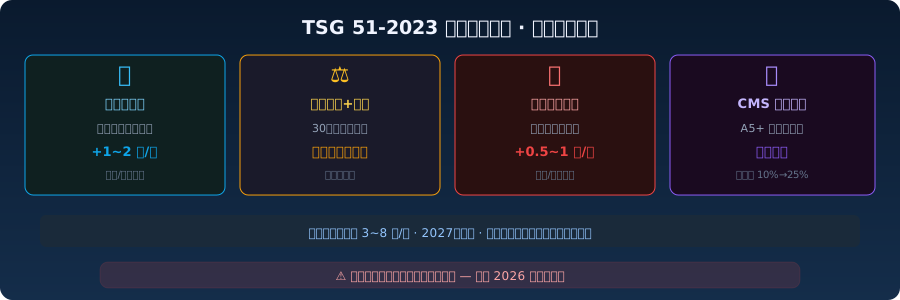
TSG 51-2023, ”Technical Regulations for the Safety of Lifting Machinery,” replaces several previous versions of safety technical specifications for cranes. The most significant changes center on the "mandatory standardization of intelligent safety features":
| New Mandatory Requirements | Technical Implementation | Impact |
|---|---|---|
| Intelligent Collision Avoidance | Laser/radar collision-avoidance systems must be installed between multiple cranes operating on the same track to automatically slow down or stop. | The retrofit cost for each unit is approximately 10,000 to 20,000 yuan. |
| Overload Limits + Records | The overload protector must be equipped with a data logging function that allows for the retrieval of load records from the past 30 days. | Traditional mechanical overload limiters need to be upgraded to electronic ones. |
| Remote Emergency Shutdown | A separate remote emergency stop button (wired or wireless) must be installed on the ground or in the control room. | The retrofit cost is approximately 0.5 to 10,000 yuan per unit. |
| Condition Monitoring System (CMS) | Hoisting mechanisms on cranes rated A5 and above must be equipped with a CMS system to monitor the status of the motor, gearbox, and brake. | The greatest impact—Driving a significant increase in the CMS configuration rate from 10% to 25% |
II. Reform of Type Testing: From the ”Commissioned System” to a ”Market-Oriented Approach”
In the past, type testing for cranes was monopolized by the China Special Equipment Inspection and Research Institute and local special equipment inspection agencies, forcing companies to wait in line—with wait times in some regions lasting as long as 6 to 12 months. The 2026 reform aims to introduce market-based third-party testing organizations to participate in type testing, bringing about the following changes:
Positive Impacts:The type testing cycle is expected to be shortened from 6 to 12 months to 3 to 4 months, accelerating the time to market for new products. Competition among third-party testing providers will reduce testing costs (currently, the fee for type testing a single model is approximately 50,000 to 150,000 yuan, and is expected to decrease by 20% to 30%).
Potential Risks:The quality of third-party testing organizations varies widely, which may lead to a ”bad money drives out good” phenomenon where certificates are issued simply in exchange for payment. It is recommended that companies continue to select reputable organizations, such as the China Special Equipment Inspection and Research Institute or provincial special equipment inspection institutes, to conduct type testing, in order to avoid losses resulting from inspection reports not being accepted by the client.
III. Smart Regulatory Platform: Cranes Must Also Be ”Registered”
In 2026, several provinces (Zhejiang, Guangdong, Jiangsu, and Shandong) launched pilot programs for a smart regulatory platform for special equipment, with data on the entire lifecycle of each crane—from manufacturing to installation, registration, periodic inspections, maintenance, and scrapping—recorded on the platform. Key features include:
① One Code per Machine:Each crane is equipped with a unique electronic record of its ”Special Equipment Use Registration Certificate”; simply scan the QR code to view the equipment’s history.
② Inspection Due Reminder:The system automatically notifies user units of the next scheduled inspection date; equipment that is overdue for inspection will be locked, and the regulatory authorities will be notified.
③ Accident Investigation + Determination of Liability:Crane operation data (load, braking, and overload records) are uploaded to the platform, allowing for the retrospective review of operation records and the chain of responsibility in the event of an accident.
Impact on Businesses:Data transparency has improved significantly, and the old ”if nothing goes wrong, we won’t intervene” mentality no longer holds water. For crane manufacturers, the ability to collect equipment data (CMS + IoT gateway) is evolving from a ”nice-to-have” feature to a ”minimum requirement.”
Frequently Asked Questions
Q: Will old cranes be forced out of service if they aren't retrofitted?
Answer: The transition period for TSG 51-2023 extends through 2027. Cranes that have not been brought into compliance by the deadline will not pass periodic inspections, and equipment without a valid inspection certificate will be ordered to be taken out of service. It is recommended to launch the retrofit plan in 2026 to avoid a last-minute rush in the final year.
Q: What information will be uploaded to the Smart Regulatory Platform?
Answer: At this stage, upload equipment registration information, periodic inspection records, and accident reports. In the medium to long term (2028+), real-time operational data from the CMS (number of lifts, load profiles, and overload records) will be gradually integrated. When purchasing new equipment, companies are advised to ensure it includes an IoT interface.
Q: Is the reform of type testing a positive or negative development for small and medium-sized enterprises?
Answer: Short-term positive (faster and cheaper testing); long-term neutral to bearish. The cost of marketization is tighter regulation—type testing that used to be able to ”cut corners” will become more standardized and stringent. Companies with high-quality products will benefit the most.
Q: What is the greatest compliance risk for companies that use cranes?
Answer: ① Failure to undergo periodic inspections by the due date (triggers automatic enforcement action); ② Failure to record overloading operations (making it impossible to prove compliance after an accident); ③ Safety devices have been intentionally bypassed (resulting in criminal liability for the legal representative in the event of an accident). It is recommended to establish a safety management log for lifting equipment and designate certified safety management personnel.
Related Reading
📄 Equipment Updates and Replacements — Equipment Upgrade Policy
📄 Unmanned Crane Deployment — Smart Safety Features
Data Source: TSG 51-2023 | Bureau of Special Equipment, State Administration for Market Regulation | Announcements on Smart Regulatory Pilot Programs in Various Provinces
