

Bridge Crane Relay to PLC VFD Retrofit Path & Cost
📋 Key Summary
There are two mainstream technical routes for overhead crane electrical control: relay-contactor hard wiring, and PLC plus VFD soft wiring. This article breaks down the boundary between the two across three dimensions—retrofit path, parameter configuration, and cost structure. The relay solution is simple in structure and easy to trace, but contact wear under high-frequency duty is its primary failure source. The PLC-VFD solution offers smooth speed control and clear energy savings, yet demands far more from power quality and grounding/shielding. The key conclusion: retrofit payoff depends on the operating condition. Cranes with frequent starts and stops, precise positioning, and multi-speed requirements deliver high retrofit value; low-frequency, light-load simple duty may not be worth the investment.
Many plant owners assume that swapping an old relay control cabinet for a full PLC-VFD setup will immediately drive down the crane's electrical fault rate. That assumption is only half right. Replacing the contactor system does eliminate hard faults like contact burning and poor contact. But if power quality is poor, grounding is inadequate, and signal cables are unshielded, the PLC will introduce soft faults that are far harder to troubleshoot—false signal triggering, CPU crashes from interference, and VFD overcurrent alarms.
In other words, an electrical upgrade is not simply swapping out a controller. It means redesigning the power supply, grounding, and interference immunity of the entire system. The following sections cover the retrofit path, parameter configuration, and cost boundary in detail.
Relay-Contactor vs. PLC-VFD: Essential Differences in Hoisting Mechanism Control Logic
To decide whether an overhead crane should be converted to PLC control, you first need to understand the fundamental logic gap between the two control modes—not which is better, but how failures manifest.
Relay-contactor control builds every hoisting, crane bridge, and trolley motion from contactor contacts and intermediate relays in a hard-wired circuit. The logic is transparent: with the wiring diagram in hand, you can trace every wire and every contact. The trade-off is that each added interlock or protection function means more contactors and dozens more wires in the cabinet—contact count grows linearly with functionality. Under the control equipment grading requirements of ISO 10245 (Electrical Control Equipment for Cranes), this type of hard-wired solution is reliable enough for simple duty. Its real weakness emerges under high-frequency operation, where contacts suffer mechanical and electrical wear.
The PLC plus VFD approach takes a different path: motion logic is written into the program, contactless digital output modules drive contactors and the VFD, and speed control is handled by the VFD for stepless or multi-step regulation. With smooth speed control, hoisting and bridge/trolley travel can transition steadily between speed ranges, improving positioning accuracy and reducing load impact. But there is an easily overlooked detail—PLC and VFD systems demand far more from power quality, grounding, and signal shielding than relay solutions do.
Kelude Heavy Industry always follows one principle during electrical upgrades: assess the on-site power grid quality first, then decide on the controller selection. The reason is simple—the vast majority of PLC soft faults are not caused by programming errors, but by interference.
VFD Power, Braking Unit, and PLC I/O Count: Three Key Parameters to Calculate Before Retrofit
Mistakes in electrical retrofits usually happen not at the wiring stage, but at parameter selection. Choose the wrong parameters, and the new system will throw faults on day one.
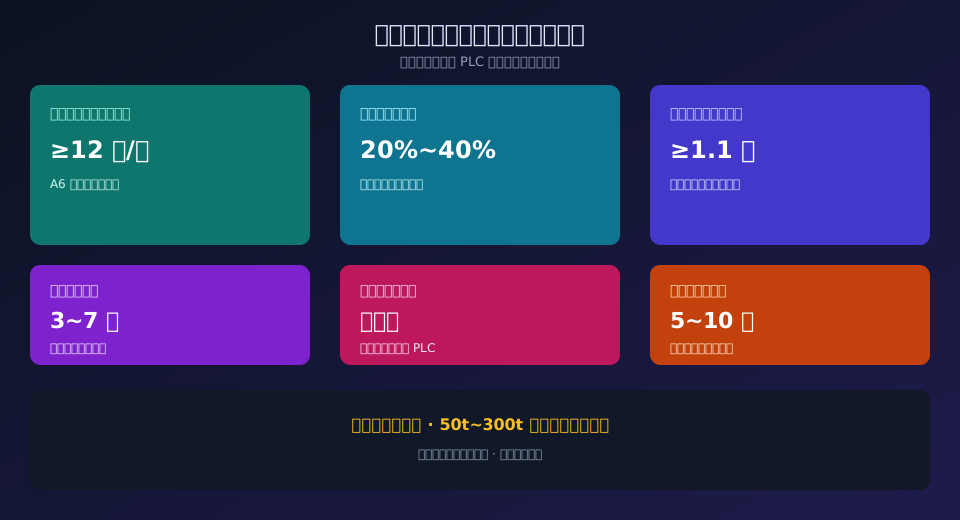
Start with VFD power. The hoisting mechanism is a potential-energy load, so the VFD rated power should generally be selected at 1.1 times the hoisting motor rated power or above. For heavy-load, low-speed, frequent inching duty, a margin of 1.3 to 1.5 times is recommended—otherwise the VFD may overheat or trip on overcurrent during full-load lifting. Per GB/T 12668 (Variable Frequency Speed Control Technical Specification) on speed control system parameter matching, power margin must be calculated together with the work duty and duty cycle.
Next, the braking unit and braking resistor. When lowering a suspended load, the motor enters regenerative braking, and the energy must be dissipated through the braking resistor—otherwise the DC bus voltage rises and triggers overvoltage protection. Resistance and power ratings must be calculated based on maximum braking torque and braking frequency. Undersize them and you get frequent overvoltage trips; oversize them and you waste money.
Finally, PLC I/O count and spare capacity. Before the retrofit, tally the actual input and output points and reserve 10% to 15% spare. At the same time, keep safety circuits—emergency stop, limit switches, overload protection—on hard wiring, not routed through the PLC program. This is the baseline for safety circuit independence.
Before releasing drawings, every Kelude Heavy Industry retrofit solution lists these three parameter groups in a configuration table for customer confirmation, avoiding rework after installation.
High-Frequency Starting Justifies Retrofit; Low-Frequency Light Load May Not—Duty-Based Decision Boundary
Whether an electrical retrofit is worth doing depends not on the controller itself, but on the operating condition. The same 20-ton overhead crane in a steel coil workshop versus a warehouse can see retrofit payback differ by several times.
Duty with frequent starts and stops, precise positioning requirements, and speed control needs delivers the highest retrofit payoff. In these scenarios, relay contacts may need replacement a dozen times a year, while VFD speed control also cuts the energy consumption of series resistance speed control. Conversely, if a crane only lifts a few times a day, handles a stable tonnage, and has no hard positioning accuracy requirement, keeping relay control with scheduled contact replacement is often more practical than blindly upgrading to PLC.
The technical manager at Kelude Heavy Industry pointed out: "Before any retrofit, answer one question—does this crane's duty actually require stepless speed regulation? If the answer is no, spending the budget on contact and brake maintenance delivers a better return."
There is also a safety red line: whichever route you choose, the safety functions of the Electrical Control System must meet the independence requirements for stopping, limiting, and overload protection under ISO 24617:2020 (Crane Electrical Control System Safety Requirements). This holds in theory, but in engineering practice it can be defeated by real-world factors like poor grounding and missing shielding—so every item must be verified during acceptance of retrofit.
Pre-Retrofit Checklist and Life Cycle Cost of Both Routes
Putting the three parameter groups and duty assessment onto paper gives you the pre-retrofit checklist below. Layer on life cycle cost, and the decision framework is complete.
| Comparison Parameter | RelayContactorcontrol system | PLCvariable frequency control | key parameters | applicable working conditions | maintenance points |
|---|---|---|---|---|---|
| control mode | Hard WiringcontactLogic | Program Logic Soft Wiring | Contactor+Relay / CPU+Module | Simpleoperating conditionSufficient | Visual Wiring Inspection / Host ComputerDiagnosis |
| Speed controlPerformance | rotor resistancegradingSpeed control | SteplessVariable Frequency Speed Control | Speed controlRatio Approx.1:5 / 1:20 | Precise PositioningRequiredVariable Frequency Drive (VFD) | — |
| Fault Characteristics | contactArcing Contact Failure | Signal Interference Program Abnormality | Hard Faults Easy to Diagnose / Soft Faults Difficult to Diagnose | — | — |
| energy consumptionSymptom | SeriesResistanceenergy consumptionRelatively High | Energy Saving 20%~40% | energy saving rateFollowoperating conditionFloating | High Frequencyoperating conditionSignificant Difference | — |
| Investment andRetrofit | New ConstructioncostRelatively Low | Frequency Inverter / VFD+PLCRelatively High Investment | One-time Investment,subject to the actual contract | — | — |
| maintenanceMethod | Periodicreplacementcontact | ReplaceModuleDust Cleaning and Wiring Inspection | maintenance cycleDifference | — | — |
Eight-point checklist to review before any retrofit:
|
📋 MotorParameterVerification
rated power、VoltageGrade、Number of Poles |
📋 Frequency Inverter / VFDPowerMargin
Hoisting mechanismTake 1.1 Times or More |
📋 braking unitInvestment andResistance
Potential Energy TypeloadRegenerative Energy |
📋 SupplyCapacitanceQuantity andharmonic
Frequency Inverter / VFDharmonic mitigation |
|
📋 earthing and shielding
signal cableshield single-point grounding |
📋 safety circuitHard Wiring
emergency stoplimit switchIndependent of PLC |
📋 PLC I/O Point Reservation
I/O I/O Point Reservation 10%~15% |
📋 CommissioningInvestment andAcceptance
No-load、Full load、Overload Test |
Life cycle cost comparison of the two approaches:
| costItem | Retainrelay control | UpgradePLCVariable Frequency Drive (VFD) | Description |
|---|---|---|---|
| Hardware Investment | Relatively Low,Based oncontactSpare partsPredominantly | Medium-High,Frequency Inverter / VFD+PLC+braking unit | One-time Investment,subject to the actual contract |
| Annualenergy consumptioncost | Relatively High,SeriesResistanceEnergy Consumption | Can Be Reduced 20%~40% | High Frequencyoperating conditionSignificant Difference |
| Annualmaintenance cost | contactreplacementPlus Labor | modularPlus SoftwareDiagnosis | ReducecontactType Faults |
| downtime cost | Sudden Faults Unpredictable | CanDiagnosisPerformance Improvement | Reduceunplanned downtime |
| lifecycle | Short-term Savings,Relatively High Long-term | High Frequencyoperating conditionpayback period 2~4 Annual | subject to the actual contract |
📖 Related reading: Crane costs should be calculated over 20 years: imported vs. domestic life cycle cost comparison | Why European Standard Cranes cost more: the technical story behind FEM and DIN standards
FAQ
Q: What is the essential difference between relay control and PLC variable frequency control on a crane?
A: Relay control builds logic through contactor and intermediate relay contacts in hard-wired circuits — every added function means another set of contacts. PLC variable frequency control writes the logic into a program and drives the VFD through contactless output modules. Relay systems are straightforward and easy to troubleshoot when a single point of failure occurs, but under high-frequency duty cycles the contacts may need replacement within a year. PLC systems deliver smooth speed control, including multi-step and stepless speed regulation, yet depend on stable power quality and proper grounding and shielding. Under the electrical control equipment requirements of ISO 10245, both approaches must satisfy one bottom line: the hoisting mechanism safety circuit must remain independent of program control.
Q: When converting a bridge crane to PLC variable frequency control, how should the VFD power and braking resistor be sized?
A: The VFD rated power is generally selected at 1.1 times the hoisting motor rated power or above. For heavy-load, low-speed, frequent inching conditions, a margin of 1.3 to 1.5 times is recommended. The braking resistor absorbs the regenerative energy produced when a potential load is lowered; its resistance and power rating must be calculated based on maximum braking torque and braking frequency. Undersizing it will trigger frequent overvoltage faults. Refer to IEC 61800 for parameter matching requirements in variable frequency speed control systems, and always confirm the final selection using the VFD manufacturer's sizing software.
Q: What does a full PLC variable frequency drive retrofit on an older relay-controlled crane cost?
A: Renovation cost consists of the VFD, PLC and modules, braking unit, electrical cabinet and cables, and installation and commissioning. Pricing varies widely with motor power and I/O count. As an industry order of magnitude, a small-to-medium capacity retrofit typically falls in the range of tens of thousands to over a hundred thousand RMB. Large-tonnage, twin trolley, or metallurgical operating conditions will cost more. Kelude Heavy Industry's retrofit solutions are quoted on a case-by-case basis according to actual operating conditions, and the final quotation is subject to the actual contract.
Q: How long does a relay-to-PLC variable frequency drive retrofit take, and how should production be scheduled?
A: For a standard bridge crane, the electrical retrofit — from removing the old cabinet and running cables to installation and commissioning and acceptance — typically takes 3 to 7 days. A major overhaul involving main girder cabling or full cabinet replacement will take longer. We recommend scheduling the work during maintenance windows or night shifts, with phased changeover and the old system kept as a fallback. Kelude Heavy Industry will provide a downtime plan and schedule before the retrofit to minimize the impact on production.
