

DTS Series Multi-Purpose Electric Hoist
Product Overview
The DTS series multi-purpose electric hoist is an upgraded version of the traditional electric hoist, engineered for both ground-level and overhead lifting applications across construction, renovation, warehousing, and individual worksites. It utilizes a cone rotor motor (or a standard electric motor) paired with a reduction gear mechanism to drive the drum, delivering smooth and controlled lifting and lowering. With a rated load capacity of 300–2,000 kg and a maximum lifting height of 100 m, it is available in both 220 V and 380 V power configurations.
Compared to conventional electric hoists, the DTS series stands out for its compact footprint, lightweight construction, cost-effective pricing, and easy installation—making it an ideal choice for light-to-medium lifting tasks. Standard models offer a travel speed of 5.5–8 m/min, ensuring stable and reliable hoisting with neatly spooled wire rope and extended service life.
Product Gallery
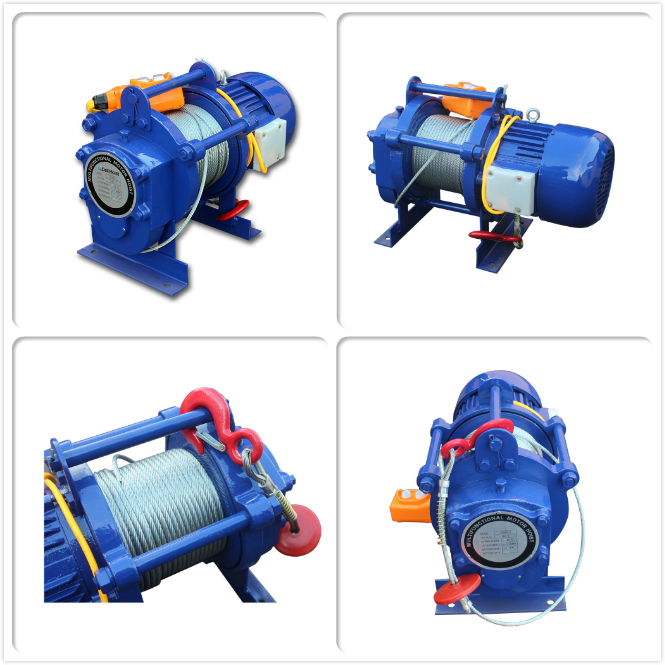
Key Features & Benefits
- Compact, Space-Saving Design: The entire unit features a compact structure and small footprint, making it easy to transport and install—particularly well-suited for confined workspaces.
- Dual Voltage Options: Compatible with both 220 V single-phase and 380 V three-phase power supplies, eliminating the need for additional transformers and adapting seamlessly to varying site power conditions.
- Smooth, Precise Lifting: The cone rotor motor brake combined with the reduction gear mechanism ensures jerk-free, impact-free hoisting and lowering, delivering superior lifting accuracy.
- Extended Lifting Height: Standard models achieve lifting heights of up to 100 m, covering the vast majority of construction and small-scale mining hoisting requirements.
- Multi-Angle Operation: Supports horizontal, inclined, and vertical lifting, moving, and loading/unloading at any angle, offering exceptional flexibility across diverse operating conditions.
- Exceptional Value: Compared to electric hoists and winches of equivalent tonnage, the DTS series delivers outstanding cost-effectiveness—a practical choice for small and medium-sized enterprises and independent operators.
- Comprehensive Safety Protections: Standard equipment includes upper and lower limit switches, overload protection, and an anti-drop device for the wire rope, ensuring safe operation at all times.
Working Principle
The DTS series multi-purpose electric hoist operates on a motor-driven, gear-reduction, drum-winding principle:
Once the motor is energized, power is transmitted through the coupling to the reduction gearbox, which then drives the drum at a reduced speed. As the drum rotates, it winds or unwinds the wire rope, raising or lowering the hook (or lifting spreader). The braking system utilizes the cone rotor motor's built-in brake (power-off braking), ensuring the load remains securely locked in position with no load slipping when the motor is stopped. Control is managed via a pendant station, with forward and reverse rotation achieved through contactors that switch the motor's direction.
The DTS hoist is available in two power configurations: Type A (single-phase 220 V) and Type B (three-phase 380 V). Type A employs a single-phase capacitor-run motor, while Type B uses a three-phase asynchronous motor. Both types offer identical power output and rated load capacity, allowing users to select the model that best matches their site's available power supply.
Structural Composition
Power Unit: Cone rotor motor (or standard asynchronous motor) with a power rating of 0.4–1.5 kW, featuring an integrated power-off brake and Insulation Class F.
Transmission Mechanism: Enclosed gear reduction gearbox with gears manufactured from 40Cr steel, hardened through quenching and tempering followed by induction hardening on the tooth surfaces. Lubrication is provided via splash lubrication.
Drum Device: Cast iron drum with machined rope grooves to ensure even wire rope spooling. The drum diameter is configured according to the lifting tonnage, with a groove depth of no less than 0.4 times the wire rope diameter.
Wire Rope: D-6X19 series regular lay wire rope with a diameter of 5.1–6.2 mm, offering a breaking force of at least 5 times the rated load capacity. The safety factor complies with GB/T 8918.
Electrical Control System: Pendant station control (IP54-rated) with built-in forward/reverse contactors, thermal overload relay for overload protection, and upper and lower limit switches. Standard control cable length is 3–5 m.
Technical Specifications
| Specification Model | Rated Load Capacity(kg) | lifting height(m) | lifting speed(m/min) | motor power(k W) | Power Supply | Cyclic Duration Factor (CDF) / Duty Factor (ED) | Work Duty / Classification | Wire Rope Specification | Total machine weight(kg) |
|---|---|---|---|---|---|---|---|---|---|
| DTS50-80-A | 500 | 100 | 5.5 | 1.5 | Single Phase220V | 0.4 | M4 | D-6X19-6.2/5.1 | <65 |
| DTS50-80-B | 500 | 100 | 5.5 | 1.0 | Three Phase380V | 0.4 | M4 | D-6X19-6.2/5.1 | <65 |
| DTS30-80-A | 300 | 100 | 8 | 1.5 | Single Phase220V | 0.4 | M4 | D-6X19-6.2/5.1 | <65 |
| DTS30-80-B | 300 | 100 | 8 | 0.4 | Three Phase380V | 0.4 | M4 | D-6X19-6.2/5.1 | <65 |
| DTS40-80-A | 400 | 100 | 8 | 1.5 | Single Phase220V | 0.4 | M4 | D-6X19-6.2 | <70 |
| DTS40-80-B | 400 | 100 | 8 | 1.0 | Three Phase380V | 0.4 | M4 | D-6X19-6.2 | <70 |
| DTS60-80-A | 600 | 80 | 5.5 | 1.5 | Single Phase220V | 0.4 | M4 | D-6X19-6.2 | <80 |
| DTS60-80-B | 600 | 80 | 5.5 | 1.5 | Three Phase380V | 0.4 | M4 | D-6X19-6.2 | <80 |
| DTS75-80-A | 750 | 80 | 5 | 2.2 | Single Phase220V | 0.4 | M4 | D-6X19-6.2 | <85 |
| DTS75-80-B | 750 | 80 | 5 | 1.5 | Three Phase380V | 0.4 | M4 | D-6X19-6.2 | <85 |
| DTS80-80-A | 800 | 80 | 4.5 | 2.2 | Single Phase220V | 0.4 | M4 | D-6X19-6.2 | <90 |
| DTS80-80-B | 800 | 80 | 4.5 | 1.5 | Three Phase380V | 0.4 | M4 | D-6X19-6.2 | <90 |
| DTS100-80-A | 1000 | 60 | 4 | 3.0 | Single Phase220V | 0.4 | M4 | D-6X19-7.4 | <100 |
| DTS100-80-B | 1000 | 60 | 4 | 2.2 | Three Phase380V | 0.4 | M4 | D-6X19-7.4 | <100 |
Matching Trolley Parameters
| Specification Model | Rated Load Capacity(kg) | lifting height(m) | lifting speed(m/min) | motor power(k W) | Power Supply | Cyclic Duration Factor (CDF) / Duty Factor (ED) | Work Duty / Classification |
|---|---|---|---|---|---|---|---|
| JTK20.5 | 500 | 500 | 12.5 | 0.12 | Single Phase | 0.4 | M4 |
| TD0.5 | 300 | 300 | 16.4 | 0.06 | Three Phase | 0.4 | M4 |
Precautions
To ensure the safe use of the DTS series multi-purpose hoist, strictly follow the operating regulations below:
- Periodically inspect the hoist mounting for security and check for loose bolts.
- When lifting, ensure at least 3 safety wraps of wire rope remain on the drum to prevent the rope from slipping off.
- Wear heavy gloves when handling wire rope to avoid cuts and abrasions.
- Never overload the hoist. Do not lift a load if its weight is unknown.
- Operators must not run the hoist while under the influence of alcohol, medication, or when ill.
- Do not pull or lift loads at an angle, as this can cause wire rope derailment or tip the equipment.
- Never modify or weld any component of the hoist.
- This hoist must never be used to carry people or as a man-lift in any way.
- No one is permitted to stand beneath a suspended load at any time.
Operation and Maintenance
Eight essential daily operation and maintenance guidelines that operators should strictly implement:
- After installation or disassembly, perform several no-load trial runs first. Do not energize the hoist until installation is fully complete.
- Before normal use, conduct a static load test at 125% of the rated load (lift the load 100 mm off the ground and hold for 10 minutes) to verify that all components function properly.
- For the dynamic load test, repeatedly raise, lower, and traverse the rated load to confirm that the mechanical drive, electrical system, and connections are reliable.
- Do not exceed 120 rated motor starts per hour or operate beyond the rated load (Cyclic Duration Factor 40%).
- During installation, commissioning, and maintenance, verify that the limit devices operate smoothly and reliably. When the hook reaches the upper limit, the distance from the hook housing to the drum housing must be ≥50 mm; when the hook is at the lower limit, at least 4 safety wraps of wire rope must remain on the drum.
- Never press the forward and reverse buttons on the pendant station simultaneously, as this can cause a short circuit and motor burnout.
- The hoist should be operated by designated personnel only, with periodic inspections and prompt troubleshooting when faults are detected.
- Do not leave loads suspended in the air when the hoist is not in use, as this can cause permanent deformation of components.
Application Scenarios
The DTS series multi-purpose electric hoist, used with lifting tools such as jacks, is widely applied in the following scenarios:
- Residential construction: Lifting bricks, cement, mortar, and other building materials to work floors, replacing manual labor and improving efficiency by 3–5 times.
- High-rise building renovation: Hoisting finishing materials (panels, paint buckets, tiles, etc.); when used with scaffolding, it enables vertical material transport to any floor.
- Well-digging and soil extraction: Suitable for soil extraction in small-scale drilling and well-digging operations, providing smooth and reliable operation.
- Freight yards and warehouse loading: For lifting, loading, unloading, and stacking small to medium-sized goods; compatible with baskets or lifting spreaders to accommodate various load types.
- Small workshops and light industrial plants: Ideal for everyday lifting tasks such as equipment maintenance, mold changes, and material handling—cost-effective and practical.
FAQ
Q: What is the main difference between the DTS series multi-purpose hoist and a standard electric hoist?
A: The DTS series multi-purpose hoist is an upgraded version of the standard electric hoist. The main differences are: ① It supports dual voltage options—220V single-phase and 380V three-phase—whereas standard electric hoists are typically 380V three-phase only; ② The DTS hoist is more compact and lighter, making it easier to transport and install; ③ It is more economical and better suited for small to medium-duty applications. Lifting height (up to 100 m) and load capacity (300–2,000 kg) are comparable to traditional electric hoists.
Q: How do I choose between Model A (single-phase) and Model B (three-phase) for the DTS hoist?
A: Choose based on your on-site power supply: Model A (single-phase 220V) is suitable for home renovations, rural construction, and small workshops where only single-phase power is available. Model B (three-phase 380V) is designed for construction sites, factory workshops, and other locations with three-phase power. At the same tonnage, Model B offers higher motor efficiency and a better power factor, delivering greater energy savings over long-term use.
Q: How often should the wire rope on the DTS series hoist be replaced?
A: The replacement interval for the wire rope depends on frequency of use and operating conditions. We recommend a monthly inspection of the wire rope's external condition. Replace immediately if you observe wire breaks (10% of total wires within one lay length), a 7% diameter reduction, severe corrosion, or kinking. Under normal operating conditions, replacement every 12–18 months is recommended. When replacing, always use the same specification (D-6X19 series, 5.1–6.2 mm diameter).
Q: Can the DTS hoist be used outdoors? What precautions should be taken?
A: Yes, outdoor use is permitted, but the following precautions apply: ① The electrical control components (pendant station) must be protected from water—install a rain cover when operating in wet conditions; ② Apply grease to the wire rope and drum regularly to prevent corrosion; ③ When not in use for extended periods outdoors, store the hoist in a dry, ventilated location; ④ Stop outdoor lifting operations when wind speeds exceed Force 4.
Q: What does the 40% Cyclic Duration Factor (CDF) on the DTS series hoist mean?
A: A 40% CDF (also referred to as duty factor ED) means that within a 10-minute working cycle, the hoist is permitted to run for no more than 4 minutes (i.e., 4 minutes of operation followed by 6 minutes of rest). Exceeding this limit will cause the motor to overheat, reducing insulation life and potentially leading to motor burnout. For continuous operation, select an industrial-grade hoist with a higher CDF rating, or alternate between multiple hoists.
