

Crane Safety Operating Procedures: Pre-Operation Checklist and Complete Process for Maintaining Safety Devices
📌 Safety Operating Procedures for Cranes The operational procedures are divided into three stages: pre-operation safety checks → standard safety operating procedures → maintenance of safety devices. Before operation, all 15 items on the checklist must be verified one by one; during operation, the “Ten No-Lift” principles and safety operating procedures must be followed; and safety devices must be maintained and calibrated on a regular basis. Adherence to these standardized procedures can reduce human-caused operational accidents on the 90% and similar equipment.
Key Figures:In 2025, 82% of the nationwide crane accidents were related to improper operation, while 71% of the accidents occurred due to a failure to conduct pre-operation inspections, malfunctioning limit switches, or uncalibrated safety devices. Adherence to standard daily inspection procedures and operating protocols could reduce accidents resulting in 85% or more casualties. In accordance with TSG Q7015 requirements, operating entities must establish safe operating procedures and conduct regular training and assessments.
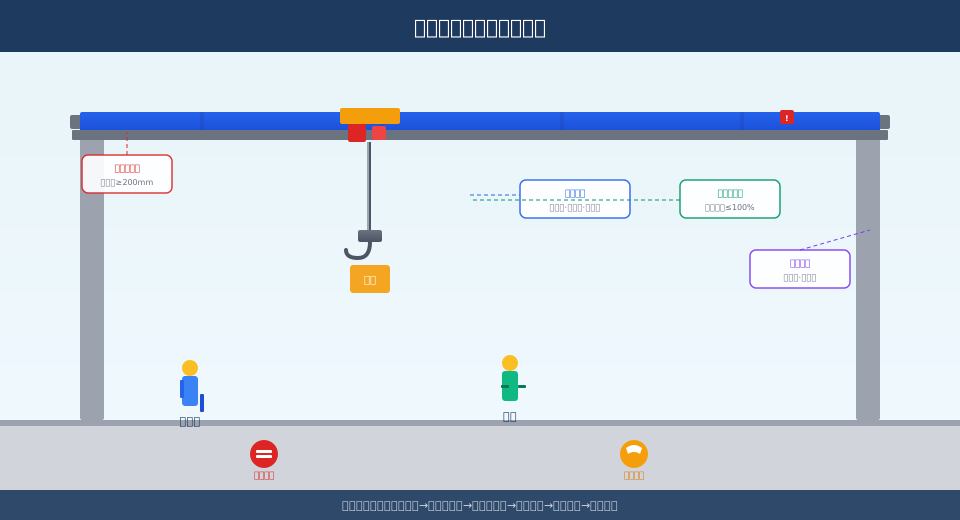
Pre-Operation Safety Checklist
In accordance with the requirements of TSG Q7015, “Rules for Periodic Inspection of Lifting Equipment,” the following 15 safety checks must be completed before the start of each shift. The equipment may only be started and operated after all inspection items have been found to be in compliance, and inspection records must be archived for future reference.
I. Inspection of Steel Wire Ropes and Lifting Equipment (5 items)
① Visual inspection of the wire rope: Visually inspect the entire wire rope for broken wires, wear, corrosion, kinks, or flattening. The number of broken wires within a single lay length must not exceed 10% of the total.
② Measuring the diameter of steel wire ropes: Measure the diameter with a vernier caliper. If wear or corrosion has reduced the diameter by more than 7%, replace the rope immediately.
③ Hook Inspection: Visually inspect the hook for cracks, deformation, or wear; check for deformation of the hook opening (if the opening has increased by more than 15% of its original size, the hook must be replaced); and verify that the anti-disengagement device is intact.
④ Pulley inspection: Check that the pulley rotates smoothly and that the depth of wear in the rope groove does not exceed 25% of the original depth.
⑤ Drum Inspection: The wire rope is neatly arranged on the drum, with at least three safety turns remaining, and the rope guide plate is in good condition.
II. Inspection of Brakes and Safety Devices (5 items)
⑥ Hoist brake inspection: The brake shoes open and close normally without sticking; the braking clearance is 0.5–1.0 mm for drum brakes and 1.0–2.0 mm for disc brakes.
⑦ Inspection of the main and auxiliary car brakes: The brakes on all operating mechanisms operate in sync, and the brake wheel surfaces are free of cracks, dents, and oil stains.
⑧ Verification of limit switch operation: Manually trigger the three-directional travel limit switches for the main hoist, auxiliary hoist, and vertical travel; operation must be reliable, and the stopping position must be at least 200 mm from the limit.
⑨ Overload limiter inspection: When unloaded, the overload limiter display reads zero, and the function indicator light is on as expected.
⑩ Audible and Visual Alarm Devices: Test the travel alarms for the main and auxiliary cranes before operation to ensure that the audible and visual signals are clear and effective.
III. Track and Environmental Inspections (5 items)
⑪ Rail Surface Inspection: The rails for the main and auxiliary trolleys must be free of oil, obstacles, and foreign objects, and rail joints must be smooth.
⑫ Buffers and Collision Prevention Devices: All end buffers are intact and undamaged, and the emitting surfaces of the laser/infrared collision sensors are clean.
⑬ Wind-proofing device inspection (outdoor equipment): The rail clamps/anchoring devices open and close smoothly, and the anemometer displays normal readings.
⑭ Operational Environment Check: The work area is well-lit, there are no flammable or explosive materials stored in violation of regulations, and emergency exits are unobstructed.
⑮ No-Load Test Run: Raise and lower the hoisting mechanism through its full travel once, and run the main and auxiliary hoists through their full travel once. All mechanisms should operate smoothly, without unusual noises, and with normal braking. Krude Heavy Industry recommends that each no-load test run be recorded in the work log as documentation for the daily inspection.
Standard Operating Procedures for Safety
The safe operation of a crane is divided into four stages: pre-lift preparation, lifting operations, travel operations, and lowering the hook to unload the load. The following procedures must be strictly followed during each stage.
I. Preparations Before Lifting
① Verify that the weight of the load does not exceed the rated lifting capacity (by visual inspection or by checking the cargo label; if in doubt, verify using a load limiter).
② Ensure that the lifting device specifications match the load, and that the angle of the wire rope does not exceed 90 degrees (60 degrees or less is recommended; if the angle is too large, the load must be reduced).
③ Verify the location of the load’s center of gravity, ensure the lifting points are selected correctly, and confirm that the load is securely tied down with no risk of loosening.
④ Ensure that there are no people or other equipment in the vicinity of the load that could interfere with the lift, and that the lifting route is clearly planned.
⑤ Verify that the command signaling system is functioning properly (hand signals, flag signals, or walkie-talkies), and ensure that the operator’s signals match those of the supervisor.
II. Lifting Operations
⑥ Before lifting, sound a bell or activate an audible and visual alarm to alert people in the vicinity to evacuate to a safe area.
⑦ First, perform a test lift to tighten the wire rope, then stop and check that the load is securely tied down and its center of gravity is stable.
⑧ When the load is approximately 200 mm off the ground, stop again to check whether the brake is engaging reliably (the load should not slide down on its own). Continue lifting only after confirming that the load is stable.
⑨ Operate at a constant speed during lifting; sudden stops and starts are strictly prohibited. Maintain a safety distance of at least 500 mm between the bottom of the load and the highest point of any obstacles on the ground.
III. Operation and Maintenance
⑩ Load travel height: The bottom of the load must be at least 500 mm above the highest point of any obstacles on the ground, and it must travel along the designated route.
⑪ When the large hoist and small hoist are operating simultaneously, start the large hoist first, followed by the small hoist; when decelerating, stop the small hoist first, followed by the large hoist, to prevent the load from swinging excessively.
⑫ Travel Speed Control: Use the low-speed gear (50%–70% of the rated speed) when fully loaded; the high-speed gear may be used when unloaded. It is strictly prohibited to operate both the hoisting and travel mechanisms simultaneously while the crane is in motion (cross-operation).
⑬ No one is allowed to stand beneath the load: During operation, no one is allowed to remain or pass through the area directly beneath the load or the surrounding danger zone.
IV. Lowering the Hook
⑭ Before lowering the hook, confirm that there are no obstacles or people at the landing point; when the hook is approximately 300 mm from the landing point, slow down and lower it gently.
⑮ Remove the lifting gear only after the load has been set down securely; raise the hook only after confirming that the load is stable and poses no risk of tipping over.
⑯ Raise the hook to its highest position (≥500 mm from the upper limit switch), return all mechanisms to their home positions, and turn off the main power supply. After completing the operation, fill out the work log, recording the day’s operations and any abnormalities.
Ten "Don'ts" for Crane Operations
The “Ten Prohibitions on Lifting” are the most basic safety requirements for crane operation and are also a core component of TSG inspections and safety inspections at all levels. Lifting operations are strictly prohibited under the following 10 circumstances:
① Do not lift if overloaded
Lifting is strictly prohibited when the rated lifting capacity is exceeded or when the lifting moment limiter sounds an alarm. Overloading is the leading cause of structural damage and overturning in cranes.
② Do not lift if the signal is unclear
Operations are strictly prohibited when signals are unclear, when multiple people are giving signals at the same time, or when there is no signaler. Before lifting, ensure that hand signals or other signals are standardized.
③ Do not lift if the load is tilted or lopsided
It is strictly prohibited to pull the load at an angle when it is not directly below the hook. Pulling at an angle can cause the wire rope to slip out of its groove, the load to swing and collide with other objects, or the load to exceed the rated capacity.
④ Do not lift if there are people beneath the load
Lifting operations and crane movement are strictly prohibited when people are present below the load or along the travel path. All personnel must evacuate to a safe area.
⑤ Do not lift if safety devices are malfunctioning
Operation is strictly prohibited if any of the safety devices—such as the limit switch, overload limiter, or brake—fails. Operation may resume only after the device has been repaired and verified to be functioning properly.
⑥ Do not lift if the lifting equipment is unsafe
It is strictly prohibited to use steel wire ropes with excessive broken strands, hooks with cracks or deformation, or lifting slings with severe wear. Lifting equipment must be in good condition and of the correct specifications.
⑦ Do not hoist embedded objects
It is strictly prohibited to lift loads that are buried, pinned, or secured by the ground or other objects. Forcing a lift may result in wire rope breakage or structural damage.
⑧ Do not lift if the load is not securely tied down
Lifting is strictly prohibited if the load is not securely tied down, its center of gravity is shifted, or the lifting points are improperly positioned, as these conditions pose a risk of overturning. The load must be retied and confirmed to be stable.
⑨ No lifting during inclement weather
Outdoor lifting operations are strictly prohibited during severe weather conditions such as winds of force 6 or higher (wind speeds ≥ 13.8 m/s), heavy rain, heavy snow, and dense fog.
⑩ No lifting without a license
Persons who have not received training and do not hold a certificate for operating special equipment are strictly prohibited from operating cranes. The operator’s certificate must be valid.
Comparison Table of Common Violations
Improper Operation Common Scenarios Direct Risk Consequences of the Accident The Correct Way to Do It Overload Lifting Estimating Weight by Visual Inspection, Lifting and Transporting Oversized Cargo Structural Overstress, Brake Failure Cracking, Collapse, or Overturning of the Main Beam Verify the weight using an overload limiter Crooked and Slanted The load was off-center, and the operator was rushing Wire Rope Slipping Out of the Sheave, Swinging Load Wire Rope Breakage / Personnel Impact Readjust the suspension points so they are directly below People Standing Beneath a Suspended Object “It'll be over in a flash.” Direct impact from a falling object Casualties (most severe) The lifting area is completely cordoned off, and caution tape has been set up. Bypassing/Removing the Limit Switch Tired of the limit switch tripping frequently, so I bypassed it myself Stroke Overshoot, Wire Rope Overwind Summit Attempt / Derailment / Wire Rope Breakage Limit switches must be in good working order and must not be short-circuited. High-Speed Operation Under Load Long lifting distances, rushing to save time The suspended load swung wildly and spun out of control Collisions with Personnel/Equipment; Falls Full Load: Use Low Gear (50%–70%) Failure to check before operating In a hurry, or don't think it's necessary Hidden hazards went undetected; the system continued to operate despite problems Sudden Failures and Accidents During Operation Complete all 15 inspection items before each shift
Safety Device Maintenance Intervals
| Improper Operation | Common Scenarios | Direct Risk | Consequences of the Accident | The Correct Way to Do It |
|---|---|---|---|---|
| Overload Lifting | Estimating Weight by Visual Inspection, Lifting and Transporting Oversized Cargo | Structural Overstress, Brake Failure | Cracking, Collapse, or Overturning of the Main Beam | Verify the weight using an overload limiter |
| Crooked and Slanted | The load was off-center, and the operator was rushing | Wire Rope Slipping Out of the Sheave, Swinging Load | Wire Rope Breakage / Personnel Impact | Readjust the suspension points so they are directly below |
| People Standing Beneath a Suspended Object | “It'll be over in a flash.” | Direct impact from a falling object | Casualties (most severe) | The lifting area is completely cordoned off, and caution tape has been set up. |
| Bypassing/Removing the Limit Switch | Tired of the limit switch tripping frequently, so I bypassed it myself | Stroke Overshoot, Wire Rope Overwind | Summit Attempt / Derailment / Wire Rope Breakage | Limit switches must be in good working order and must not be short-circuited. |
| High-Speed Operation Under Load | Long lifting distances, rushing to save time | The suspended load swung wildly and spun out of control | Collisions with Personnel/Equipment; Falls | Full Load: Use Low Gear (50%–70%) |
| Failure to check before operating | In a hurry, or don't think it's necessary | Hidden hazards went undetected; the system continued to operate despite problems | Sudden Failures and Accidents During Operation | Complete all 15 inspection items before each shift |
Safety devices serve as the last line of defense for the safe operation of cranes. All safety devices must be inspected and maintained on a regular basis to ensure they remain in good working order at all times. The following are the standard maintenance intervals for each safety device:
Lifting Height Limit Switch
Inspection Frequency:WeeklyManually Trigger Verification
Motion Standard: Distance from the Limit Position≥200 mmReliable Action
Calibration Interval:QuarterlyCalibration of Motion Accuracy
Overload Limiter
Inspection Frequency:DailyZero-Check
Operating Standard: Exceeding the rated load105%Time-based Alarm Shut-off
Calibration Interval:QuarterlyCalibrate using standard weights
Travel Limit Switch
Inspection Frequency:WeeklyThree-Way Verification for Large and Small Vehicles
Motion Specification: Distance from the end of the track≥200 mmReliable Stop
Maintenance Requirements:Short-circuiting or removal is strictly prohibited.Limit Switch
Buffers and Collision Prevention
Inspection Frequency:MonthlyVisual Inspection for Integrity
Rubber Aging: OccursCracks or permanent deformationReplace immediately
Collision Sensors:WeeklyClean the transmitter and receiver surfaces
Windbreak
Inspection Frequency:WeeklyTrack Clamp / Flexible Opening and Closing
Anemometer:QuarterlyAccuracy of Wind Speed Calibration
Alert Level: Wind Force 613.8 m/sAlarm: Stop Work
Emergency Stop Device
Inspection Frequency:DailyPressure Test Before Operation
Action Standard: After pressingInstant DisconnectionAll Power
Reset Requirements: After a rotational reset, each mechanismCannot automatically restart
Frequently Asked Questions (FAQ)
Q: How long does a pre-operation inspection of a crane take?
A: A complete pre-operation inspection takes approximately 15 to 20 minutes and includes a visual inspection of the wire rope and a diameter check (5 minutes), testing of the brakes and limit switches (5 minutes), inspection of the tracks and surroundings (3 minutes), and a no-load test run (2 to 3 minutes). In accordance with Section 9.3 of GB/T 3811, daily inspection records must be signed and filed for future reference. Krude Heavy Industry recommends using a standard inspection checklist to tick off each item and sign it, ensuring that no items are omitted.
Q: What are the specific details of the "Ten No-Lift Rules" for cranes?
Answer: The “Ten No-Lift Rules” are 10 safety prohibitions for crane operation: ① Do not lift when overloaded; ② Do not lift when signals are unclear; ③ Do not lift if the load is being pulled at an angle or lifted at an oblique angle; ④ Do not lift if there are people beneath the load; ⑤ Do not lift if safety devices are malfunctioning; ⑥ Do not lift if lifting equipment is unsafe; ⑦ Do not lift if the load is embedded; ⑧ Do not lift if the load is not securely fastened; ⑨ Do not lift in severe weather; ⑩ Do not lift if the operator is unlicensed . These 10 rules are mandatory items for safety inspections at all levels, and violations will result in administrative penalties.
Q: How often should crane limit switches be inspected?
Answer: The three-directional limit switches (hoist/main hoist/trolley) must be manually triggered and tested weekly to confirm that they operate reliably and stop when the distance to the limit position is ≥200 mm. The operational accuracy must be calibrated quarterly using standard equipment (with a deviation not exceeding ±5% of the set value). It is strictly prohibited to bypass, remove, or adjust limit switches beyond their rated travel. If a limit switch is found to be malfunctioning, the machine must be shut down immediately for repair. After repair, normal operation may resume only after verification under no-load conditions.
Q: Which department establishes the safety operating procedures for cranes?
Answer: In accordance with the *Law on the Safety of Special Equipment* and the requirements of TSG Q7015, the safety management department of a crane-using entity must establish safety operating procedures. These procedures must cover inspection checklists, operating procedures, the “Ten Prohibitions on Lifting,” and the maintenance of safety devices. The procedures must be revised every two years, and all operators must undergo training and testing following each revision. The operating procedures must be posted in a conspicuous location in the operator’s cab or near the equipment.
Q: How long does a pre-operation inspection of a crane take?
A: A complete pre-operation inspection takes approximately 15 to 20 minutes and includes a visual inspection of the wire rope and a diameter check (5 minutes), testing of the brakes and limit switches (5 minutes), inspection of the tracks and surroundings (3 minutes), and a no-load test run (2 to 3 minutes). In accordance with Section 9.3 of GB/T 3811, daily inspection records must be signed and filed for future reference. Krude Heavy Industry recommends using a standard inspection checklist to tick off each item and sign it, ensuring that no items are omitted.
Q: What are the specific details of the "Ten No-Lift Rules" for cranes?
Answer: The “Ten No-Lift Rules” are 10 safety prohibitions for crane operation: ① Do not lift when overloaded; ② Do not lift when signals are unclear; ③ Do not lift if the load is being pulled at an angle or lifted at an oblique angle; ④ Do not lift if there are people beneath the load; ⑤ Do not lift if safety devices are malfunctioning; ⑥ Do not lift if lifting equipment is unsafe; ⑦ Do not lift if the load is embedded; ⑧ Do not lift if the load is not securely fastened; ⑨ Do not lift in severe weather; ⑩ Do not lift if the operator is unlicensed . These 10 rules are mandatory items for safety inspections at all levels, and violations will result in administrative penalties.
Q: How often should crane limit switches be inspected?
Answer: The three-directional limit switches (hoist/main hoist/trolley) must be manually triggered and tested weekly to confirm that they operate reliably and stop when the distance to the limit position is ≥200 mm. The operational accuracy must be calibrated quarterly using standard equipment (with a deviation not exceeding ±5% of the set value). It is strictly prohibited to bypass, remove, or adjust limit switches beyond their rated travel. If a limit switch is found to be malfunctioning, the machine must be shut down immediately for repair. After repair, normal operation may resume only after verification under no-load conditions.
Q: Which department establishes the safety operating procedures for cranes?
Answer: In accordance with the *Law on the Safety of Special Equipment* and the requirements of TSG Q7015, the safety management department of a crane-using entity must establish safety operating procedures. These procedures must cover inspection checklists, operating procedures, the “Ten Prohibitions on Lifting,” and the maintenance of safety devices. The procedures must be revised every two years, and all operators must undergo training and testing following each revision. The operating procedures must be posted in a conspicuous location in the operator’s cab or near the equipment.
