
Crane Configuration Solutions for Manufacturing
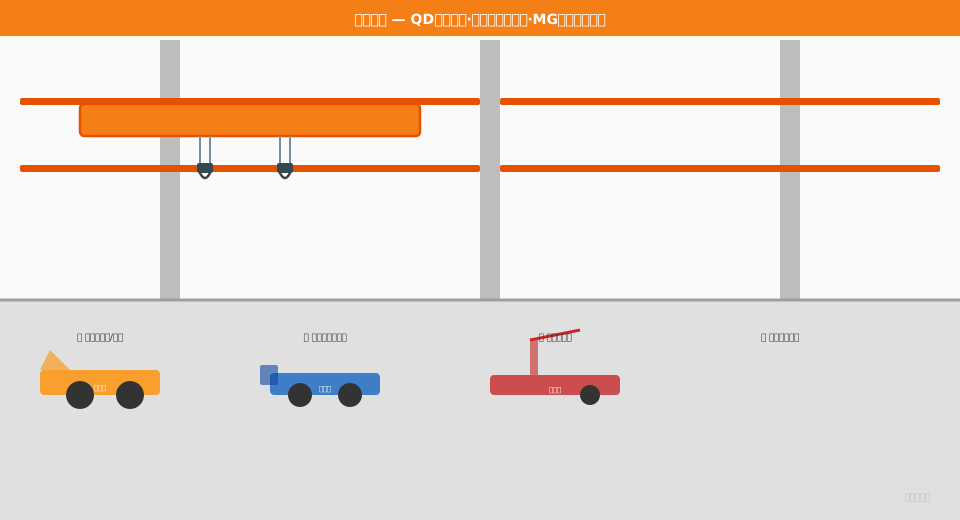
For construction machinery manufacturing, crane configurations must cover three key stages: structural welding, final assembly, and testing/commissioning. In the welding workshop, we recommend QD overhead cranes (16–50 t) with double-hook turnover capability; on the assembly line, a combination of QD/LH overhead cranes (10–32 t), KBK workstations, and pneumatic balancers for engine installation; and in the testing area, outdoor gantry cranes or truck cranes. Kelude's double-hook turnover system completes the full rotation cycle in a single operation.
Construction machinery manufacturing—covering excavators, wheel loaders, bulldozers, cranes, and road rollers—is one of the most demanding industries for crane applications. Structural welding shops require multiple overhead cranes working in tandem with welding positioners to flip and rotate large structural components. Final assembly lines call for an integrated setup of overhead cranes, KBK workstations, and balancers. Outdoor testing and commissioning areas need large-tonnage gantry cranes for complete machine lifting and transport. This article provides crane configuration solutions organized around three key scenarios: structural welding, final assembly lines, and testing/commissioning areas.
Crane Configuration Comparison for Construction Machinery Manufacturing
| Comparison Parameter | structural component Welding Workshop | complete machine assembly line | Test Commissioning Zone |
|---|---|---|---|
| recommended model | QD Typedouble-girder bridge crane | QD/LHoverhead type+KBK | Outdoor Gantry Crane/truck crane |
| Lifting Capacity Range | 16~50t | 10~32t | 20~50t |
| core functions | Double Hook Tilting+tandem lifting | engine Assembly+Component Line Loading | Complete Machine Lifting and transport |
| speedrequirements | variable frequency micro-speed | Variable Frequency Drive (VFD)+KBKManual | High-Speed Lifting and transport |
| control mode | remote control+Cabin / Operator Cab | remote control+pneumatic balancer | remote control |
| reference price | 20~8010K CNY/Unit×4 | 15~5010K CNY/Unit | 30~10010K CNY |
Structural Welding Workshop Cranes — Flipping Large Structural Components
Structural components for construction machinery (excavator booms, arms, and buckets; wheel loader chassis frames and rocker arms; bulldozer blades, etc.) are large (3–10 m in length), heavy (1–30 t), and require extensive welding — a single weld seam can run several meters. These components must be flipped multiple times during welding (flat, vertical, and overhead positions) to ensure weld quality and minimize deformation:
- Recommended model: QD Type double-girder bridge crane (16–50 t), Work Duty A5–A6, span 22–30 m, with 4–6 units installed per bay
- Double-hook flipping: Structural components are flipped using a main hook + auxiliary hook combination — the main hook lifts one end of the component (bearing the primary load), while the auxiliary hook supports the other end (controlling the flip angle). Flipping is achieved by varying the lifting height differential between the two hooks, with the flip angle controllable from 0–180°. Hoisting speeds of the main and auxiliary hooks are synchronized via PLC to prevent off-center loading
- Welding positioner integration: For high-volume structural components (e.g., excavator booms), we recommend pairing a welding positioner (with rotation/tilt mechanisms) with an overhead crane at the welding station — the crane positions the component onto the positioner and clamps it in place; the positioner then handles all flips during welding, while the crane is only used for loading and unloading
- Multi-crane density: Structural welding workshops typically install 4–6 overhead cranes in a single bay, spaced 15–20 m apart. Each crane operates in its own dedicated zone, but they can work in tandem for oversized components (e.g., joint lifting of 100 t-class excavator chassis frames)
Assembly Line Cranes — Component Mating and Line Coordination
Final assembly of construction machinery (excavators, wheel loaders, bulldozers — built up sequentially from the chassis, engine, hydraulic system, operator cabin, and work attachment) is organized as a flow line, with workpieces moving along chain plate conveyor lines or rail-mounted trolleys. The cranes serve three roles: ① component loading (lifting engines, hydraulic pumps, cabins, etc. from storage to the line), ② component mating (installing heavy components onto the main machine as it moves along the line), and ③ complete machine handling (lifting finished machines from the end of the line to the testing and commissioning area):
- Workshop-level bridge cranes: QD/LH Type overhead cranes (20–50 t) are arranged along both sides of the assembly line, covering component unloading, storage, and line feeding. Typically 2–4 units are installed
- Station-level KBK + balancer: KBK rails with pneumatic balancers (200–1,000 kg capacity) are installed above engine and gearbox assembly stations. Operators use the balancer to lift the engine or gearbox from the rack, move it over the main machine on the line, and lower it slowly into position. The balancer's zero-gravity characteristic lets operators control the mating process precisely by feel
- Hydraulic flipping fixtures: Large structural components on the assembly line (e.g., excavator booms and arms) require dedicated hydraulic flipping fixtures to adjust assembly angles — the crane delivers the component to the assembly station, the fixture clamps it and hydraulically rotates it to the required process angle, and the operator completes the pin and bolt connections
- Complete machine off-line: Finished machines weigh 10–50 t (e.g., a 20 t-class excavator weighs approximately 20 t; a 5 t-class wheel loader around 16 t). Bridge cranes (20–50 t) with specialized spreaders (hook + lifting slings securing the machine) transfer them from the end of the line to the test area
Testing and Commissioning Area Cranes — Outdoor Machine Handling
Final machine commissioning (engine start-up, hydraulic system pressure checks, travel system tests, work attachment function testing, etc.) takes place in outdoor or semi-outdoor test yards. These yards require gantry cranes (MG Type) for machine handling and maintenance access:
- Recommended model: MG Type gantry crane (20–100 t), span 25–40 m, Work Duty A4–A5
- Outdoor protection: Electric control cabinet rated IP55 + rain cover + corrosion-resistant coating (salt spray ≥ 1,000 h) + wind rail clamps (wind resistance ≥ Force 8)
- Complete machine spreaders: Beam-type spreaders (connecting to front and rear lifting points on the machine via slings or chains) or H-type lifting beams (with 4 lifting points, accommodating machines with different wheelbases)
- Reference price: MG Type 50 t / 30 m span: approximately $89,000–$178,000
Kelude Service Advantages for Construction Machinery
- Double-hook flipping solution: Kelude's double-hook control system is purpose-built for flipping structural components in construction machinery — the main and auxiliary hooks are synchronized via PLC, with real-time load monitoring on both hooks during the flip to maintain balance (automatic stop if load imbalance exceeds 10%). The flip angle is displayed in real time on the operation panel in both digital and graphical formats.
- Assembly line coordination solution: Kelude's layered bridge crane + KBK + balancer approach has been deployed on assembly lines at multiple construction machinery manufacturers — bridge cranes handle workshop-level heavy lifting (engines, cabins, complete machines), while KBK rails with balancers cover station-level precision mating (engine installation into the nacelle, gearbox alignment), with each system working independently without interference.
- Large gantry crane experience: Kelude has supplied MG Type gantry cranes (20–100 t) to numerous construction machinery manufacturers for their testing and commissioning areas, with spans and lifting heights configured to cover the full range of machine sizes and models.
Frequently Asked Questions
Q: How do you turn an excavator boom for welding?
A: An excavator boom is a classic box girder welded structure (two side plates + top and bottom flanges + internal stiffener plates). After full-length welding, it needs to be turned from the flat welding position to weld the opposite side symmetrically. The turning method uses two overhead cranes (or one double-hook overhead crane) working together. Option 1 – Dual-crane turning: Two adjacent overhead cranes coordinate, with one lifting one end of the boom (using the process lifting lugs at the ends) and the other lifting the opposite end. Both cranes hoist simultaneously to about 1.5m off the ground, then one crane hoists while the other lowers (differential speed control), allowing the boom to turn while suspended. Option 2 – Single-crane double-hook turning: Using a double-hook overhead crane, the main hook lifts one end and the auxiliary hook lifts the other, with turning achieved through differential hoisting/lowering of the main and auxiliary hooks. Kelude's double-hook control system can automatically execute the complete "hoist-turn-lower" turning cycle with the push of a single button.
Q: What is the best solution for installing an engine into a wheel loader engine bay?
A: Engine installation (lifting the engine into the engine bay of a wheel loader, excavator, or bulldozer) is the most critical and time-consuming step in the complete machine assembly line. The engine weighs 300–1500kg depending on the model, and precise alignment of the engine mounting bolt holes with the chassis frame mounting holes is required. The recommended solution is a KBK rail system with a pneumatic balancer: The operator uses the pneumatic balancer (load capacity 500–2000kg, lifting speed adjustable 0–10m/min) to lift the engine from the rack, move it over the engine bay, and use the balancer's zero-gravity feature to lower it smoothly into position. The operator can easily move a several-hundred-kilogram engine up or down with one hand while aligning the bolt holes with the other. The balancer's floating mode allows fine adjustment of the suspended engine in all directions (forward/backward, left/right, up/down) without additional power, achieving installation accuracy of ±1mm. This solution is more flexible than using an overhead crane (which requires waiting for the operator in the cab) and safer (zero-gravity prevents accidental drops).
Q: What lifting capacity is needed for a test track gantry crane?
A: The lifting capacity of a test track gantry crane is determined by the maximum total machine weight on the track. We recommend selecting a capacity of 1.2 times the maximum machine weight as the safety factor. Typical total machine weights for construction machinery: small excavators (6–15t) → 20t gantry crane; medium excavators (20–30t) → 32–50t gantry crane; large excavators (40–80t) → 50–100t gantry crane; wheel loaders (5t class ≈16t, 8t class ≈25t) → 20–32t gantry crane; bulldozers (≈20–50t) → 32–50t gantry crane. If the test track needs to cover multiple types and tonnages of construction machinery, we recommend using the heaviest machine weight × 1.2 as the gantry crane's lifting capacity. Kelude offers custom design for gantry crane span and lifting height – the span must cover the test track width (including maintenance access on both sides), and the lifting height must allow the lowest vehicle to pass underneath when the machine is lifted off the ground.
Q: How many cranes are needed for a construction machinery assembly line?
A: Using an assembly line producing 5,000 units of 20t-class excavators per year as an example: ① Structural component welding workshop – 4 × QD overhead cranes, 32t each (one per work area for booms, arms, buckets, and chassis frames; approx. $17,800–$26,700 per crane × 4 ≈ $71,200–$106,800); ② Complete machine assembly line – 2 × QD/LH overhead cranes, 20t each (one for the engine/operator cab installation station and one for the complete machine off-line station; approx. $22,200–$37,100 per crane × 2 ≈ $44,500–$74,200) + 10 × KBK systems with balancers (one per station for engine installation, gearbox, hydraulic pump, operator cab, etc.; approx. $4,400–$8,900 per system × 10 ≈ $44,500–$89,000); ③ Testing and commissioning area – 1 × MG gantry crane, 32t (approx. $74,200–$118,600). The total whole plant investment is approximately $234,400–$388,600. Kelude can provide whole plant solution design and volume purchase discounts.