
Crane Configuration Solutions for Rubber Machinery Manufacturing
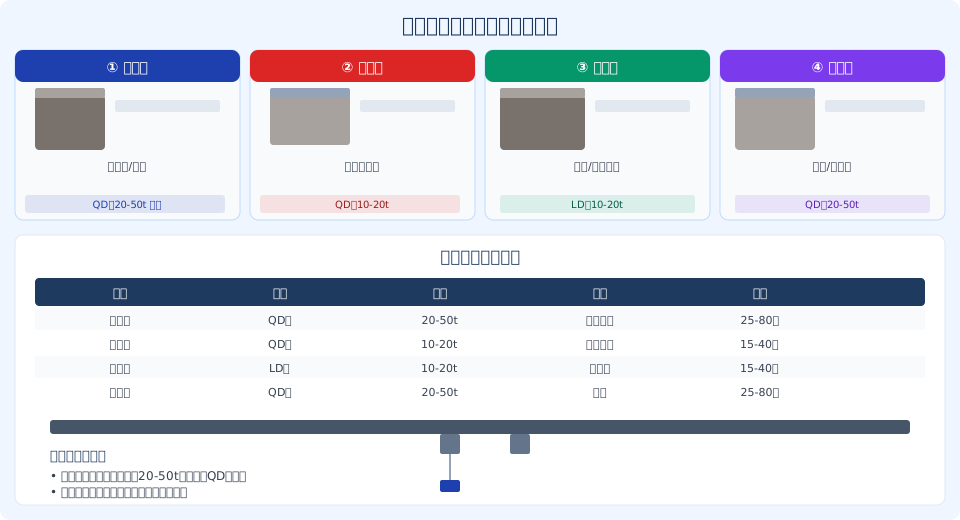
Cranes for rubber machinery manufacturing are configured for four equipment types: internal mixers, open mills, calenders, and vulcanizing presses. For internal mixer rotor hoisting, a QD Type 20–50t crane is used; for open mill roll changes, a QD Type 10–20t; for calender roll sets, an LD Type 10–20t; and for vulcanizing press hot platens, a QD Type 20–50t. Complete plant solutions range from approximately $150,000 to $800,000.
Internal Mixer Assembly: Heavy Rotor Hoisting
Internal mixers weigh 30–80t in total, with individual rotors ranging from 3–8t. The clearance between the rotor and the mixing chamber wall during installation is 1.5–3mm. A QD Type 20–50t double-girder crane is recommended, equipped as standard with variable frequency micro-speed control (≤1m/min) and anti-sway control. Kelude's QD Type cranes for the internal mixer area feature a VFD-driven crane bridge with a response time of under 1 second.
Assembling the rotor's end-face sealing and hydraulic locking mechanisms demands exceptional precision. The sealing rings (silicon carbide/tungsten carbide) weigh 10–30kg each and must not be subjected to impact during installation. Kelude's cranes for the internal mixer area work with precision lifting spreaders to maintain a levelness of within 0.1mm/m when handling end-face seal assemblies. The wear-resistant liners (10–20mm thick) on the mixing chamber walls require periodic replacement, with each liner weighing 50–200kg.
Open Mill Assembly: Roll Parallelism Control
Open mill rolls range from 550–800mm in diameter and 1.8–2.5m in length, with each roll weighing 2–8t. The parallelism between the two roll axes must be maintained within ±0.01mm. A QD Type 10–20t crane is recommended. Kelude's cranes for the open mill area feature a two-speed hoisting option of 8/2m/min.
After assembly, the safety device (emergency tie bar + reverse braking) on the open mill must undergo braking distance testing (≤1/4 of the roll circumference). This test requires rapidly lifting a 500–2000kg load away from the rolls, demanding a crane brake response time of under 0.5 seconds. Kelude's cranes for the open mill area are equipped with fast-response brakes as standard.
Calender Assembly: High-Precision Roll Alignment
Three-roll and four-roll calenders have rolls measuring 2–4m in length and weighing 3–10t each, with a coaxiality requirement of ≤0.02mm. An LD Type 10–20t crane is recommended. Kelude's cranes for the calender area come standard with micro-speed lifting and anti-sway control.
The roll heating/cooling system (through-hole or drilled configurations) on calenders must undergo temperature control testing after roll assembly, with a surface temperature differential of ≤2°C across the roll face. The bearing housings weigh 300–1500kg and require hydraulic jacks working in conjunction with the crane for precise positioning during assembly.
Vulcanizing Press Manufacturing: Platen Accuracy and Frame Assembly
Vulcanizing press hot platens range in size from 1.5×1.8m to 2.5×3m, weighing 2–5t each, with a flatness requirement of ≤0.05mm/m. A QD Type 20–50t crane with a lifting height of ≥12m is recommended.
Electric heating cartridges for the vulcanizing press platens are inserted into drilled holes (16–20mm diameter) after the drilling process. Each platen accommodates 20–60 heating cartridges, weighing 5–15kg each. Kelude's cranes for the vulcanizing press area work with platen tilting tables to facilitate heating cartridge installation.
internal mixer QD Type20-50t Rotor Clearance1.5mm | open mill QD Type10-20t Roller Spreader Beam | calender LD Type10-20t Multi-Roller Coaxial |
vulcanizing press QD Type20-50t Hot Plate | Roller Lifting spreader Adjustable Spreader Beam+Nylon | complete plant 15-8010K |
Rubber Machinery Crane Configuration Table
| Equipment | Model | tonnage | Core | Accuracy | investment |
|---|---|---|---|---|---|
| internal mixer | QD Type | 20-50t | Rotor | Clearance1.5mm | 25-8010K |
| open mill | QD Type | 10-20t | Roller | Parallel±0.01mm | 15-4010K |
| calender | LD Type | 10-20t | Roller Set | Coaxial≤0.02mm | 15-4010K |
| vulcanizing press | QD Type | 20-50t | Hot Plate | Flat Surface≤0.05mm/m | 25-8010K |
Kelude Heavy Industry brings extensive experience in heavy-load crane systems for the rubber machinery sector. Our large-tonnage Double Girder QD cranes for GK internal mixers and vulcanizing presses, along with dedicated Spreader Beams for the rolls of open mills and calenders, have served numerous publicly listed rubber machinery manufacturers.
Heavy load QD Type20-50t+variable frequency micro-speed+anti-sway control | Roller Hoisting Adjustable Spreader Beam+Nylon+polyurethane liner | precision alignment Creep speed≤1m/min+remote control+anti-sway control |
FAQ: Rubber Machinery Hoisting & Positioning
Q: What are the hoisting requirements for internal mixer rotors?
A: The clearance between the rotor and the inner wall is 1.5–3 mm, requiring creep speed and anti-sway control. Kelude Heavy Industry standard configuration includes variable frequency micro-speed and active anti-sway control.
Q: How should the spreader beam for open mill rolls be configured?
A: Open mill rolls range from 1.8 to 2.5 m in length, with individual roll weights of 2–8 t. An adjustable lifting point spreader beam (1–2 m adjustable spacing) with polyurethane contact surface coating of ≥10 mm thickness is recommended. Kelude Heavy Industry offers a standard series of roll lifting spreaders.
Q: What accuracy requirements apply to calender machinery?
A: Coaxiality must be ≤0.02 mm, with trolley positioning accuracy of ±5 mm. VFD with PID closed-loop control is required.
Q: Is explosion-proof equipment required in rubber machinery manufacturing workshops?
A: General machining operations (turning, milling, welding, assembly) in rubber machinery manufacturing typically do not require explosion-proof equipment. However, if the workshop also conducts rubber compound testing or uses organic solvents (toluene, acetone), the explosion-proof zone classification must be assessed in accordance with GB 50058.