

Custom Non-Standard Cold Storage Crane for -40°C
Custom Cold Storage Crane for -40°C: Steel Selection, Low-Temperature Lubrication, and Electrical Protection. Cold storage and blast freezer facilities typically operate at -25°C to -40°C, conditions under which standard cranes cannot function reliably.
Cold storage and blast freezer rooms typically maintain temperatures between -25°C and -40°C, and standard cranes are not designed to operate reliably under such extreme conditions. Structural steel undergoes low-temperature embrittlement—impact toughness drops sharply below -20°C, and at -40°C, Q235B steel can exhibit impact absorption energy below 10J, far beneath the safety threshold. Standard lithium grease solidifies and fails below -30°C, with base oil separation exceeding 60%, causing dry friction in bearings and gears. Moisture condensation and ice formation inside electrical components can reduce insulation resistance to below 0.5MΩ, leading to short circuits. A cold storage crane designed for non-standard service requires systematic customization across three dimensions: structural materials, lubrication systems, and electrical protection. Kelude Heavy Industry, drawing on non-standard design experience from more than 15 cold chain logistics and cold storage projects, has compiled a comprehensive technical solution for crane design under -40°C operating conditions. The applicable standards include ISO 4301 Crane Design Standard (2024 edition, low-temperature design clauses), GB/T 1591-2018 High-Strength Low-Alloy Structural Steels, JB/T1306 Electric Single-Girder Crane, JB/T 1265 Low-Temperature Pressure Vessel Steel Forgings, and GB/T 7323 General-Purpose Lithium Grease low-temperature applicability clauses—five national standards in total.
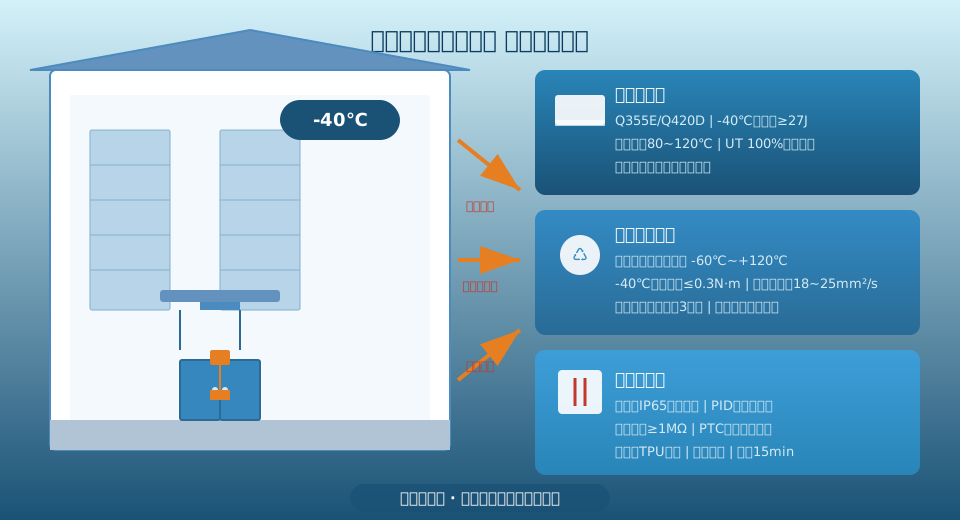
Cold Storage Environment: Key Crane Requirements
Cold storage cranes operate under a unique set of conditions: 1) Sustained low temperatures—typically -25°C to -40°C with minimal fluctuation but continuous exposure; 2) High humidity—relative humidity in cold storage rooms remains at 80%–95% year-round, and when doors open, warm moist air enters and rapidly condenses on metal surfaces (with temperature differentials exceeding 30°C, condensation can form at rates up to 0.5mm/min); 3) Frost and ice accumulation—ice layers of 3–8mm can form on metal and electrical component surfaces, interfering with moving-part clearances; 4) Difficult maintenance—personnel exposure time inside cold storage is limited (continuous work below -30°C should not exceed 30 minutes), placing a premium on equipment reliability. These factors make non-standard crane design for cold storage far more demanding than for ambient-temperature applications. ANSI/ASME B30.17 and ISO 14798 provide supplementary technical guidance for similar low-temperature conditions. Kelude Heavy Industry offers custom non-standard solutions for cold storage clients in accordance with ISO 4301 and ISO 19353.
Cold storage crane applications include: cargo stacking and retrieval in cold chain logistics warehouses (typically 5–16t capacity, 16–31m span, 6–12m lifting height); raw material and finished product transfer in quick-frozen food processing plants (3–10t, A3~A5 work duty); and installation and maintenance of cold storage racking systems (2–5t, two-speed control). While each application imposes different requirements for lifting capacity, lifting height, and operating frequency, -40°C low-temperature adaptability remains the common technical core. Temperature stratification within cold storage is also a notable factor—near the floor, temperatures can reach -40°C, while near the ceiling, equipment heat dissipation may raise temperatures to around -20°C, a differential of roughly 15–20°C. This requires material selection for the full crane height to be based on the most severe condition.
Low-Temperature Steel Selection for Structural Components
The primary concern for structural steel in low-temperature environments is the ductile-to-brittle transition. When temperatures fall below the transition point, impact toughness deteriorates rapidly and the material becomes susceptible to brittle fracture under load. Per Clause 5.8 of ISO 4301 (low-temperature design provisions), when the working environment falls below -20°C, steel must provide guaranteed low-temperature impact toughness. For -40°C cold storage cranes, standard Q235B (ductile-to-brittle transition at approximately -5°C; impact energy of only 12J at -20°C) and Q355B (transition at approximately -15°C; impact energy below 20J at -40°C) are both unsuitable.
Recommended material selection: Main girders and end carriages should use Q355D (impact tested at -20°C, guaranteed impact energy ≥34J) or Q355E (impact tested at -40°C, guaranteed impact energy ≥27J), meeting the GB/T 1591 requirement of longitudinal impact energy ≥27J and transverse impact energy ≥18J at -40°C. For heavy-duty cold storage cranes (≥20t capacity), Q420D (-20°C impact energy ≥48J) or Q420E (-40°C impact energy ≥34J) is recommended, offering a yield strength of 420MPa—approximately 18% higher than Q355E. Connection bolts should be made of ML20MnTiB steel (Grade 10.9S, low-temperature type) and must pass -40°C impact testing. Welding electrodes should be J507RH (ultra-low hydrogen, -40°C impact energy ≥47J). Welding procedures require preheating to 80–120°C, interpass temperature control between 150–200°C, and post-weld slow cooling under insulating blankets to room temperature. All weld seams must undergo 100% Ultrasonic Testing (UT) with 20% Radiographic Testing (RT) sampling.
For light-duty lifting equipment dedicated to cold storage use (such as the SDXQ suspended single-girder crane), aluminum alloy or stainless steel main girder options are available. Aluminum alloy 6061-T6 maintains a tensile strength of approximately 310MPa at -40°C (15% higher than at room temperature) with elongation remaining at ≥8%, exhibiting no low-temperature embrittlement issues. Maximum single-girder span reaches 12m with a rated load of ≤5t. 316L stainless steel provides yield strength ≥170MPa and impact energy ≥50J at -40°C, along with excellent salt spray corrosion resistance (≥1000h without red rust in salt spray testing), making it suitable for high-humidity, high-salt seafood storage environments. Note that the aluminum alloy option costs approximately 2.5–3 times more than standard structural steel, while the 316L option runs 3–4 times the cost of steel.
Lubrication and Sealing System Design
The most common failure mode in cold storage cranes is bearing seizure and gearbox lock-up caused by lubrication failure—data indicates that bearing failure rates in electric hoists operating in cold storage are approximately 3.2 times higher than in ambient-temperature environments. Standard lithium grease (e.g., No. 3 lithium grease) undergoes significant base oil separation below -30°C (oil separation rate ≥50%), with cone penetration dropping from 220 to 80 (0.1mm)—a reduction of approximately 64%—resulting in a complete loss of fluidity. The gearbox gears of electric hoists (module 2–4mm) and wheel bearings (6206–6212 series) are the most vulnerable components.
Grease selection: Per the low-temperature applicability clauses of GB/T 7323 General-Purpose Lithium Grease, -40°C cold storage cranes should use synthetic hydrocarbon low-temperature grease with a service temperature range of -60°C to +120°C, starting torque at -40°C of ≤0.3N·m (per ASTM D1478), and base oil viscosity of 18–25mm²/s at 40°C. Recommended brands: Klüber ISOFLEX NBU 15 (-60°C to +130°C, starting torque 0.18N·m at -40°C) or Mobil SHC 100 premium synthetic grease (-55°C to +160°C). For gearboxes, fully synthetic low-temperature gear oil such as Mobil SHC 629 (ISO VG 100) or Klüber GEM 4-150 N is recommended, with Brookfield viscosity ≤1500mPa·s at -40°C and pour point ≤-55°C. Grease re-lubrication intervals should be shortened to half the standard cycle (replenish every 3 months, complete replacement every 12 months).
Sealing design: Wheel bearings should use double-lip skeleton oil seals (nitrile rubber NBR, low-temperature elasticity retention ≥70% at -40°C, tested per JB/T 1265). Gearbox output shafts should feature dual protection combining a labyrinth seal with a skeleton lip seal, with radial runout tolerance ≤0.15mm. All seals should be manufactured from low-temperature-grade nitrile rubber (NBR, service temperature -50°C to +100°C, hardness Shore A 70±5) or fluororubber (FKM, low-temperature rating to -40°C, service up to +200°C, suitable for cold storage facilities requiring high-temperature sanitation cycles). It should be noted that NBR compression set at -40°C must not exceed 30%, and seals should be allowed to rest at room temperature for 24 hours to restore elasticity before installation.
Electrical System Protection for Low-Temperature Operation
The primary challenge for electrical systems in cold storage cranes is condensation and ice formation caused by low temperatures. With relative humidity at 80%–95% inside cold storage, when a crane moves from an ambient environment (+10°C to +35°C) into the cold storage interior (-25°C to -40°C), the temperature differential can exceed 60°C. Moisture rapidly condenses and freezes on electrical component surfaces—field measurements show that a 0.2–0.5mm water film can form within 5 minutes, developing into an ice layer after 15 minutes. Insulation resistance can drop to below 0.5MΩ (the standard requirement is ≥1MΩ), creepage distance between terminals is reduced by more than 50%, leading to dielectric breakdown, short circuits, and control signal malfunctions.
All electrical enclosures are constructed from 304 stainless steel (minimum 1.5mm wall thickness) with a Protection Rating (IP) of IP65 (Water Jet Proof and Dustproof, per IEC 60529). The interior walls are lined with 10mm closed-cell polyurethane insulation board (thermal conductivity ≤0.024W/(m·K)), and a φ6mm Drain hole at the base prevents condensate accumulation. The Control Cabinet houses a PID-controlled Heater (sized at 40W per liter of cabinet volume, typically 50–200W) paired with a PT100 Temperature Sensor and thermostat to maintain a slight positive pressure environment at +5°C to +15°C. The Heater must preheat for 15 minutes before the crane's main Power Supply is energized (controlled via a time-delay Relay), ensuring the cabinet interior reaches +5°C before the Frequency Inverter (VFD) and PLC are started. Recommended VFDs include the Siemens SINAMICS G120 series or Schneider ATV340 series (both with conformal-coated circuit boards and an operating range of -10°C to +50°C when used with the Heater); the recommended PLC is the Siemens S7-1200 series (operating temperature -20°C to +60°C).
Cable and connector specifications: Power Cables feature a low-temperature TPU jacket rated for -40°C to +90°C (compliant with the low-temperature cold bend Test per GB/T 2951). Control cables use a low-temperature PVC/TPU composite-jacket Shielded Cable with a bending radius of ≥6D at -40°C and Insulation Resistance of ≥20MΩ·km. All connectors are waterproof aviation plugs (IP67, zinc alloy housing with silicone Seal rings, gold-plated pins for oxidation resistance) rated at a minimum rated current of 16A. Electric Motors must be low-temperature units equipped with anti-condensation heating tape—standard YZR series motors are fitted with PTC ceramic heating elements (220V, 50–100W) that automatically maintain winding temperature at least 5°C above the storage room's dew point during shutdown to prevent condensation. Control options include Wireless remote control (industrial 433MHz or 2.4GHz band, battery life ≥8h at -40°C) or Floor operation stations (with a PTC thermostatic Heater inside the pendant).
Manufacturing Process & Quality Control for Cold Storage Cranes
Cold storage crane manufacturing demands rigorous process controls: 1) After Cutting, Steel Plate undergoes a -40°C low-temperature impact test (one set of three specimens sampled per heat number, per GB/T 229); 2) Main Girder Welding uses submerged arc welding (SAW) with H10Mn2 wire and SJ101 flux, with heat input controlled at 18–28kJ/cm; 3) Post-weld stress-relief Annealing is performed on the complete structure (heating to 580°C–620°C, holding time calculated at 2min/mm of plate thickness); 4) All Bolted Connection torque values are controlled within ±5% of design specifications, with each Bolt re-tightened using a digital torque wrench (accuracy ±0.5%); 5) Finished units undergo a 72-hour -40°C low-temperature Type Test verifying three core Indicators: Main Girder Deflection (≤S/800 per ISO 4301 Crane Design Standard, where S is the Span in mm), mechanism noise (≤85dB(A)), and electrical Insulation Resistance (≥1MΩ); 6) All non-standard custom Components are fully traceable, with each crane carrying a unique nameplate QR code linked to its factory inspection report.
Cold Storage Crane Selection Reference Table
| Selection Criteria | Ambient Temperature Standard Solution | -40℃Custom Cold Storage Solution |
|---|---|---|
| Main Girder Material | Q235B (≈S235JR)/Q355B (≈S355JR) | Q355D/Q355Eor316LStainless Steel |
| Grease | Lithium-Based Grease(-20℃) | Synthetic Hydrocarbon-Based(-60℃~+120℃) |
| gearbox Oil | Mineral Gear Oil(ISO VG 220) | Full Synthetic Low-Temperature Gear Oil(VG 68~100) |
| electrical cabinet Body | Carbon Steel Plate IP54 | Stainless Steel IP65+Insulation Layer+Heater |
| cable sheath | Standard PVC(-15℃) | Low Temperature / Arctic Service TPU(-40℃) |
| Motor Protection | Standard Vertical Motor | With Moisture-Proofheating tape Low-Temperature Motor |
| Seal Material | Standard Nitrile Rubber (NBR) | Low Temperature / Arctic Service NBRor FKM |
| Full Synthetic Low-Temperature Test | Without | -40℃ 72h Type Test |
| Welding Flaw detection | UTSampling Inspection20% | UT 100%+RTSampling Inspection20% |
Cold Storage Crane Installation & Commissioning: Key Considerations
Installing and commissioning a crane in a cold storage environment involves several specific requirements: 1) The runway beam foundation should be located outside the cold storage insulation layer (i.e., in the warm zone between the cold room ceiling and the outer cladding) to prevent frost heave and foundation deformation caused by thermal bridging—if a cold bridge is unavoidable, install a 30mm thick XPS insulation barrier between the foundation and the insulation layer; 2) A thermal transition section of at least 2m should be provided for the crane rail at the cold room door area, with a 20mm rubber base plate under the rail to minimize heat transfer; 3) After commissioning, a 24-hour low-temperature soak test must be performed at the actual cold storage temperature. Before startup, check the grease breakaway torque (≤0.3N·m) and electrical insulation resistance (≥1MΩ), and record the motor starting current (which should not exceed 1.2 times the rated value); 4) Develop a dedicated operating procedure for cold storage cranes, covering: the correct door opening sequence (open the door before moving the crane), the pre-start warm-up routine (energize the heater for 15 minutes, then power up the VFD and run at no load for 3 minutes before lifting), and post-shutdown maintenance tasks (clear ice from the rail surface, inspect seals for deformation, and dry any condensation inside the electrical cabinet).
Cold Storage Crane Applications & Case Studies
Kelude Heavy Industry has completed numerous custom non-standard cold storage crane projects in recent years. Representative examples include: six QD-type 16t/22.5m double-girder cranes for a large cold chain logistics center in Shandong (operating at -25°C, featuring Q355E steel, synthetic grease, and IP65-rated electrical cabinets—running reliably for 3 years with zero low-temperature faults); four LX-type 5t/19.5m suspension single-girder cranes for a frozen food plant in Guangdong (-35°C duty, 316L stainless steel rail with aluminum alloy end carriages, radio remote control operation); two LH-type 10t/31m hoist double-girder cranes for an exported seafood cold storage facility in Dalian (-30°C duty—customer feedback confirms starting current remains stable at or below 1.05 times the rated value, with normal oil levels and a 12-month maintenance-free interval); and one SDXQ-type 2t/10.5m manual single girder suspension crane for a pharmaceutical cold storage facility in Beijing (-40°C duty, all-stainless steel construction with manual push/pull operation, used on a vaccine transfer platform). These installations demonstrate that custom non-standard cold storage crane solutions deliver reliable performance across a wide range of low-temperature applications.
Cold Storage Crane FAQ: Materials, Lubrication & Electrical Protection
Q: What are the key material differences between cold storage cranes and standard cranes?
A: At -40°C, the critical material differences versus standard cranes lie in low-temperature impact toughness of steel, low-temperature flowability of grease, and low-temperature elasticity retention of seals. For steel, standard Q235B/Q355B delivers impact energy below 20J at -40°C, creating a risk of brittle fracture—these must be upgraded to Q355E (guaranteed impact energy ≥27J at -40°C) or Q420E. For smaller capacities (≤5t), aluminum alloy 6061-T6 or 316L stainless steel (which has no low-temperature embrittlement) are viable alternatives, though aluminum alloy costs approximately 2.5 to 3 times that of structural steel. Bolts, welding consumables, seals, and other ancillary materials must also pass -40°C low-temperature impact or elasticity testing. All weld seams require 100% ultrasonic testing (UT) plus 20% radiographic spot inspection. Kelude Heavy Industry has extensive low-temperature material selection experience from custom -40°C cold storage crane projects, ensuring every unit meets the required impact toughness specifications.
Q: How should grease be selected for -40°C operation, and what performance criteria must it meet?
A: For -40°C cold storage cranes, a synthetic hydrocarbon-based low-temperature grease is required, with a service temperature range of -60°C to +120°C, a breakaway torque at -40°C of ≤0.3N·m (per ASTM D1478), and a base oil viscosity of 18–25mm²/s at 40°C. Recommended products include Kluber ISOFLEX NBU 15 (breakaway torque of 0.18N·m at -40°C) or Mobil SHC 100 synthetic grease. For gearboxes, use a full-synthetic low-temperature gear oil such as Mobil SHC 629 or Kluber GEM 4-150 N, with a pour point of ≤-55°C. Maintenance intervals should be halved compared to ambient-temperature equipment—replenish grease every 3 months and perform a complete change every 12 months. Inspect seals (low-temperature NBR or FKM rubber) every 6 months, and measure electrical insulation resistance monthly. Kelude Heavy Industry equips cold storage cranes with a complete synthetic low-temperature lubrication package to ensure reliable startup at -40°C.
Q: What special electrical protection measures are required for cold storage crane environments?
A: Temperature differentials between the inside and outside of a cold room can exceed 60°C, allowing a 0.2–0.5mm condensation film to form on electrical components within 5 minutes—this can drop insulation resistance below 0.5MΩ and cause short circuits. The electrical system on a cold storage crane requires a comprehensive upgrade: enclosures should be 304 stainless steel (minimum 1.5mm wall thickness) with IP65 protection and a 10mm closed-cell polyurethane insulation liner, plus a PID-controlled heater (50–200W) inside to maintain a +5°C to +15°C environment with slight positive pressure during the 15-minute pre-start warm-up. Motors should be fitted with PTC anti-condensation heating tapes that activate automatically when the crane is idle to prevent winding condensation. Cables require low-temperature TPU jacketing (bending radius ≥6D at -40°C), and connectors should be IP67-rated waterproof aviation plugs. We recommend VFDs with conformal-coated circuit boards (such as Siemens G120 or Schneider ATV340) paired with wireless remote control operation. Kelude Heavy Industry applies a complete low-temperature electrical protection package—from enclosure to cabling—fully adapted to -40°C cold storage environments.
Q: What experience does Kelude Heavy Industry have with custom non-standard cold storage cranes?
A: Kelude Heavy Industry brings over 15 cold chain logistics and cold storage project references in custom non-standard crane design, with completed deliveries across Shandong, Guangdong, Dalian, and Beijing covering -25°C to -40°C duty cycles. Our portfolio includes QD-type double-girder cranes (16t/22.5m), LX-type suspension single-girder cranes (5t/19.5m), LH-type hoist double-girder cranes (10t/31m), and SDXQ-type manual suspension cranes (2t/10.5m). The company operates an in-house -45°C low-temperature test chamber capable of performing the full series of low-temperature type tests, including -40°C × 72h deflection measurement, mechanism operation testing, and insulation resistance and dielectric strength testing. While procurement costs run approximately 1.8 to 2.5 times that of equivalent ambient-temperature equipment, the investment is offset by significantly reduced fault shutdown losses. Kelude Heavy Industry offers complimentary selection and sizing calculations, delivering a detailed selection report based on your specific cold storage temperature, lifting capacity, and duty cycle requirements.
