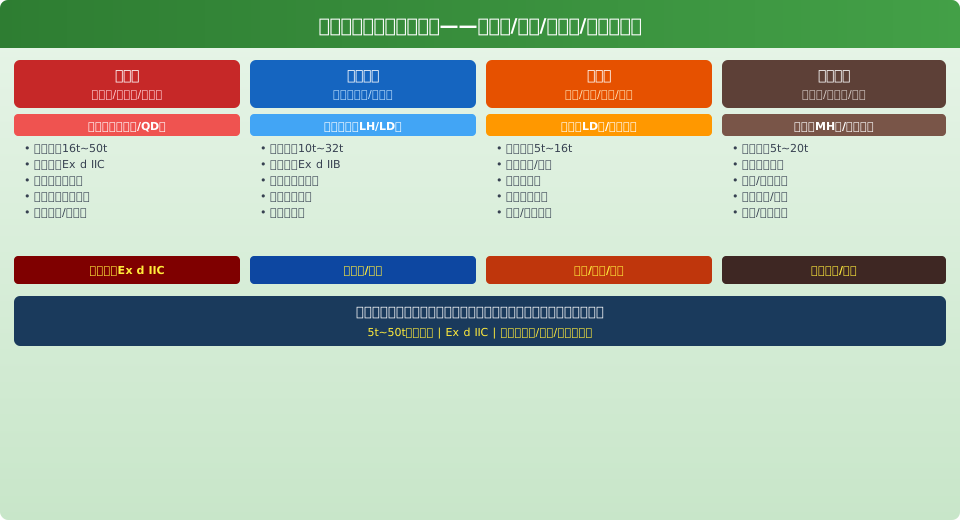

Fertilizer Plant Crane Selection: Ammonia, Urea & Compound
At a glance: Kelude Heavy Industry provides complete plant crane equipment investment solutions for fertilizer manufacturers, covering four key areas—synthesis gas (ammonia), urea, compound fertilizer, and finished-product storage. The configuration solution supports lifting capacities from 3 to 50 short tons and spans from 12 to 36 meters, with total crane equipment investment ranging from approximately $44,500 to $445,000. The ammonia area is equipped with explosion-proof bridge cranes (10–20 short tons) for ammonia synthesis converter and heat exchanger maintenance; the urea area uses stainless steel anti-corrosion overhead cranes (16–32 short tons) to resist ammonium carbamate corrosion; the compound fertilizer area features corrosion-resistant electric hoists (5–10 short tons) to handle acidic granulation exhaust; and the storage area relies on grab bridge cranes or gantry cranes (10–20 short tons) for loading and unloading finished fertilizer. These selections meet the demanding special working conditions of fertilizer production, including high temperature, high pressure, and highly corrosive environments.
Crane Selection Guide for Fertilizer Production
Ammonia Synthesis | Urea Production | Compound Fertilizer | Finished-Product Storage
Fertilizer production spans everything from high-temperature, high-pressure ammonia synthesis with explosion hazards to dusty, corrosive compound fertilizer environments—so crane selection varies significantly across each process area.
Scenario 1: Ammonia Synthesis
• Lifting capacity: 16–50 short tons, explosion-proof bridge crane / QD type
• Hydrogen explosion-proof rating: Ex d IIC
• Compressor overhaul lifting
• Synthesis converter catalyst loading
• Variable frequency inching / anti-sway control
• Kelude supplies hydrogen explosion-proof configuration
Hydrogen Explosion-Proof IIC | Compressor Maintenance | Catalyst Loading
Scenario 2: Urea Production
• Lifting capacity: 10–32 short tons, explosion-proof LH/LD type
• Ammonia explosion-proof rating: Ex d IIB
• Urea prilling tower maintenance
• High-pressure equipment servicing
• Anti-corrosion coating
• Kelude supplies explosion-proof + corrosion-resistant configuration
Ammonia Explosion-Proof IIB | Prilling Tower Maintenance | Anti-Corrosion Coating
Scenario 3: Compound Fertilizer
• Lifting capacity: 5–16 short tons, LD type / electric hoist
• Dusty environment sealing
• Fertilizer corrosiveness
• Frequent equipment maintenance
• Dustproof / anti-corrosion coating
• Kelude supplies dustproof + corrosion-resistant configuration
Dustproof Sealing | Fertilizer Corrosion | Frequent Maintenance
Scenario 4: Finished-Product Storage
• Lifting capacity: 5–20 short tons, MH type / grab bridge crane
• Bulk material grab unloading
• Dual-purpose: bagged and bulk handling
• Indoor/Outdoor
• Grab/Hook Dual-Purpose
• Kelude Grab-and-Hook Combination
Bulk Grab | Bagged Bulk | Dual-Mode Operation
Selection Parameters by Zone: A Four-Area Comparison
| Parameter Item | Ammonia Synthesis | Urea Production | Compound Fertilizer | Finished Product Storage |
|---|---|---|---|---|
| recommended model | explosion-proof overhead crane/QD Type | Explosion-proof LH/LD Type | LD Type/Electric Hoist | MH Type/grab bridge crane |
| Lifting Capacity | 16t~50t | 10t~32t | 5t~16t | 5t~20t |
| Explosion Protection Class | Ex d IIC | Ex d IIB | Dust Dustproof | General |
| control mode | remote control+Operator Cabin | remote control+Operator Cabin | remote control | remote control/Operator Cabin |
| Kelude Process | Hydrogen Explosion-proof | Ammonia Explosion-proof+Anti-corrosion | Dustproof Anti-corrosion | Grab (grab bucket)Hook Dual-Purpose |
Ammonia Synthesis Plants
Hydrogen (IIC) and ammonia (IIA) atmospheres require explosion protection rated Ex d IIC T4.
The primary lifting equipment in an ammonia synthesis plant handles reformer tube replacement (5–8 short tons), synthesis gas compressor maintenance (8–15 short tons), and ammonia converter internals change-out (20–40 short tons). Kelude Heavy Industry recommends a 20/5t or 32/5t explosion-proof double-girder bridge crane (Ex d IIB T2) with a span of 80–100 ft and a work duty classification of A5. The main hook handles heavy lifts such as converter internals and compressor rotors, while the auxiliary hook manages heat exchanger heads and reformer tube assemblies. Given operating pressures of 2,175–4,640 psi, all electrical systems must carry explosion-proof certification, and the pendant station must be Intrinsic Safety (IS) rated. The rail foundation must include a lifting lug above the equipment bay.
Urea and Compound Fertilizer Plants
Urea production demands protection against ammonia corrosion, while compound fertilizer lines require hermetic motors and anti-corrosion coating.
Ammonium carbamate corrosion in urea plants is the most severe challenge in fertilizer equipment, with corrosion rates of 3–5 mm/year at 390–480°F. Kelude Heavy Industry addresses this with SUS316L stainless steel cranes, titanium alloy hooks, and PTFE-coated wire rope, recommending a 16/3.2t or 20/5t stainless steel anti-corrosion double-girder bridge crane. In the compound fertilizer area, granulator and dryer maintenance requires 20–32t corrosion-resistant overhead cranes. The steel structure is protected with a three-layer anti-corrosion system: hot-dip galvanizing, epoxy zinc-rich primer, and polyurethane topcoat, with IP56-sealed electrical cabinets.
Kelude Heavy Industry: Crane Solutions for Fertilizer Plants
Kelude Heavy Industry specializes in overhead lifting systems for fertilizer manufacturing, delivering complete plant lifting solutions from ammonia synthesis to finished product warehousing for nitrogen, phosphate, potash, and compound fertilizer producers. Our product lineup covers three core series: explosion-proof cranes, high-temperature corrosion-resistant cranes, and large-tonnage grab cranes, with over 40 fertilizer plants across China relying on our equipment.