
EN 13135-2:2018 Crane Safety Device Requirements Explained
EN 13135-2:2018 — Crane Safety Requirements for Safety Devices is a key technical specification in the crane industry. As the core European standard governing crane safety devices, it systematically defines design requirements, performance indicators, test methods, and reliability criteria for all major types of safety protection devices used on lifting appliances, including overload limiters, load moment limiters (LML), limit switches, buffers, and anti-collision devices.
The standard provides a unified technical basis for design personnel, inspection bodies, and end users. Kelude strictly implements the technical requirements of this standard throughout its product development and manufacturing processes to ensure compliance and reliability.
Scope and Application of the Standard
EN 13135-2:2018 specifies the technical requirements and safety indicators for safety devices used on cranes and lifting appliances with a rated lifting capacity above 0.5 t. The standard covers not only the design and manufacturing of new equipment but also provides clear technical guidance for the inspection, maintenance, and modification of cranes already in service. As a key component of the crane standard system, it aligns with the EN 13001 Crane Safety Standard series and ISO 4309 Wire Rope Inspection Standard, together forming a complete framework of technical specifications. The clearly defined technical parameters and safety factors give design personnel a solid design basis and offer third-party inspection bodies quantifiable acceptance criteria for type tests and factory inspections.

Core Technical Parameter Framework
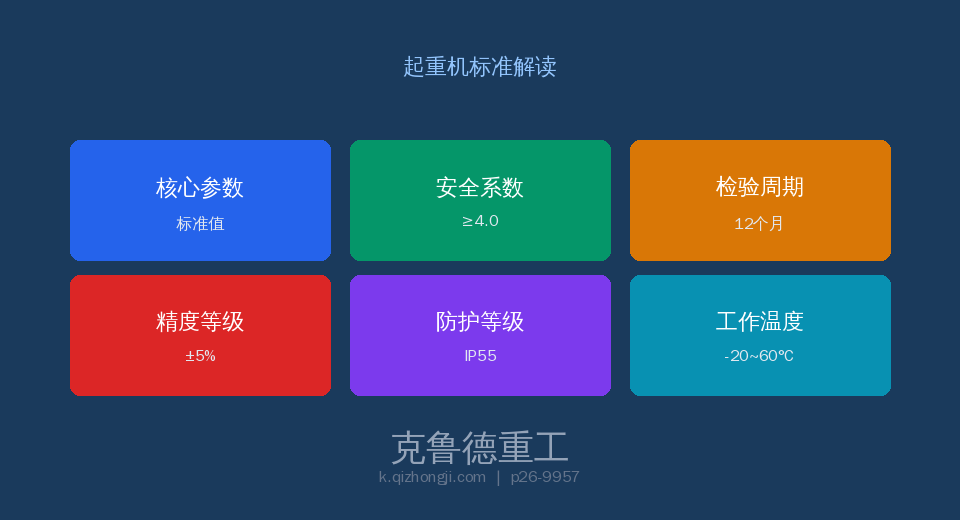
Under EN 13135-2:2018, the design and manufacturing of crane safety devices must satisfy a stringent set of technical parameter requirements. These parameters are established on the basis of extensive test data and sound safety engineering principles, covering everything from material selection to structural design. The safety factor ranges specified in the standard take full account of fatigue life and limit load conditions under severe operating environments. In practical engineering applications, design personnel must select the appropriate combination of parameters based on the equipment's work duty classification, load spectrum, and operating conditions. The parameter cards below summarize the core technical indicators defined by the standard:
Comparative Analysis of Key Technical Parameters
The comparison table below systematically contrasts the core parameters specified in EN 13135-2:2018 with common engineering practice. The values shown are taken directly from the standard's mandatory or recommended clauses and should be strictly implemented during design and selection as well as factory acceptance testing.
| Item | technical requirements | Description |
|---|---|---|
| Overload Limiter | ≤110%rated load Cut-off Hoisting / Lifting Rising | Accuracy±5%, Response≤0.5s |
| Load moment limiter (LML) | ≤100%Rated load moment Alarm and Cut-off | Mandatory Configuration for Tower Crane, Including Working radius Detection |
| Travel Limit Switch | repeat positioning accuracy±5mm | Counterweight+Rotary Limit Switchdual redundancy |
| Buffer | stroke Calculated by Kinetic Energy Absorption | Polyurethane/hydraulic type, Recovery Time≤30s |
| Anti-Collision Device | Distance Between Cranesearly warning+Maintain Clearance | Infrared≥0.5mearly warning,≥0.3mShutdown |
| reliability Requirement | MTBF≥10000Hours | safety device Single Failure Mode Analysis(FMEA) |
Inspection Requirements and Intervals
EN 13135-2:2018 sets out clear requirements for Factory Acceptance Tests, Type Tests, and periodic inspections of crane safety devices. Factory Acceptance Tests must be performed on every unit at the manufacturer's facility by the quality inspection department, and each approved unit must be accompanied by a detailed inspection report and a certificate of conformity. For cranes in service, the periodic inspection interval is determined by the work duty/classification and operating environment, and generally must not exceed 12 months.
| Item | technical requirements | Description |
|---|---|---|
| Overload Limiter | Accuracy Inspection(Standard Weight) | Quarterly+Tolerance≤±5% |
| Load moment limiter (LML) | Working radius-Load Curve Verification | Quarterly+Monthly for Tower Crane |
| Travel Limit Switch | Trigger Position Accuracy Confirmation | Monthly+repeatability±5mm |
| Buffer | Visual Inspection+Rebound Capability+Oil Level | Quarterly+Agingand Leakage Replacement |
| anti-collision | Sensitivity+Alarm+Braking Interlock | Monthly+Sensor Cleaning Calibration |
Safe Operation and Management Requirements
Under EN 13135-2:2018, safe operation and routine management play a critical role in crane safety. The standard places strong emphasis on operator qualification and training, requiring that all operators complete specialized training and obtain the necessary certifications before operating equipment. User units must establish a robust equipment file management system that documents the full installation, use, maintenance and inspection lifecycle of the equipment. Any safety hazards identified must be addressed through the rectification procedure specified in the standard, ensuring the equipment remains in a safe and controllable condition at all times. Additionally, the standard imposes restrictive requirements on equipment operation under extreme operating conditions.
FAQ
Q: What are the technical requirements for overload limiters under EN 13135-2?
A: The standard requires the overload limiter to reliably cut off hoisting power when the load reaches 110% of the rated value, with an accuracy of ≤±5% and a response time of ≤0.5 seconds. An audible and visual early warning must be triggered when the load reaches 100% of the rated value. Sensors must have an IP67 protection rating and operate within a temperature range of -20°C to +60°C. The system must include a self-diagnostic function that automatically checks sensor and controller status at every startup. The limiter should be equipped with a bypass switch (for no-load commissioning), but the bypass status must be clearly indicated in the operator cabin. Kelude's overload limiters fully comply with EN 13135-2 requirements and are individually calibrated before leaving the factory.
Q: What special requirements apply to load moment limiters on tower cranes?
A: Tower cranes must be equipped with a load moment limiter (LML) that monitors both lifting capacity and working radius simultaneously. The standard requires the LML to sound an audible alarm and automatically cut off hoisting and luffing-out power when the load moment reaches 100% of the rated value. Working radius detection accuracy must be ≤±2%, and the angle sensor resolution must be ≤0.1°. The system must display the current load moment percentage, actual load weight, and rated load value. After a major overhaul or any change to the working radius configuration, the LML must be recalibrated.
Q: What are the selection and inspection requirements for buffers?
A: The standard requires that the buffer stroke be sufficient to fully absorb the kinetic energy of the crane impacting at rated speed, calculated using the kinetic energy formula E=0.5mv². Polyurethane buffers are recommended for smaller cranes, while hydraulic buffers are recommended for larger units. Polyurethane buffers must have a recovery time not exceeding 30 seconds, and hydraulic buffers require regular checks of oil level and sealing. Buffer installation must align with the bumping stops, with a misalignment angle not exceeding 2°. Inspection interval is quarterly; any permanent deformation, crack, or leakage requires immediate replacement.
Q: What technical requirements apply to anti-collision devices?
A: When multiple cranes operate on the same crane rail, anti-collision devices are mandatory. The standard requires the anti-collision device to issue an early warning signal when the distance between adjacent cranes reaches 0.5m, and to automatically cut off travel mechanism power and apply braking when the distance reaches 0.3m. Acceptable device types include infrared, LiDAR, ultrasonic, or mechanical limit switches. The effective detection distance of sensors must be no less than 2m, with a response time not exceeding 0.2 seconds. When multiple cranes operate jointly, anti-collision signals must be interconnected via wireless or wired networks. Functional testing of anti-collision devices must be performed monthly, including cleaning sensor surfaces and verifying the alarm function.
— Dedicated to crane design and manufacturing, our products strictly comply with the EN 13135-2:2018 standard system, offering lifecycle service from solution design and manufacturing and installation to after-sales maintenance. To learn how this standard is applied in our products, contact our technical team for detailed technical documentation.