

Overhead Crane Gearbox Noise: Wear Measurement & Discard Criteria
Over time, heavy-load operation causes gear and bearing wear in overhead crane gearboxes, leading to abnormal vibration and noise. Statistics show that approximately 30% of sudden crane shutdowns are caused by drive system failures. When a gearbox operates beyond 5,000 hours, tooth thickness wear exceeding the 0.5mm critical threshold significantly increases the risk of tooth breakage. This article systematically outlines troubleshooting approaches for abnormal noises and standards for wear measurement.
During crane maintenance and inspection, structural calculation requirements from the FEM 1.001 Crane Design Specification must be strictly followed, while mandatory scrapping regulations for transmission components outlined in the TSG 51-2023 Crane Safety Technical Supervision Regulation must be implemented.
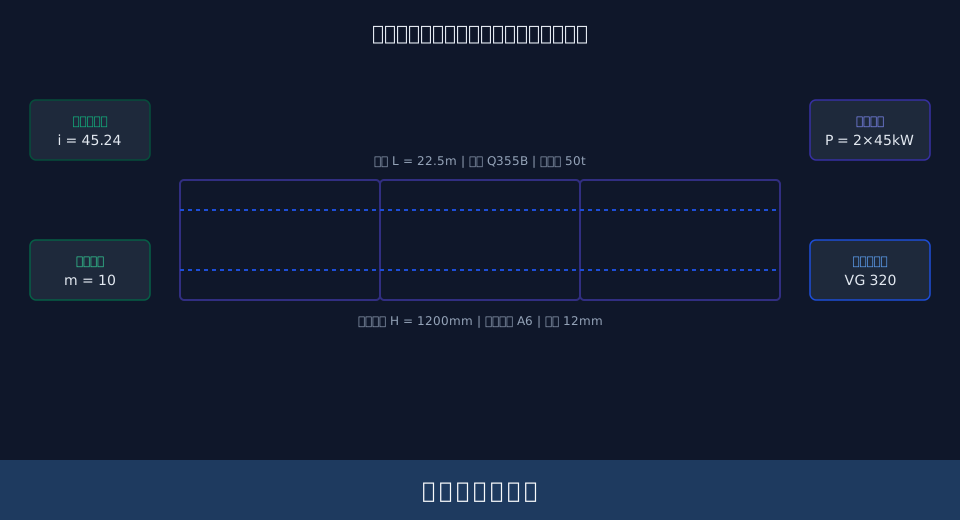
The following sections detail the technical aspects of overhead crane gearbox maintenance and control across five dimensions: sound source localization, precision measurement, discard criteria, lubrication maintenance, and heavy-load selection.
Initial Diagnosis of Abnormal Noises and Sound Source Localization
Abnormal noises in gearboxes are often early signals of internal component failure. Under normal operating conditions at a motor rated speed of 1480 r/min, proper gear meshing should produce a uniform, low-frequency hum. Sharp whining or periodic knocking sounds indicate abnormalities in the transmission chain. If abnormal frequencies concentrate between 80Hz and 120Hz, high-speed stage gear issues are typically the cause.
Troubleshooting abnormal noises requires scientific steps to avoid blind disassembly.
First, use a listening rod against the gearbox housing to preliminarily determine if the noise originates from the bearing area or the center of the gear box. This helps narrow down the fault range.
Second, collect spectral data using a vibration analyzer. Combined with impact load characteristics caused by improper control of the anti-collision safety distance, analyze whether tooth flank spalling has occurred due to momentary overloads.
"Industry field data shows that in cranes with A6 Work Duty / Classification, abnormal gearbox noises caused by frequent Inching operation of the Crane Travel Mechanism account for up to 42%. The root cause is alternating stress accelerating tooth surface fatigue."
⚠️ Note
When localizing sound sources, never open the gearbox inspection cover while the equipment is under load. Ensure the equipment is stopped and energy sources are locked out to prevent mechanical injury.
Precision Measurement Methods for Gear Wear and Data Recording Standards
Once an abnormal noise is confirmed to originate from gears, precise measurement of tooth flank wear is required. For heavy-load gears with a module m=10 and pressure angle 20°, directly measuring pitch circle tooth thickness is difficult. Engineering practice typically uses the measurement of span length to indirectly calculate tooth thickness wear.
Before measurement, clean oil stains from the tooth surfaces to ensure they are dry. Taking the hoisting mechanism gearbox of a 50-ton overhead crane as an example, the number of teeth on the high-speed stage gear is z=40. The calculated number of spans is k=z/9+0.5=40/9+0.5≈4.9, rounded to k=5.
The theoretical formula for span length is W=m×[2.9521×(k-0.5)+0.014×z]. Substituting the data: W=10×[2.9521×4.5+0.014×40]=10×[13.28445+0.56]=138.44mm.
If the on-site measured span length is 137.10mm, the wear amount ΔW=138.44-137.10=1.34mm. This data must be recorded in detail in the equipment maintenance record to serve as a baseline for subsequent trend analysis.
"Maintenance records from a steel plant's casting workshop indicate that regular measurement using a micrometer for span length can detect abnormal tooth wear trends three months in advance, reducing unplanned downtime by 27%."
💡 Tip
When measuring span length, the micrometer measuring force should be controlled between 600g and 1000g. Excessive force will result in smaller readings, affecting the accuracy of wear calculations.
Quantitative Determination of Discard Criteria and Replacement Intervals for Gearbox Gears
Measured wear data must be compared against standard-specified scrap thresholds. Scrapping crane gearbox gears depends not only on tooth thickness wear but also on comprehensive evaluation of indicators such as pitting and plastic deformation. Typically, when tooth thickness wear reaches 15% of the original thickness, it hits the wear limit.
To more intuitively guide on-site maintenance, the following table summarizes the specific comparison between gear wear amounts and discard criteria for quick reference by technicians.
The table below details the quantitative discard criteria corresponding to different failure modes, serving as the core basis for determining whether gears should continue service.
📊 Comparison Table: Gear Wear Amount and Discard Criteria
| FailureForm | MeasurementIndicator | scrap threshold | handling recommendation |
|---|---|---|---|
| Tooth ThicknessWear | Reduction in Normal Tooth Thickness | Original Tooth Thickness15% | replace immediatelyGearSet |
| Tooth Surfacepitting | pittingArea Ratio | Of Tooth Surface Area30% | Post-AssessmentreplacementOr Repair |
| plastic deformation | Root Depression Depth | 0.5mm | Mandatoryscrap and replacement |
Per special equipment inspection standards, gears in Hoisting mechanisms and non-balance Luffing mechanisms must be scrapped when tooth thickness wear reaches 15% of the original dimension. For other travel mechanism gears, the scrap threshold is relaxed to 20%.
⚠️ Note
When replacing gears, meshing gear pairs must be replaced as a set. Mixing new and old gears is strictly prohibited, as improper gear meshing can cause severe wear within 8,000 operating hours.
Crane Reducer Lubrication Maintenance & Abnormal Noise Prevention
Proper lubrication is the foundation for preventing abnormal noise in Gearboxes. Lubricating Oil not only reduces friction but also dissipates heat and metal debris generated during gear meshing. When oil temperature exceeds 65°C (149°F), viscosity drops significantly, leading to oil film rupture, dry friction on tooth surfaces, and subsequent noise.
Lubricant selection and oil change intervals vary based on Working Environment and Load conditions. While AI anti-sway control improves operational smoothness and reduces impact loads on the reducer, this does not eliminate the need for regular lubrication maintenance.
The table below summarizes lubricant selection and maintenance cycles for common operating conditions, providing standardized guidance for field maintenance personnel.
The following table outlines the viscosity grade selection and initial/regular oil change intervals for reducer lubricating oil under different ambient temperatures and operating conditions.
📊 Reducer Lubricant Selection and Replacement Interval Table by Operating Condition
| Ambient Temperature | Recommended ViscosityGrade | Firstoil change interval | Standardoil change interval |
|---|---|---|---|
| -10℃ ~ 20℃ | VG 220 | Operation300Hours | Per2000Hours |
| 20℃ ~ 40℃ | VG 320 | Operation300Hours | Per2000Hours |
| > 40℃ (High-temperature service) | VG 460 OrSynthetic oil | Operation200Hours | Per1500Hours |
"Comparative data from a port terminal crane maintenance project shows that equipment strictly adhering to a 2,000-hour oil change interval and regularly filtering metal debris extended its gearbox overhaul interval by 4,500 hours."
⚠️ Note
When adding lubricating oil, the oil level must be maintained between the upper and lower marks on the oil dipstick. An excessively low oil level leads to poor lubrication, while an overly high level increases churning losses, causing abnormal temperature rise.
Optimizing Gearbox Selection for Heavy Load Conditions & Kelude Custom Solutions
For heavy-duty cranes with a lifting capacity exceeding 50 tons and a work duty classification of A6, standard gearboxes often fail to meet the demands of long-term, high-intensity operation. During equipment selection, beyond calculating the transmission ratio and rated power, it is crucial to account for the impact allowance and thermal power limits inherent in actual operating conditions.
During system matching, the vibration characteristics of the gearbox directly affect the overall structure. Feedback from weld crack detection on the main girder indicates that excessive gearbox vibration accelerates fatigue cracking at the main girder seams. Therefore, equipment selection must prioritize dynamic balancing and vibration damping design.
To address such complex operating conditions, Kelude Heavy Industry provides customized gearbox solutions based on actual load spectra. By optimizing gear profile modification parameters and utilizing high-strength alloy forgings, we effectively enhance the drive system's resistance to shock and extend service life.
"Test certificates from authoritative institutions indicate that heavy-load gearboxes with micro-profile and lead modifications reduce gear meshing impact energy by 32% and average operational noise by 4.5 decibels."
💡 Tip
When selecting gearboxes for heavy load conditions, it is recommended to set the thermal power safety margin coefficient between 1.2 and 1.5. Equipping independent cooling fans or a water cooling system is mandatory to completely resolve lubricating oil failure caused by high temperatures.
FAQ
Q: Does slight abnormal noise in an overhead crane gearbox require immediate shutdown?
A: If the noise is a uniform low-frequency sound without abnormal temperature rise, a scheduled shutdown inspection can be arranged. However, if accompanied by severe vibration, metallic knocking sounds, or a rapid spike in oil temperature, immediate shutdown and power cutoff are required to prevent fault escalation, such as gear fracture or seizure.
Q: What are the accuracy requirements for micrometers when measuring gear wear amount?
For heavy-load gears with a module greater than 6mm, an outside micrometer with a resolution of 0.01mm is recommended. For smaller modules or higher accuracy requirements, a digital micrometer with a resolution of 0.001mm should be used, with regular calibration checks.
Q: What is the approximate cost of replacing a gear set for a heavy-duty overhead crane gearbox?
Costs vary significantly depending on gear material, module, and machining accuracy. Standard material gear sets typically cost around $1,500–$3,000. If high-strength alloy forgings and precision grinding processes are used, costs will increase accordingly. Specific amounts are subject to the actual contract.
Q: How can one distinguish whether gearbox noise is caused by bearing damage or gear wear?
Bearing damage typically produces continuous high-frequency hissing or rumbling, with vibration values increasing significantly as rotational speed rises. Gear wear or broken teeth manifest as periodic impact sounds consistent with the gear meshing frequency, which can be clearly distinguished through spectrum analysis.
In summary, troubleshooting abnormal noise and measuring wear in overhead crane gearboxes is a systematic engineering task requiring comprehensive assessment using precision instruments and standards. With deep technical expertise and customization capability, Kelude Heavy Industry provides lifecycle service—from equipment selection and condition monitoring to maintenance and retrofit—ensuring safe and efficient operation of lifting equipment.
