
Crane Configuration Solutions for Marine Equipment Manufacturing
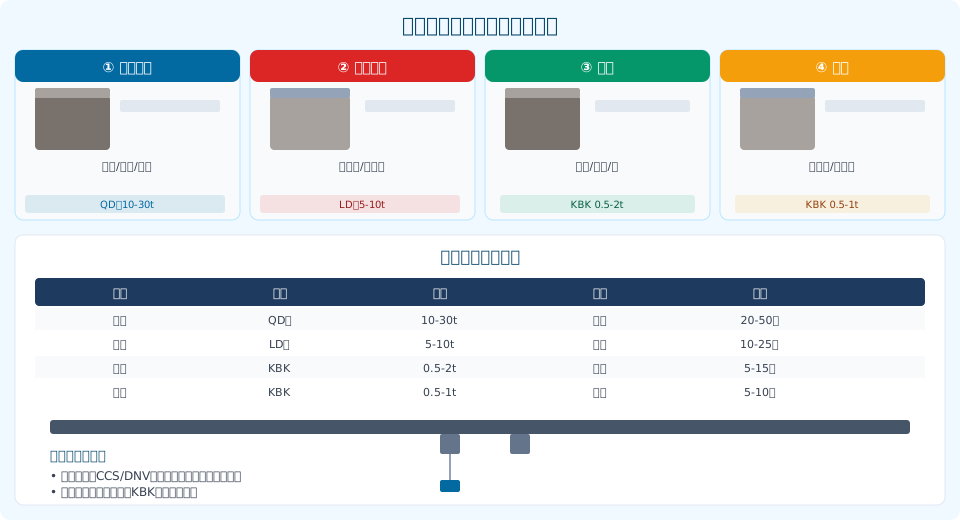
Marine equipment manufacturing cranes are configured across four categories: deck machinery, cabin equipment, piping systems, and electrical equipment. For deck machinery, the QD Type (10–30 t) is class-certified for marine service; cabin equipment uses the LD Type (5–10 t) for welding and assembly; piping systems rely on KBK workstation cranes (0.5–2 t); and electrical equipment is served by KBK units (0.5–1 t) with shock-proof features. Marine equipment requires CCS or DNV classification certification.
Deck Machinery: Class-Certified Hoisting Requirements
Windlasses, winches, and steering gears typically weigh 5–20 t each. The recommended solution is the QD Type in the 10–30 t range. Since deck machinery requires CCS or DNV classification, the crane must accommodate scheduled inspection and survey hold points during manufacturing, so hoisting time for these joint inspections needs to be built into the production plan.
The meshing test between the windlass chain sprocket and anchor chain links is a critical inspection step for deck machinery. The fit accuracy between the sprocket pitch circle and the chain links must be within 1 mm. Kelude's cranes in the deck machinery area support windlass turnover and test-fixture hoisting throughout these operations.
Cabin Equipment: Welding and Assembly Configuration
Hatch covers, watertight doors, and portholes range from 1–5 t each. The recommended solution is the LD Type in the 5–10 t range. Cabin equipment involves extensive welding, so crane coverage must extend across all welding stations.
After the frame and door panel of a watertight door are welded, a watertightness test (0.3–0.5 bar) is required. The test fixture weighs 200–500 kg. Kelude's cranes in the cabin equipment area cover the full workflow — welding, assembly, and testing stations.
Piping Systems: KBK Workstation Crane Solution
Marine piping, valves, and pump units weigh 50–500 kg, with pipe runs spanning 3–12 m. The recommended solution is the KBK 0.5–2 t workstation crane, positioned to cover the pipe fabrication area. The KBK rail runs along the piping production line.
Pipe bending and flange welding for marine piping are completed on the fabrication line. Pipe modules (bundled pipe racks) weigh 200–2,000 kg and must be lifted and transported as a complete unit to the installation station in the hull. Kelude extends the KBK rail system all the way to the pre-installation area for seamless transfer.
Electrical Equipment: Light-Duty Shock-Proof Hoisting
Distribution panels and control cabinets weigh 200–1,000 kg. The recommended solution is the KBK 0.5–1 t. Electrical equipment assembly demands shock-proof, smooth lifting and transport. Kelude's KBK cranes come standard with variable frequency micro-speed control for precise, vibration-free positioning.
deck Machinery QD Type10-30t classification survey | accommodation equipment LD Type5-10t | piping system KBK 0.5-2t |
electrical system KBK 0.5-1t | classification survey Certification CCS/DNVjoint inspection coordination | complete plant 10-5010,000 |
Marine Equipment Crane Configuration Table
| category | crane type | tonnage | features | requirements | investment |
|---|---|---|---|---|---|
| deck Machinery | QD Type | 10-30t | Heavy load | CCS/DNVclassification survey | 20-5010,000 |
| accommodation equipment | LD Type | 5-10t | Welding | standard | 10-2510,000 |
| piping system | KBK | 0.5-2t | workstation crane | along the working line | 5-1510,000 |
| electrical system | KBK | 0.5-1t | shock-proof | variable frequency micro-speed | 5-1010,000 |
Kelude Heavy Industry provides crane solutions across the full spectrum of marine equipment—covering deck machinery, accommodation areas, piping systems, and electrical installations. Our offerings include ship-class hoisting for deck machinery and KBK workstation systems for piping layouts.
classification survey plan QD Type10-30t+coordination CCS/DNVjoint inspection | piping system KBK Crane Railarranged along the working line, full workstation coveragecoverage | electrical systemshock-proof KBK+variable frequency micro-speed+smooth lifting |
Frequently Asked Questions (FAQ)
Q: Do marine equipment and cranes require classification society certification?
A: Deck machinery (anchor windlasses, winches, steering gear) requires CCS/DNV Certification. During manufacturing, the crane is integrated into the inspection workflow. Kelude provides a coordinated survey support plan.
Q: What is the standard length of a KBK crane rail for piping systems?
A: Rail lengths typically range from 20 to 50 m, depending on the length of the piping assembly line. KBK sections can be joined for extended runs. Kelude extends the KBK rail to the pre-assembly station.
Q: Why is shock-proof hoisting required for electrical equipment?
A: Switchboard components are precision items (relays, contactors, PLC modules). Vibration during lifting and transport can loosen wiring or dislodge solder joints. Kelude KBK systems come standard with variable frequency micro-speed control.
Q: What classification surveys are required for marine cranes?
A: Deck machinery requires CCS/DNV survey during fabrication. Cranes must undergo static and dynamic load tests with the surveyor present. Kelude supplies the full technical file required for classification.