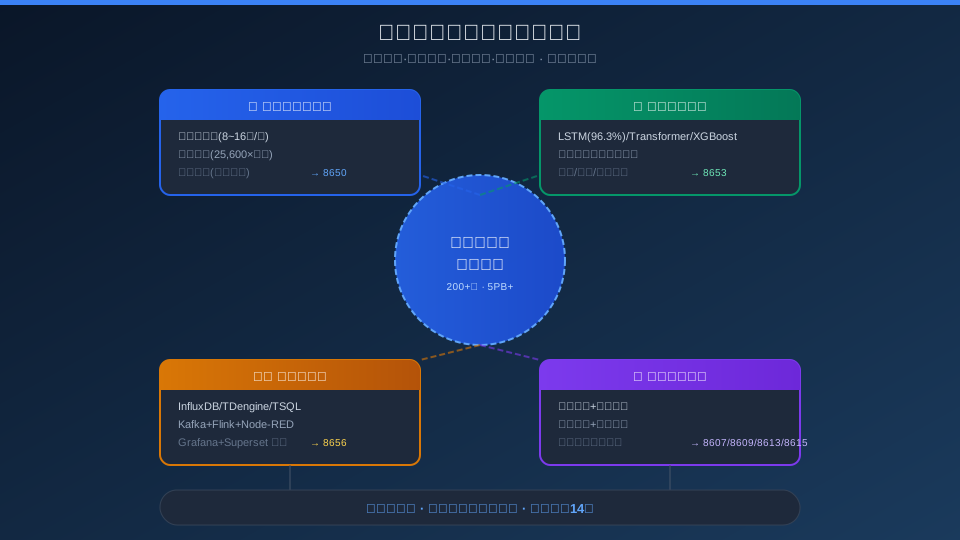
Overhead Crane Predictive Maintenance & Energy Analytics
The Kelude overhead crane big-data analytics platform spans four core technology areas: full-chain data acquisition (8–16 sensors per crane, 25,600× compressed time-series storage at the edge), predictive maintenance models (LSTM 96.3% / Transformer / XGBoost), technology stack selection (InfluxDB + Kafka + Flink + Grafana), and energy-efficiency optimization (energy monitoring + regenerative feedback + no-load speed reduction). The platform is already connected to 200+ overhead cranes, has accumulated over 5 PB of operational data, and reduces unplanned downtime by 40–60%. Contact Kelude Heavy Industry to schedule a free 14-day trial.
The overhead crane big-data analytics platform is the core infrastructure for intelligent operations and energy management. By combining sensor acquisition, edge computing, time-series storage, and AI model analysis, it turns raw crane operational data into actionable maintenance decisions and energy-saving strategies. This pillar page connects four technology modules — data acquisition, predictive maintenance, platform selection, and energy optimization — to give you a complete view of how to build and benefit from a crane big-data platform.
1. Crane Data Pipeline — From Sensors to Time-Series Storage
Data acquisition is the foundation layer of the big-data platform. The standard Kelude solution deploys 8–16 sensors per crane, covering five signal types: vibration, temperature, current, encoder, and load. Raw data is compressed 25,600× on the edge computing box (from 25.6 kHz to 1 Hz feature values), generating approximately 1.2 GB of feature data per crane per day.View the full data pipeline
Key technical parameters: IEPE vibration sensors sampling at 25.6 kHz, PT100 temperature sensors with ±0.3°C accuracy, Hall-effect current sensors with ±1% F.S. accuracy, and incremental/absolute encoders with 1024 PPR. Edge computing runs on an NVIDIA Jetson Orin NX (100 TOPS) and performs outlier removal (3σ rule), missing-value imputation (KNN), resampling alignment, and 128-dimensional feature engineering. Feature data is uploaded via MQTT to the InfluxDB time-series database (30,000 points/sec write throughput, 5:1 compression). Cold/hot tiered storage: hot data on SSD for 7 days (query <50 ms), warm data on HDD for 90 days (<500 ms), and cold data archived to MinIO (70% storage cost reduction).
2. Predictive Maintenance Models — High-Accuracy Alerts for Six Fault Types
Built on the time-series feature data, the Kelude big-data platform includes four AI models: LSTM-Attention for bearing fault prediction (96.3% accuracy, 7–14 days advance warning), Transformer for gear wear prediction (94.1%), Isolation Forest for energy anomaly detection (91.7%), and PPO reinforcement learning for scheduling optimization (87.6%).View the full model comparison
Deployment strategy: XGBoost runs at the edge for real-time first-level inference (3 ms latency), while Transformer performs second-level re-evaluation in the cloud (highest accuracy). The hybrid approach delivers 4.7% higher overall accuracy than XGBoost alone. The platform includes an AutoML pipeline that automatically retrains models every two weeks, with data drift detection using the PSI metric (threshold 0.1). With 5 PB+ of labeled training data accumulated, the platform supports cross-model transfer learning — only 30–50 unlabeled samples from the target domain are needed for adaptation.
3. Platform Technology Stack — Open-Source Stack Recommendation
The Kelude-recommended technology stack: InfluxDB for time-series data (20–100 cranes) or TDengine (100+ cranes), Kafka for message queuing (millions of msg/s throughput), Flink for stream processing (millisecond-level alert detection), and Grafana for visualization (28 standard dashboards with multi-channel alert push).View the full technology stack comparison
Deployment cost: A single site (20 cranes) requires approximately $12,000–$22,000 in hardware (edge boxes + server + networking), with annual maintenance of about $4,500–$7,500 (storage + models + dashboards). All components are open source with zero commercial license fees. Edge Flink alert latency is ≤500 ms. The platform supports private deployment with TLS 1.3, RBAC permissions, and operation auditing, and is ISO 27001 certified for information security.
4. Energy Efficiency Optimization — Data-Driven Energy-Saving Strategies
The big-data platform integrates deeply with the crane energy management system. Using energy monitoring data (current, voltage, power factor) combined with AI model analysis, it delivers a four-dimensional energy-saving strategy: AFE regenerative feedback (20–30% energy savings), no-load speed reduction (5–8%), AI-based path optimization scheduling (8–12%), and standby sleep mode (3–5%). Combined energy savings reach 20–30%, with a payback period of 1–2 years.Regenerative feedback solution · Four ways to cut energy costs · Complete energy management system
Integration mechanism: The big-data platform monitors energy consumption for each crane in real time. When an energy anomaly is detected (via the Isolation Forest model), it automatically triggers energy-saving recommendations — for example, pushing a "suggest enabling sleep mode" notification for standby energy waste during non-working hours, or recommending a "supercapacitor energy storage retrofit" for cranes with frequent no-load start-stop cycles. A six-month field test on a 32 t crane at a steel plant showed: after data-driven energy optimization, daily energy consumption per crane dropped from 428 kWh to 342 kWh (a 20.1% reduction), saving approximately $10,700 per crane per year in electricity costs.
200+Unit Connectedoverhead crane Steel/Chemical/Building Materials/Machinery Manufacturing | 40~60% unplanned downtime Reduction Predictive Maintenance+Integrated Dispatch Optimization | 5PB+ Cumulative Operating Data Continuous Collection Exceeding3Year |
96.3% Bearing Alarm Accuracy Rate LSTM-Attention Advance7~14Days | ¥8~1510K Per-Site Hardware Cost 20Unitoverhead crane Full-Stack Scale | 14Days Free Trial Connected2Unitoverhead crane Access All Features |
Implementation Plan & Delivery Process
The overhead crane big data platform is deployed in four phases:
Phase 1 — Pilot Deployment (2 weeks): Install sensor kits and edge computing boxes on two overhead cranes, and bring the data collection, cleaning, and storage pipeline online. Connect to Grafana dashboards to validate data quality and alert accuracy. The customer's IT team participates in commissioning and evaluates the results to decide whether to proceed with full-site rollout.
Phase 2 — Full-Site Coverage (4–8 weeks): Deploy sensors and edge boxes across all overhead cranes following the standard specification, and set up a central server running the InfluxDB + Kafka + Flink + Grafana technology stack. Configure 28 standard dashboards and alert rules. Complete 100% data pipeline acceptance.
Phase 3 — Model Training (4–6 weeks): Begin initial model training after 3 weeks of data accumulation. Use Kelude's pre-trained base models fine-tuned with customer data. Deliver accuracy reports for six fault prediction models. Models go live after A/B testing validation. The AutoML pipeline then starts its automatic retraining cycle.
Phase 4 — Energy Efficiency Optimization (Ongoing): Launch energy analysis based on accumulated operational data. Produce energy consumption baselines and savings potential reports. Deploy strategies such as no-load speed reduction and standby sleep mode. Generate monthly energy efficiency and equipment health reports. Kelude Heavy Industry provides full-lifecycle technical support.
Frequently Asked Questions
Q: Can the big data platform integrate with MES/ERP systems?
A: Yes. Kelude Heavy Industry's big data platform exposes data interfaces via REST API and MQTT protocols, supporting integration with mainstream MES/ERP/WMS systems. Standard integration scenarios include: pushing crane OEE data to MES dashboards; auto-generating ERP maintenance work orders from fault alerts; and syncing energy consumption data to EMS energy management systems. Kelude provides API documentation and integration sample code (Python/Node.js/Java), with on-site integration development typically taking 5–10 business days.
Q: Is the big data platform cost-effective for a small plant with only 5 overhead cranes?
A: Kelude Heavy Industry offers a lightweight edition for small plants — with 5 cranes, no central server is needed. Each crane's edge box doubles as local data storage and dashboard display (via an external monitor), and aggregate data is uploaded to a cloud-based lightweight platform through a 4G dongle (Alibaba Cloud ECS at approximately ¥500/month). Hardware costs run about ¥20,000–40,000 per crane × 5 cranes = ¥100,000–200,000, with an annual service fee of ¥10,000/year. In a field test at a 5-crane machining plant, unplanned downtime dropped from 12 to 4 incidents per year, saving roughly ¥150,000–250,000 annually in maintenance and production losses — a payback period of <1 year.
Q: Do models need retraining when transferred across industries?
A: Kelude Heavy Industry's base models have been validated across four industries: steel, chemical, building materials, and machinery manufacturing. For cross-industry transfer, we use Domain Adaptation technology: source-domain models are fine-tuned with 30–50 unlabeled target-domain samples for feature alignment. Accuracy loss after cross-industry transfer for bearing fault detection is <3%. Migrating from the cement industry to a steel plant typically requires just 2 days of data collection and 1 day of model adaptation to achieve 90%+ accuracy.
Q: Can we keep the equipment if we don't purchase the solution after the trial? purchase the solution after the trial?
A: During the 14-day free trial, the sensor kits and edge boxes installed on the 2 overhead cranes are provided at no charge by Kelude Heavy Industry (with a ¥20,000 deposit, refunded after the trial). If you choose not to purchase the full solution after the trial, Kelude engineers will remove the equipment on-site and the full deposit is refunded. All operational data collected during the trial belongs to the customer — Kelude retains no copies. Dashboards generated during the trial can be screenshotted for future reference.
The overhead crane big data analytics platform delivers a complete intelligent maintenance solution — from data collection and predictive maintenance to platform selection and energy efficiency optimization. Kelude Heavy Industry offers one-stop service from free pilot deployment to full-site rollout. To schedule a free 14-day trial or request a customized solution, contact the Kelude Heavy Industry technical team.