

3 Overlooked Interfaces for Smart Crane Selection
When transforming aging factory buildings into smart facilities, upgrading and retrofitting lifting equipment often encounters significant technical bottlenecks. Industry-measured data indicates that in smart crane retrofit projects, interface debugging and protocol matching account for approximately 40% of the total project duration. Furthermore, if communication signal latency cannot be controlled within 50ms, the anti-sway system will fail directly. This article provides an in-depth analysis of the three most easily overlooked critical interfaces in smart crane selection and retrofitting, helping you avoid technical pitfalls and ensuring the successful implementation of your retrofit project.
The design of a crane’s electrical control system must strictly adhere to relevant national specifications. When selecting interfaces and establishing system architecture, engineers should refer to the specific requirements for electrical control and protection circuits outlined in FEM 1.001 Crane Design Standard (formerly FEM 1.001) to ensure the reliability of underlying hardware interfaces. Simultaneously, for data interaction involving the Safety Monitoring and Management System, compliance with the mandatory provisions of the TSG 51-2023 Crane Safety Technical Supervision Regulation is essential to guarantee operational safety under complex operating conditions.
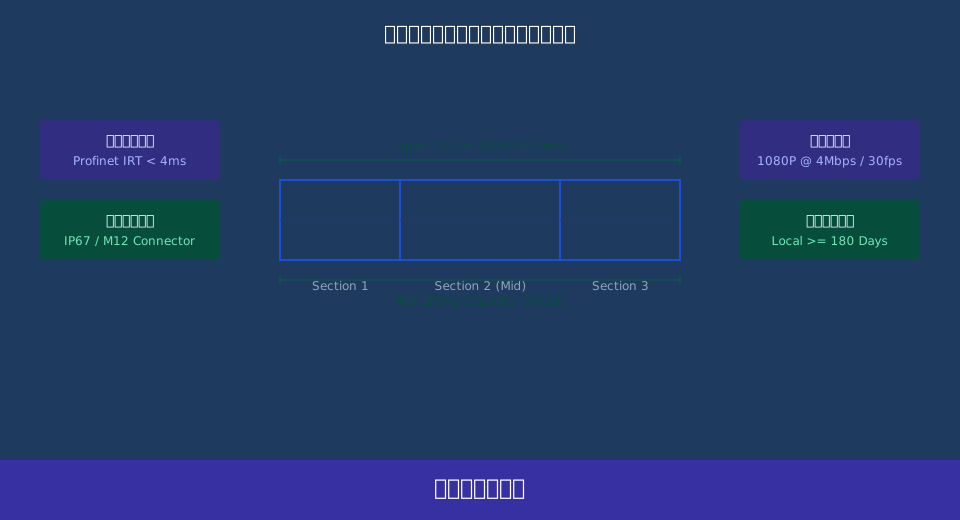
The following section details core technological nodes in smart crane retrofits, focusing on communication protocol matching, analog accuracy calibration, physical interface protection, and video stream bandwidth requirements, providing you with a comprehensive guide for selection and construction.
PLC Communication Protocol Matching and Data Latency Control in Smart Crane Retrofits
In intelligent upgrades, matching communication protocols between PLCs, frequency inverters (VFDs), and sensors is the primary challenge. Traditional Profibus-DP protocols are showing limitations when handling high-frequency data acquisition, whereas industrial Ethernet protocols like Profinet have become the preferred choice for new and retrofit projects due to their ultra-fast 4ms communication cycles. However, protocol upgrades involve more than simple hardware replacement; they require careful attention to data latency control across the entire network topology.
Consider the retrofit of the Crane Travel Mechanism in a steel mill workshop, where the Long Travel Speed is set at 60 m/min (equivalent to a linear velocity of 1 m/s). When a laser distance sensor triggers an anti-collision early warning, the system deceleration is set to 0.5 m/s². According to kinematic formulas, the braking distance $s = v^2 / (2a) = 1^2 / (2 \times 0.5) = 1$ meter. This means that from the moment the sensor detects an obstacle, through PLC data processing, to the VFD executing braking, the communication latency of the entire link must be strictly controlled within 50ms. Otherwise, the actual braking distance will exceed the safe range. For detailed technical specifications regarding such safety distance calculations and protection, refer to Crane Anti-Collision Safety Distance.
"According to Section 8.4.2 of the FEM 1.001 Crane Design Standard (formerly FEM 1.001), the design of the control system must ensure that transmission delays of control commands do not affect the braking performance of mechanisms or the timeliness of safety protection actions during full load and eccentric load conditions."
⚠️ Note
In mixed network architectures, never mix Profinet real-time communication data with standard TCP/IP office data on the same physical network switch. You must configure separate VLANs and enable QoS priority policies to ensure control packets always receive the highest forwarding privileges, preventing latency spikes caused by network storms.
Analog Interface Accuracy Calibration for VFDs and Main Control Systems in Hoisting Mechanisms
The stability of the hoisting mechanism directly determines the positioning accuracy of the lifting spreader. In many older crane retrofits, the main control system still sends frequency setpoint commands to VFDs via 0-10V analog signals. While this interface method is simple, it is highly susceptible to electromagnetic interference on-site, leading to voltage fluctuations that cause minor adjustments in motor speed and result in suspended load sway. To meet the high-precision requirements of AI Anti-Sway Algorithms, calibrating and upgrading analog interfaces is particularly critical.
Traditional 8-bit analog modules offer a resolution of only 256 levels. When adjusting frequencies from 0-50Hz, each level spans approximately 0.2Hz. Upgrading to 12-bit resolution modules increases the adjustment levels to 4096, reducing each step to just 0.012Hz. This improvement in precision allows for smoother speed control during micro-motion operating conditions. Measured data shows that the static positioning deviation of the lifting spreader can be reduced from the original 3.5mm to within 0.5mm.
| interfaceType | Resolution | anti-interference capability | Application Scenarios |
|---|---|---|---|
| 0-10V Analog | 8bit / 12bit | Weak,Shielded Cable Required | Legacysystem compatibilityRetrofit |
| 4-20mA Analog | 12bit / 16bit | Strong,CurrentSignal Immunity / Noise Immunity | LongdistanceTransmissionoperating condition |
| Profinet Digital | 32bit Floating Point | Very Strong,Pure Digital Communication | HighAccuracyAnti-Sway System |
In a recent retrofit of a stamping workshop at an automotive manufacturing plant, upgrading the hoisting analog interface to 12-bit resolution and adding hardware filtering circuits resulted in a repeat positioning accuracy of ±0.5mm over 1,000 continuous lifting tests. This performance fully meets the precision requirements for automated die grabbing.
💡 Tip
If retaining an analog interface is mandatory on-site, always use double-shielded cable with the shield grounded at a single point only at the PLC cabinet end. The strong electromagnetic field from the Frequency Inverter (VFD) output can easily couple into analog signal lines, causing millivolt-level fluctuations in the reference voltage. In precision hoisting applications, these minor fluctuations are amplified into noticeable speed jitter.
Impact of Sensor and Data Acquisition Module Physical Interface Selection on Long-Term Maintenance Costs
Smart Cranes deploy a wide array of sensors, including Load Limiters, Encoders, and Limit switches. While often overlooked during initial design, the selection of physical interfaces for these components significantly impacts long-term maintenance costs. In harsh operating conditions—such as high-dust, high-humidity, or extreme temperature variations found in metallurgical plants or Ports—the Protection Rating (IP) and connection reliability directly determine the equipment’s mean time between failures (MTBF).
Consider M12 circular connectors: standard IP65-rated connectors may suffer from water ingress and short circuits during heavy outdoor rain. In contrast, aviation-style connectors with IP67 or even IP69K ratings offer superior protection. Although their procurement cost increases by approximately $2 per unit (roughly 15% more), they maintain a Response time of under 2ms and reduce failure rates caused by connector corrosion by 80%. For heavy-load custom projects, Kelude Heavy Industry employs specialized silicone sealing components rated for temperatures up to 50°C (122°F) for sensor interfaces in high-temperature smelting workshops, significantly extending maintenance cycles.
The table below provides a cost comparison of sensor physical interface Protection Ratings across different industrial environments, serving as a selection reference.
📊 Comparison of Sensor Interface Protection Ratings and Costs Across Environments
| Applicationenvironment | RecommendedProtection Rating (IP) | interfaceType | Initialprocurement cost | 3Year(s)maintenance cost |
|---|---|---|---|---|
| Indoor, Normal Temp, Dry | IP54 | Standardterminal block | Low | Low |
| Outdoor, Dusty & Humid | IP67 | M12Aviation Connector / Circular Connector | Medium | Very Low |
| High-Temp High-Pressure Washdown | IP69K | Special PurposeStainless Steelinterface | High | Very Low |
Industry statistics indicate that in coastal port Quay Crane automation retrofits, electrical faults caused by corrosion of sensor physical interfaces account for over 35% of total failures. Implementing connectors with an IP67 or higher Protection Rating reduced this figure to under 5% within two years, delivering a significant return on investment (ROI).
⚠️ Note
Do not rely solely on nominal Protection Ratings during selection. Some substandard connectors are only certified for IP67 in clean water at room temperature; in chemical workshops containing acidic or alkaline gases, their seal rings will age and fail rapidly. Suppliers must provide material compatibility reports specific to the chemical media involved.
Bandwidth Requirements for Smart Anti-Sway Video Streams and Image Recognition Latency Analysis
Smart anti-sway systems based on machine vision require industrial cameras mounted on the Hoisting mechanism to capture Lifting spreader status in real-time. The bandwidth allocation for video stream interfaces and the latency of image processing are critical factors determining whether the anti-sway algorithm can intervene effectively. At 1080P Resolution, the bit rate for a single video stream is typically around 4Mbps. If the system requires a frame rate of 30fps, this places strict demands on the backplane bandwidth of onboard network switches.
The latency of image recognition depends not only on camera exposure time but also on the total duration of video stream transmission and AI inference. Measured data shows that the entire chain—from real-time acquisition by the camera, transmission via Gigabit Ethernet ports to Edge Computing boxes, to the output of sway angle control commands—must maintain end-to-end latency under 100ms. If latency exceeds 150ms, control commands will lag behind the actual physical position of the Lifting spreader, causing a negative damping effect that exacerbates sway. For scenarios requiring structural health management combined with vision, such as weld crack detection on the Main Girder, video stream bandwidth requirements increase exponentially.
In the automation retrofit of a logistics warehousing center, the testing team compared visual latency across different network architectures. After implementing an independent Gigabit optical fiber ring network, the end-to-end latency of video streams stabilized at 65ms, reducing the convergence time of the anti-sway system by 40% compared to using a 100Mbps shared network.
💡 Tip
When calculating video stream bandwidth, always reserve at least 30% redundancy. During crane operation, bending of Conductor Rails or Drag Chain Cables causes signal attenuation at high frequencies. If bandwidth is at its limit, frame loss is highly likely. It is recommended to use industrial network switches supporting hardware-level QoS to prioritize the transmission of control video streams.
Standardized Acceptance and Data Backup Mechanisms for Crane Safety Monitoring Interfaces
The Safety Monitoring and Management System serves as the "black box" of Smart Cranes. The standardization of its data interfaces and the reliability of its data backup mechanisms directly impact equipment compliance and accident traceability. The system must perform real-time acquisition of key parameters such as Lifting Capacity, Torque, and travel distance, with a sampling frequency typically set at 10Hz. This generates substantial data every second, testing both local storage and remote upload interfaces.
According to special equipment safety management requirements, the capacity of local storage media must support at least 180 days of cyclic data coverage. Calculating at a 10Hz sampling rate with 50 bytes per packet, a single unit generates approximately 43MB of data daily, requiring about 8GB of storage for 180 days. Considering system logs and anomaly snapshot images, the actual installed industrial-grade SD cards or solid-state drives usually range from 32GB to 64GB. Additionally, remote upload interfaces must support full-network 4G/5G connectivity to ensure real-time synchronization of data to enterprise cloud platforms.
The TSG 51-2023 Crane Safety Technical Supervision Regulation explicitly requires that lifting appliances' Safety Monitoring and Management Systems possess data backup functions. Stored data must be tamper-proof, and the storage cycle must meet relevant safety technical specification requirements to ensure data integrity and traceability during accident investigations.
⚠️ Note
During the acceptance inspection of Safety Monitoring and Management System interfaces, do not merely verify if data uploads normally; conduct power-loss simulation tests as well. Ensure that in the event of sudden power failure, the system utilizes standby capacitors or batteries to write the last 24 hours of key data completely into non-volatile memory, preventing data loss that could lead to compliance review failures.
FAQ
Q: What should be done if the old PLC does not support the latest Profinet protocol during Smart Crane automation retrofit?
A: There is no need to replace the entire PLC. By adding a protocol conversion gateway, old Profibus-DP or Modbus signals can be converted to Profinet Ethernet signals. This preserves the original control logic while enabling high-speed communication with smart modules, significantly reducing retrofit cost.
Q: If the Variable Frequency Drive analog interface resolution reaches 12bit, how much does it improve Hoisting positioning accuracy?
A: A 12-bit resolution increases the frequency adjustment steps from 256 to 4096, narrowing each step to 0.012Hz. Under micro-motion operating conditions, this reduces the static positioning deviation of the Lifting spreader from 3.5mm to under 0.5mm, significantly enhancing the accuracy of precision assembly or grabbing operations.
Q: What is the approximate Quotation for adding video stream interfaces and anti-sway modules to the overall retrofit?
A: The renovation cost is primarily driven by the lifting capacity, span, and specific operating conditions. It typically covers industrial cameras, edge computing units, network switches, and algorithm licensing fees. A precise Quotation requires a Site Survey to assess actual site conditions; final pricing is subject to the actual contract. We recommend contacting Kelude Heavy Industry for a detailed solution.
Q: What are the local data storage requirements for the Safety Monitoring and Management System interfaces?
A: Per special equipment specifications, local storage media must support at least 180 days of cyclic data coverage. At a sampling frequency of 10Hz, a single unit requires approximately 8GB of pure data space. In practice, 32GB or 64GB industrial-grade storage cards are configured to ensure redundancy.
The intelligent upgrading of Smart Cranes is a systematic engineering project. Details such as communication protocol matching, analog interface Calibration, Protection Rating (IP) selection, and video stream bandwidth planning determine the Stability and safety of the final system. With deep expertise in Heavy load customization, Kelude provides full-chain solutions ranging from hardware selection to algorithm integration. This ensures the precise implementation of every intelligent upgrade, helping enterprises achieve efficient and safe Material Handling.
