

Specifications, Prices, and Selection Guide for the Full Range of Balancing Cranes: Comparison of the Five Major Series—PDJ, PJ, PAJ, PJZ, and PAY
📌 Key Points Balance cranes (also known as balance hoists or single-arm cranes) utilize the principle of a parallelogram mechanism to enable the effortless horizontal and vertical movement of loads through counterweight balancing. ① Classified by structure, there are five types: PDJ (tall), PDJA (short), PJ (standard), PJSZ (dual-speed), and PAY (hydraulic); ② Lifting capacity ranges from 50 to 1,000 kg, lifting height from 1.2 to 4 m, and working radius from 1 to 3.5 m; ③ The dual-speed models allow for switching between high and low speeds, while the heavy-duty models are used for assembling large workpieces; ④ Balancing cranes offer flexible operation and precise positioning, and are widely used for loading and unloading machine tools and for lifting operations at assembly line stations. Krude Heavy Industry’s full series of balancing cranes comprises 12 models, covering a lifting capacity range of 50–1,000 kg.
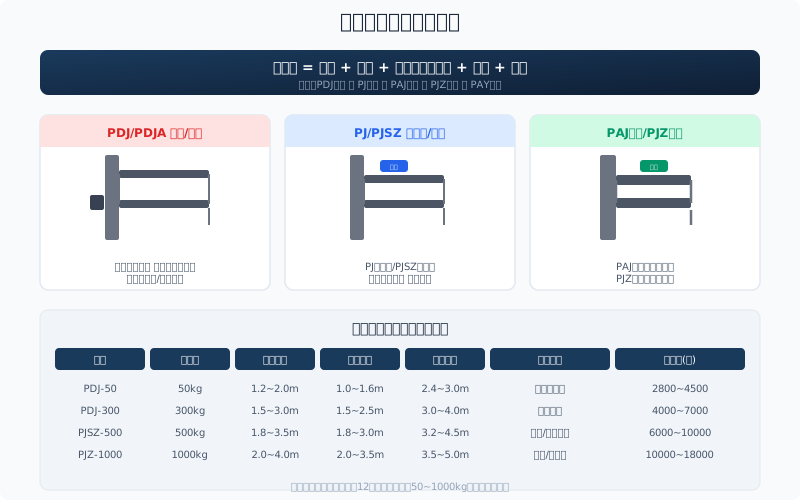
Types and Structures of Balancing Cranes
A counterbalanced hoist is a lightweight, compact lifting device that uses the principle of lever balance to allow the load to be moved easily in both vertical and horizontal directions, offering flexible operation and precise positioning. Compared to electric hoists, counterbalanced cranes are better suited for frequent, short-distance workpiece handling—operators can support the workpiece with one hand while moving the boom with the other, with the same flexibility as moving their own arm. Krud Heavy Industry’s full range of balance cranes includes five major series—PDJ, PJ, PAJ, PJZ, and PAY—and is widely used in machine tool loading and unloading, assembly line workstation lifting, and component handling applications.
| Series | Model | Lifting Capacity (kg) | Lifting Height (m) | Working Radius (m) | Pole Height (m) | Suggested Price (yuan) |
|---|---|---|---|---|---|---|
| PDJ Tall | PDJ-50–300 | 50~300 | 1.2~3.0 | 1.0~2.5 | 2.4~4.0 | 2800~7000 |
| PDJA Short Type | PDJA-50–200 | 50~200 | 0.5~1.5 | 0.8~1.5 | 1.2~1.8 | 2000~4000 |
| PJ Standard Model | PJ-100–600 | 100~600 | 1.5~3.5 | 1.3~3.0 | 3.0~4.5 | 3500~8000 |
| PJSZ Two-Speed Type | PJSZ-100–500 | 100~500 | 1.8~3.5 | 1.8~3.0 | 3.2~4.5 | 6000~10000 |
| PJZ Heavy-Duty | PJZ-600–1000 | 600~1000 | 2.0~4.0 | 2.0~3.5 | 3.5~5.0 | 10000~18000 |
| PAY Hydraulic Type | PAY-100–500 | 100~500 | 1.5~3.0 | 1.3~2.5 | 2.8~4.0 | 5000~12000 |
Note: The above are reference prices for Krude Heavy Industry’s counterbalanced cranes, which include the mast and boom assembly but exclude foundation construction and installation costs. Non-standard sizes can be customized for all series upon request.
Considerations for Selecting a Balancing Hoist
Working Principle and Core Structure of a Balancing Crane
The counterbalanced hoist uses a parallelogram linkage mechanism and a pneumatic/spring balancing system to keep the load in a state of gravitational equilibrium in the vertical plane, allowing the operator to move the load up, down, left, or right with minimal effort. The core components include: ① the balancing arm (a parallelogram linkage that ensures the load remains at a constant height as the hook moves horizontally); ② the balancing system (spring cylinder/pneumatic cylinder, which provides a balancing force equal to the load’s weight); ③ a swivel column (fixed or mobile base, with a rotation angle of 270–360°); ④ lifting attachments (hooks, clamps, electromagnetic chucks, etc.).
The fundamental difference between a counterbalance hoist and an electric hoist: An electric hoist uses an electric motor to lift cargo (momentary control), while a counterbalance hoist uses a spring- or pneumatic-powered balancing mechanism to make the cargo ”float” (weightless operation). The operating force required for a counterbalanced hoist is ≤30 N (approximately 3 kgf), which requires 80% or more less effort compared to the manual operation of an electric hoist.
Selection and Calculation of Balancing Hoists: Pneumatic vs. Spring-Balanced
Spring-balanced type:The load weight is matched by adjusting the spring preload; the design is simple and requires no air supply. The applicable load range is 0.5–100 kg, with an adjustment accuracy of ±1 kg. The spring fatigue life is ≥500,000 cycles. Krude Heavy Industry’s PDJ series spring-balanced hoists come standard with an adjustable spring seat, with an adjustment range of ±20%.
Pneumatic Balanced Type:Compressed air drives the cylinder to generate a balancing force, which is continuously adjustable via a pressure-regulating valve. Suitable for loads ranging from 10 to 500 kg (depending on cylinder diameter), with high adjustment accuracy (±0.5 kg). Requires an air supply pressure of 0.4–0.6 MPa, with an air consumption of approximately 0.1–0.5 m³/h. The PJ series pneumatic balancing hoists are equipped with a filter-regulator and an oil mist lubricator.
Selection Formula:Required balancing force F平 = m×g + FLifting Equipment(including the weight of the fixture). Spring type: F平To select a spring specification, for pneumatic models, press F平÷ Select the cylinder bore based on the air supply pressure. Use a safety factor of 1.2. Krude Heavy Industries offers a free sizing calculation service.
Installation Requirements and Safety Operating Procedures
Installation:The base of the counterbalanced crane must be secured to a concrete floor with a strength of ≥C25 (mobile models are equipped with swivel casters and braked casters); the verticality of the column must be ≤1/1000; for pneumatic models, a stable air supply pressure must be ensured, and the air inlet must be equipped with a three-piece air filter assembly (filter + pressure regulator + oil mist lubricator).
Safety Procedures:① Before operation, check that the balance is appropriate for the weight of the load; ② Overloading is strictly prohibited (overloading will disrupt the balance and cause the load to drop suddenly); ③ Ensure there are no obstacles within the operating range; ④ After use, lower the load to the ground to relieve stress on the balancing system. Krude Heavy Industry’s balancing hoists come standard with an overload protection valve (pneumatic type) and an explosion-proof spring break device (spring type), with a safety factor of ≥4.
Comparison Table of All Specifications for the Five Major Series of Balancing Cranes
| Series | Balancing Method | Load Range (kg) | Working Radius (m) | Lifting Height (m) | Air Supply Requirements | Typical Scenarios | Suggested Price (yuan) |
|---|---|---|---|---|---|---|---|
| PDJ | Spring Balance | 5~100 | 1.5~3.0 | 1.5~3.0 | Not necessary | Assembly lines, light-duty material handling | 3,000~8,000 |
| PJ | Pneumatic Balancing | 10~500 | 2.0~4.0 | 2.0~4.0 | 0.4–0.6 MPa | Loading and unloading for machining, mold changeovers | 6,000~20,000 |
| PAJ | Pneumatic + Power Assist Arm | 50~300 | 2.5~4.5 | 2.0~3.5 | 0.4–0.6 MPa | Fixture Handling, Precision Assembly | 12,000~30,000 |
| PJZ | Pneumatic + Column Rotation | 20~200 | 2.0~4.0 | 2.0~3.0 | 0.4–0.6 MPa | Multiple workstations, transport between workstations | 15,000~35,000 |
| PAY | Rigid-Arm Pneumatic Balancing | 20~300 | 2.0~4.0 | 1.5~3.0 | 0.4–0.6 MPa | High-Precision Assembly, Suspended Conveyor | 20,000~50,000 |
Safety Devices and Operating Procedures for Balancing Cranes
Safety Features:Krud Heavy Industry’s counterbalanced cranes come standard with four major safety features: ① Overload protection valve (pneumatic type)—automatically cuts off the air supply when the load exceeds the preset value of 120%, causing the load to descend slowly; ② Explosion-proof spring break device (spring-type)—If a spring breaks, a mechanical locking mechanism immediately locks the boom to prevent the load from falling; ③ Limit protection—Limit switches are installed at the upper and lower limit positions; the balancing circuit is cut off when the load exceeds these limits; ④ Emergency release valve—in the event of a power or air supply failure, manually operate the release valve to slowly lower the load. All safety devices are individually tested before shipment, and a test report is provided.
Selection Recommendations:For light-load precision assembly, choose the PDJ spring-type (no air supply required, low cost); for medium-load reciprocating handling, choose the PJ-type (pneumatic stepless adjustment, minimal operating force); for wide-range movement across workstations, choose the PJZ-type (column rotation ≥270°); For high-precision positioning, choose the PAY rigid-arm type (rigid cantilever, horizontal positioning accuracy of ±1 mm). Krude Heavy Industry offers a 7-day trial period for prototype workstations.
📌 Recommended Standards
• ASME B30.28《平衡吊装装置安全标准》
• GB/T 3811-2008 "Interpretation of Key Provisions in the Code for the Design of Cranes: Five Major Systems—Load, Structure, Mechanism, Electrical, and Safety"
Frequently Asked Questions
Q: What is the difference between a balance crane and an electric hoist?
Answer: A balance crane uses a parallelogram mechanism combined with a counterweight for balance. During operation, it can move flexibly in both the vertical and horizontal directions, allowing the operator to hold the workpiece with one hand and control the boom with the other, just as if controlling their own arm. An electric hoist provides vertical lifting and horizontal movement (requiring manual pulling or the use of a trolley), but its operational flexibility is not as good as that of a counterbalanced crane. Counterbalanced cranes are better suited for machine tool loading/unloading and assembly stations.
Q: Do counterbalance cranes need to undergo inspection?
Answer: Balancing cranes are not classified as special equipment (lifting capacity ≤ 1,000 kg) and therefore do not require a manufacturing license or periodic inspections. However, all Krude Heavy Industry products are designed and manufactured in accordance with the relevant GB/T 3811 standards and are safe and reliable.
Q: What is the purpose of a dual-speed counterbalance hoist?
Answer: The PJSZ dual-speed balancing crane can switch between high and low speed settings. High speed is used for long-distance movement (to improve efficiency), while low speed is used for precise workpiece alignment (with positioning accuracy of up to ±2 mm). It is particularly suitable for workstations that require fine adjustments, such as mold installation and precision assembly.
Q: How long is the warranty period for a counterbalanced crane?
A: Krude Heavy Industry’s counterbalanced cranes come with an 18-month warranty (effective from the date of manufacture), covering the mast, boom, counterweight, and hook. During the warranty period, repairs or replacements for non-human-caused damage are provided free of charge. These counterbalanced cranes feature a simple and durable design, with a typical service life of over 10 years.
The above is a comprehensive guide to the specifications, prices, and selection criteria for the full range of PDJ/PJ/PAJ/PJZ/PAY counterbalanced cranes. Krude Heavy Industry’s full series of counterbalanced cranes comprises 12 models, covering lifting capacities from 50 to 1,000 kg, and supports custom designs. For assistance with model selection, please contact the Krude Heavy Industry technical team.
