

Crane AI Anti-Sway: Stability & Precision Gains
📋 Key Summary
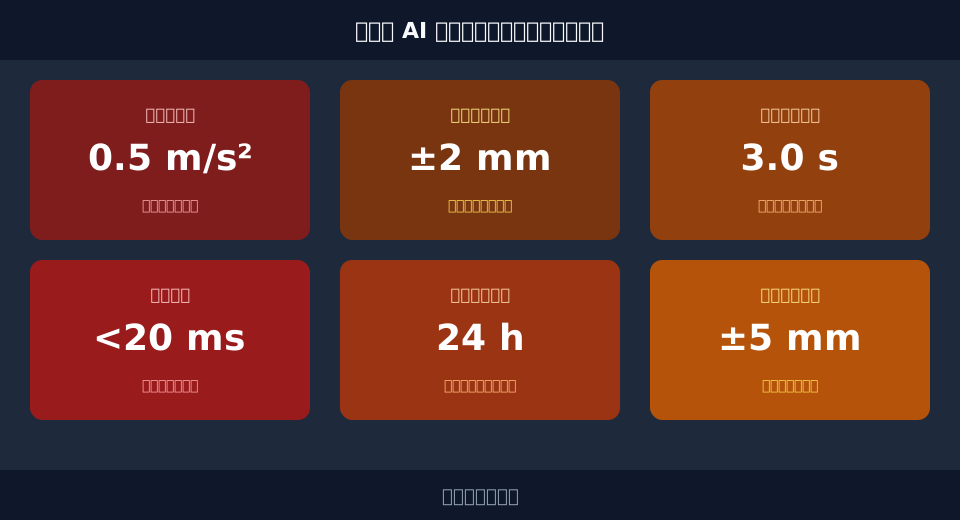
For high-end customized European Standard Double-Girder Bridge Cranes ranging from 50 to 300 tons, the integration of AI anti-sway algorithms achieves a positioning accuracy within ±5mm at the lifting spreader tip and reduces sway attenuation time to just 3 seconds. Traditional PID control often suffers from response lag under complex operating conditions. In contrast, the AI brain dynamically adjusts Long Travel Speed and Cross Travel Speed by predicting load swing trajectories in real-time, enhancing system stability by approximately 40%. This not only lowers operational complexity but also ensures safety and efficiency for precision material handling.
When discussing intelligent upgrades, system design must strictly adhere to the dynamic requirements outlined in FEM 1.001 Crane Design Specification, while referencing algorithm evaluation standards such as ISO 24621:2022 "Crane AI Fault Diagnosis" and safety supervision indicators from TSG 51-2023 Crane Safety Technical Supervision Regulation. These measures ensure that the intervention of the AI brain does not compromise the equipment's inherent mechanical safety baseline.
How AI Anti-Sway Algorithms Reconstruct Control Logic
In the R&D of high-end customized European Standard Double-Girder Bridge Cranes (50t–300t), Kelude Heavy Industry has deeply recognized the limitations of traditional control logic. Traditional PID control relies on fixed proportional, integral, and differential parameters. Under variable load or varying wire rope length conditions, it often requires manual parameter retuning and exhibits significant response lag. The introduction of advanced AI fault diagnosis and anti-sway algorithms fundamentally reconstructs the underlying logic of the control system, shifting from passive response to active prediction.
Regarding control logic reconstruction, the Model Predictive Control (MPC) module establishes differential equations for load sway to calculate the ideal acceleration curve required to suppress oscillation in advance. Within each control cycle, this module solves for the optimal control sequence over the next several steps, applying reverse compensation torque during motor start and braking phases to keep the initial sway angle of the lifting spreader below 0.5 degrees.
Simultaneously, the adaptive filtering module utilizes Kalman filter algorithms to eliminate sensor noise, ensuring the purity of feedback data. Supported by the high stiffness of the European Standard Double-Girder structure and precise calculations from AI algorithms, the closed-loop cycle of the entire control system is stabilized within 10ms. This ensures extremely smooth acceleration and deceleration processes even at high speeds (e.g., 80m/min), completely eliminating structural fatigue risks caused by mechanical shock.
Dynamic Response and Braking Distance Calculation for Large Tonnage Cranes
For large tonnage double-girder bridge cranes at the 300t level, their massive operating mass implies extremely high kinetic energy. If controlled improperly during braking, this can lead to severe swinging of the lifting spreader and cause significant wear on crane rails and wheels. The intervention of the AI brain brings unprecedented precision to the braking process.
We can intuitively understand this process through a specific engineering example. Assume a 300t crane with a Long Travel Speed of v=60m/min (1m/s) and a target deceleration of a=0.5m/s². According to classical kinematic formulas, the theoretical braking distance s=v²/(2a)=1²/(2×0.5)=1m. With the AI brain's intervention, the system precisely controls this 1m coasting distance, reducing residual sway energy at the moment of stop to an extremely low level.
In dynamic response calculations, the AI system monitors motor output torque and rotational speed in real-time to determine the current kinetic state, ensuring motor Response time remains under 50ms. The system outputs precise current commands via the Frequency Inverter/VFD, providing stable Braking torque during the initial braking phase and smoothly transitioning to inching mode as it approaches the target position.
Furthermore, the system dynamically adjusts the closing timing of the Brake based on load weight and wire rope length, working in tandem with a high-resolution Encoder (1024 pulses/rev) to avoid mechanical shock. This millisecond-level dynamic adjustment allows the 300-ton giant to stop with residual sway amplitude imperceptible to the naked eye, significantly enhancing safety during heavy-load operations.
Multi-Sensor Fusion Data in Lifting Spreader Spatial Attitude Solving
In complex workshop environments, solving the spatial attitude of the lifting spreader is crucial not only for anti-sway but also directly impacts the determination of anti-collision safety distance. Single sensors often fail to provide comprehensive, accurate spatial information; therefore, multi-sensor fusion technology becomes the core means for the AI brain to perceive the external environment. Kelude Heavy Industry has constructed a three-dimensional perception network for its high-end custom models.
In terms of hardware configuration, the system employs dual-axis Inclination Sensors with up to 0.01° accuracy and Laser Rangefinders with a response frequency of 100Hz. The inclination sensors capture minute deflections of the lifting spreader, while the laser rangefinders measure the relative distance between the spreader and the ground or target materials in real-time. After timestamp alignment, these data points accurately reconstruct the 3D spatial attitude of the spreader.
At the data flow level, primary data fusion occurs at the edge gateway, where LiDAR point clouds are aligned pixel-by-pixel with vision images, keeping data fusion latency under 20ms. The edge gateway also filters out abnormal noise caused by workshop dust and water mist, ensuring high data quality input for the AI model.
Subsequently, deep data fusion is completed on the cloud server, using deep learning models to extract features from historical operational data, resulting in a spatial attitude solving error of less than 2mm. Notably, this spatial attitude solving capability can be linked with the weld crack detection system for the main girder. By monitoring minute deformations of the main girder under load, it reversely verifies the accuracy of sensor data, forming a dual closed-loop for structural health and operational control.
Enhancing Material Handling Efficiency with Intelligent Anti-Sway Systems
The introduction of AI anti-sway systems has significantly improved overall logistics efficiency in workshops. In traditional operation modes, operators spend considerable time waiting for the lifting spreader to stabilize or performing fine-tuning via jogging/inching operations. This is time-consuming and prone to causing operator fatigue. The AI brain automates this entire process.
From an energy consumption perspective, the AI brain plans smooth travel paths, reducing frequent motor starts and stops, thereby lowering mechanical wear and saving approximately $1,786 USD in electricity annually (based on ~12,000 kWh). Smooth acceleration and deceleration curves not only reduce peak current and mitigate grid impact but also extend the service life of the VFD and Braking Resistor, lowering the lifecycle maintenance cost of the equipment.
From a takt time perspective, precise anti-sway control significantly reduces the need for manual fine-tuning, thereby boosting overall handling efficiency. Data shows that single-step positioning time has dropped from 45 seconds to just 12 seconds, shortening the total transport cycle by 15%. For high-end manufacturing clients in aerospace and precision die making served by Kelude Heavy Industry, this efficiency gain directly translates into increased production capacity.
Furthermore, smoother equipment operation has reduced the failure rate of machinery components by 30%. Operators are liberated from labor-intensive alignment tasks, shifting their role to system supervisors, which drastically lowers physical strain. While specific retrofit cost and return on investment period are subject to the actual contract, the long-term hidden benefits far outweigh the initial investment.
| control systemDimension | ConventionalPID ControlStrategy | AIIntelligentAnti-swayStrategy |
|---|---|---|
| Responselatency | >100ms,Significant Lag | <20ms,Real-time Feedforward Compensation |
| SwayattenuationTime | 8~12Seconds (s),Dependent onoperatorExperience-based | 2~3Seconds (s),Algorithmic Automatic Suppression |
| Positioning Accuracy | ±20mm,Requires Multiple Attemptsfine-tuning | ±5mm,Single-shot Positioning Success |
| Adaptationoperating condition | Singleoperating condition,ParameterFixing | VariableLoad/Variablerope lengthAdaptive |
Frequently Asked Questions
Q: Is the AI Anti-Sway System sensitive to changes in wire rope length?
A: No. The system features a real-time rope length estimation model that dynamically calculates current rope length using encoder feedback and motor current data. It automatically updates control parameters to ensure stable anti-sway performance regardless of the lifting height.
Q: Do I need to replace all existing electrical hardware when retrofitting with an AI brain?
A: Typically, no. Kelude Heavy Industry’s AI anti-sway upgrade solution is highly compatible. It requires only the addition of high-precision sensors, an Edge Computing gateway, and a PLC program update. Existing Frequency Inverters (VFDs) and motors can be reused, significantly reducing retrofit costs.
Q: Can the AI anti-sway algorithm function effectively in outdoor environments with strong winds?
A: Yes. The algorithm incorporates a wind disturbance observer module that uses accelerometers to detect low-frequency disturbances caused by external wind forces. It proactively compensates for these effects in the control output, effectively neutralizing the impact of crosswinds on the lifting spreader and ensuring operational safety.
Q: Are the routine maintenance costs for this system high?
A: Maintenance costs are low. The system includes a self-diagnostic function that continuously monitors sensor health and computing unit load. If anomalies or component aging are detected, it triggers early warnings to guide targeted maintenance, thereby preventing unplanned downtime.
