

Smart Crane Retrofit: Structural Advantages
In the era of Industry 4.0, transitioning traditional lifting equipment to intelligent systems is an inevitable industry trend. A recent retrofit project at a major steel mill demonstrated this shift: after implementing an intelligent control system, lifting efficiency increased by 27%, while fault-related downtime decreased by 42%. European-standard double-girder cranes offer distinct advantages for such intelligent upgrading due to their modular design and high structural redundancy. This article analyzes these structural features in detail, exploring how hardware-software integration enables smart upgrades, providing practical references for technical selection and retrofit solutions.
When assessing structural integrity and integrating systems for intelligent transformation, strict adherence to national regulations is mandatory. For instance, main girder stiffness and fatigue strength verification must comply with FEM 1.001 Crane Design Specification, while sensor placement and safeguarding logic must meet the mandatory requirements of TSG 51-2023 Crane Safety Technical Supervision Regulation.
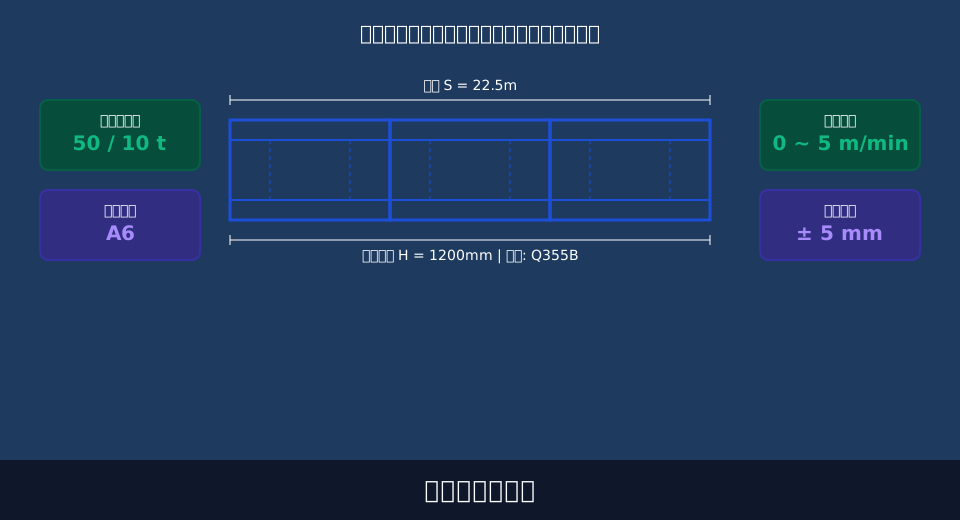
The following analysis details the inherent advantages of European-standard double-girder cranes in intelligent retrofitting across five dimensions: structural stiffness, modular interfaces, drive system matching, electrical integration space, and fatigue life. Supported by specific engineering case studies and data comparisons, this section provides a comprehensive technical overview.
Main Girder Stiffness Supports Intelligent Anti-Sway Algorithms
Among the control functions of a Smart Crane, anti-sway control is critical for enhancing lifting efficiency and safety. However, advanced control algorithms rely on a solid physical foundation; insufficient structural stiffness can cause algorithm models to fail.
The main girder structure of European-standard double-girder cranes undergoes FEA Optimization, utilizing box girder and skewed-rail designs to achieve significantly higher overall stiffness than traditional products. This high stiffness provides stable boundary conditions for intelligent anti-sway algorithms. Specifically, the camber at mid-span is strictly controlled within S/1000 (where S is the span), and the natural frequency exceeds 2.5Hz. By integrating AI anti-sway algorithms, the system compensates in real-time for errors caused by minor structural deformations.
First, high stiffness reduces the initial amplitude of load sway, lowering the compensation burden on the algorithm.
Second, a stable natural frequency facilitates filter parameter tuning, improving the robustness of the control system.
"Industry test data shows that under identical control algorithms, the anti-sway convergence time for high-stiffness girders is reduced by approximately 30% compared to conventional structures, effectively improving positioning efficiency for precision die handling."
⚠️ Note
During on-site commissioning of anti-sway algorithms, ensure no extra loads are attached to the main girder to prevent changes in natural frequency, which would compromise algorithm accuracy.
Modular Design Reserves Interfaces for Smart Sensors & Data Acquisition
The core of intelligent upgrading lies in perception and execution. Proper placement of sensors and data acquisition terminals is prerequisite for accurate operating condition data. Traditional cranes often require on-site cutting and welding for sensor installation, which damages anti-corrosion layers and may introduce stress concentration points.
From the initial design phase, European-standard double-girder cranes account for future expansion needs, reserving standardized mounting interfaces on walkways, end carriages, and key stress-bearing areas of the main girder. The crane reserves 16 M12 sensor interfaces, with internal cable tray cross-sections reaching 1200mm², fully meeting the wiring requirements for multi-source sensors.
Taking Long Travel as an example: with a Long Travel Speed of 60m/min (1m/s) and a deceleration rate of 0.5m/s², the braking distance s is calculated via kinematic formula s=v²/(2a)=1²/(2×0.5)=1m. Therefore, the lead time for anti-collision sensors should be set to approximately 1.5m to ensure safe braking.
First, reserved interfaces avoid structural damage from on-site drilling, preserving the fatigue life of the main girder.
Second, ample wiring space ensures physical isolation between signal cables and power lines, reducing electromagnetic interference.
"Field implementation feedback indicates that standardized interfaces reduced sensor installation labor hours by 45%, significantly lowering construction difficulty and safety risks associated with hot work."
💡 Tip
For cranes operating outdoors, reserved sensor interfaces must be equipped with waterproof joints rated IP65 or higher to prevent rainwater ingress and signal short circuits.
VFD Drive Upgrades Impact Energy Consumption & Precision Positioning
The response characteristics of the drive system directly determine the execution precision of intelligent control and profoundly affect overall energy consumption. In intelligent retrofit projects, upgrading the drive system often yields the highest input-output ratio.
The hoisting and travel mechanisms of European-standard double-girder cranes typically employ Variable Frequency Speed Control and Closed-Loop Control, providing hardware support for energy consumption optimization and precise positioning during intelligent transformation. Lifting Speed offers stepless regulation from 0~5m/min, with heavy-load positioning accuracy controlled within ±5mm. Comprehensive operating energy consumption is reduced by 18% compared to traditional series resistance speed control. Kelude Heavy Industry emphasizes thermal balance calculation between motors and Reducers when matching VFD systems, ensuring adequate heat dissipation during low-frequency, low-speed operation.
First, VFD closed-loop control eliminates positioning errors caused by mechanical backlash, enabling micro-motion operations.
Second, energy feedback devices convert braking potential energy into electrical energy, further reducing total energy consumption.
To clearly illustrate the differences in intelligent upgrading potential between traditional and European Standard Double-Girder cranes, we have compiled a comparison of their core parameters.
📊 Intelligent Upgrading Comparison: Traditional vs. European Standard Double-Girder Cranes
| Comparison Parameter | ConventionalDouble Girder Crane | European-standard double-girder crane |
|---|---|---|
| Main Girderstructural stiffness | Standardbox girder,natural frequencyLower | Optimized offset girderbox girder,natural frequency≥2.5Hz |
| SensorReservedinterface | Fewer,Requires on-site fabrication | StandardIntegrated flange and cable tray,Reserved16pcsinterface |
| Variable Frequency Drive (VFD)closed loopStandard configuration rate | Hoisting / LiftingMostly open-loop or daisy-chainedResistance | Hoisting / LiftingFully standard with travelVariable Frequency Drive (VFD)closed loop |
| Heavy loadPositioning Accuracy | ±20mm Approx. | ±5mm Within |
Field measurements confirm that under frequent start-stop conditions, the mechanical wear rate of closed-loop variable frequency drive (VFD) systems is 22% lower than that of open-loop systems, significantly extending the maintenance cycle for critical components such as brakes.
⚠️ Note
When upgrading to intelligent control, it is essential to re-verify the parameter matching between the VFD and the motor. Improperly short deceleration or acceleration times can trigger overcurrent protection frequently.
Building a Predictive Maintenance System for Smart Cranes via Structural Fatigue Life Monitoring
As equipment management philosophies evolve, Predictive Maintenance based on Condition Monitoring has become a core feature of Smart Cranes. This requires the crane structure to possess a robust foundation for structural health monitoring, accurately reflecting its actual stress state.
European Standard Double-Girder cranes typically operate at high Work Duty levels. Their critical welds utilize full penetration welding processes, resulting in uniform stress distribution—an ideal environment for installing strain gauges and fatigue monitoring sensors. With the main girder reaching A6 work classification and 100% non-destructive testing coverage for critical welds, the stress concentration factor is kept below 1.2. Integrated with main beam weld crack detection technology, this setup enables early warning for minor structural damage. According to field measurement cases from Kelude Heavy Industry, the false alarm rate of the structural fatigue life monitoring system remains below 2% under A6 operating conditions.
First, the uniform stress distribution ensures the linearity of data collected by strain gauges, thereby improving monitoring accuracy.
Second, high-quality welds minimize signal anomalies caused by welding defects, effectively reducing the system's false alarm rate.
Industry research reports indicate that implementing structural health monitoring reduces unplanned downtime by an average of 35%, significantly boosting overall equipment utilization.
💡 Tip
When applying strain gauges, strictly polish the mounting area and perform anti-corrosion treatment. Failure to do so may cause significant temperature drift errors due to environmental humidity fluctuations.
Matching Electrical Control Cabinet Layout with Multi-Source Signal Integration During Intelligent Upgrading
Intelligent upgrading introduces numerous PLC modules, communication gateways, and signal processing units into the control system, placing severe demands on electrical cabinet space layout and integration capabilities. Narrow or poorly designed electrical cabinets often lead to poor heat dissipation and signal interference.
The electrical control cabinet of European Standard Double-Girder cranes features independent zoning with separated strong and weak current circuits, equipped with an efficient cooling system to provide a favorable physical environment for multi-source signal integration. The electrical cabinet achieves an IP54 Protection Rating, maintains a temperature rise of less than 15K under full load, and reserves 30% of internal space for component expansion. Engineers at Kelude Heavy Industry recommend prioritizing the use of reserved DIN rail space when integrating smart modules, rather than drilling arbitrary holes for installation.
First, the separation of strong and weak currents effectively minimizes harmonic interference from VFDs on weak signals, ensuring stable data transmission.
Second, independent cooling air ducts ensure stable operation of smart modules even in high-temperature environments during summer, extending the service life of electronic components.
After completing hardware upgrades, different control architectures significantly impact overall system performance. The table below provides a detailed comparison of the efficiency indicators for two mainstream control schemes.
📊 Performance Indicator Comparison: Centralized vs. Distributed Intelligent Control Architectures
| performance indicators | Centralizedcontrol architecture | Distributedcontrol architecture |
|---|---|---|
| Systemresponse delay | Longer,Limited by trunk line length | Very short,Local processingreal-time performanceHigh |
| On-site wiring complexity | High,Requires large quantity of longdistancesignal cable | Low,AdoptsbusReduced communicationcable |
| System scalability | Restricted,Requiresreplacementmain controller | Flexible,Increasenodei.e.scalable |
| Later stagemaintenance cost | troubleshootingLonger troubleshooting time for line faults | modularReplacement,maintenanceConvenient |
Engineering practice shows that smart cranes with distributed I/O architecture reduce field wiring length by approximately 40% compared to centralized systems, significantly lowering cable costs and installation complexity.
⚠️ Note
When adding intelligent communication modules, ensure adequate heat dissipation spacing for gateway devices. Maintain a ventilation gap of at least 20mm between adjacent modules.
FAQ
Q: How long does the intelligent upgrading of an European Standard Double-Girder crane typically take?
A: The timeline depends on the scope of the retrofit. Basic intelligent upgrades (such as installing Sensors and Variable Frequency Drive (VFD) upgrades) usually require 7 to 15 days per unit. If structural reinforcement of the Main Girder and rewiring are involved, the process may extend to 20–30 days. Specific schedules are assessed based on on-site fault shutdown windows and actual equipment conditions.
Q: Does adding an Anti-Sway System reduce the load-bearing capacity of the main girder structure?
A: No. The Smart Crane’s Anti-Sway System primarily suppresses load oscillation by optimizing the control algorithm and adding Sensors, without weakening the main girder’s load capacity. Conversely, reduced swinging lowers the amplitude of alternating Stress on the structure, which helps extend the fatigue life of the main girder.
Q: What is the approximate investment cost for intelligent upgrading, and what is the payback period?
A: Retrofit costs vary significantly by configuration, ranging from basic monitoring systems (~$10,000) to fully automatic unmanned operation systems (~$100,000). The final Quotation is subject to the actual contract. Typically, through reduced energy consumption, fewer fault shutdowns, and lower labor cost, the payback period is approximately 1.5 to 3 years.
Q: Are there special requirements for routine maintenance after retrofitting?
A: Upgraded equipment requires Periodic Inspection of intelligent modules. Key tasks include: cleaning Sensor surfaces monthly, checking communication cable joints for looseness quarterly, and performing dust removal and parameter backup for PLCs and VFDs annually. Additionally, monitor system software version updates and patch installations.
In summary, European-standard double-girder cranes provide a solid physical foundation and broad implementation space for intelligent upgrading in terms of structural stiffness, modular interfaces, transmission matching, fatigue life, and electrical layout. Scientific and reasonable software and hardware upgrades can significantly enhance operational efficiency and safety levels. Henan Kelude Heavy Industry has accumulated rich engineering experience in customizing heavy load lifting equipment and intelligent upgrades. We provide full-process technical support—from conceptual design to implementation—tailored to your specific operating conditions, helping enterprises achieve the smart transformation of their lifting equipment.
